

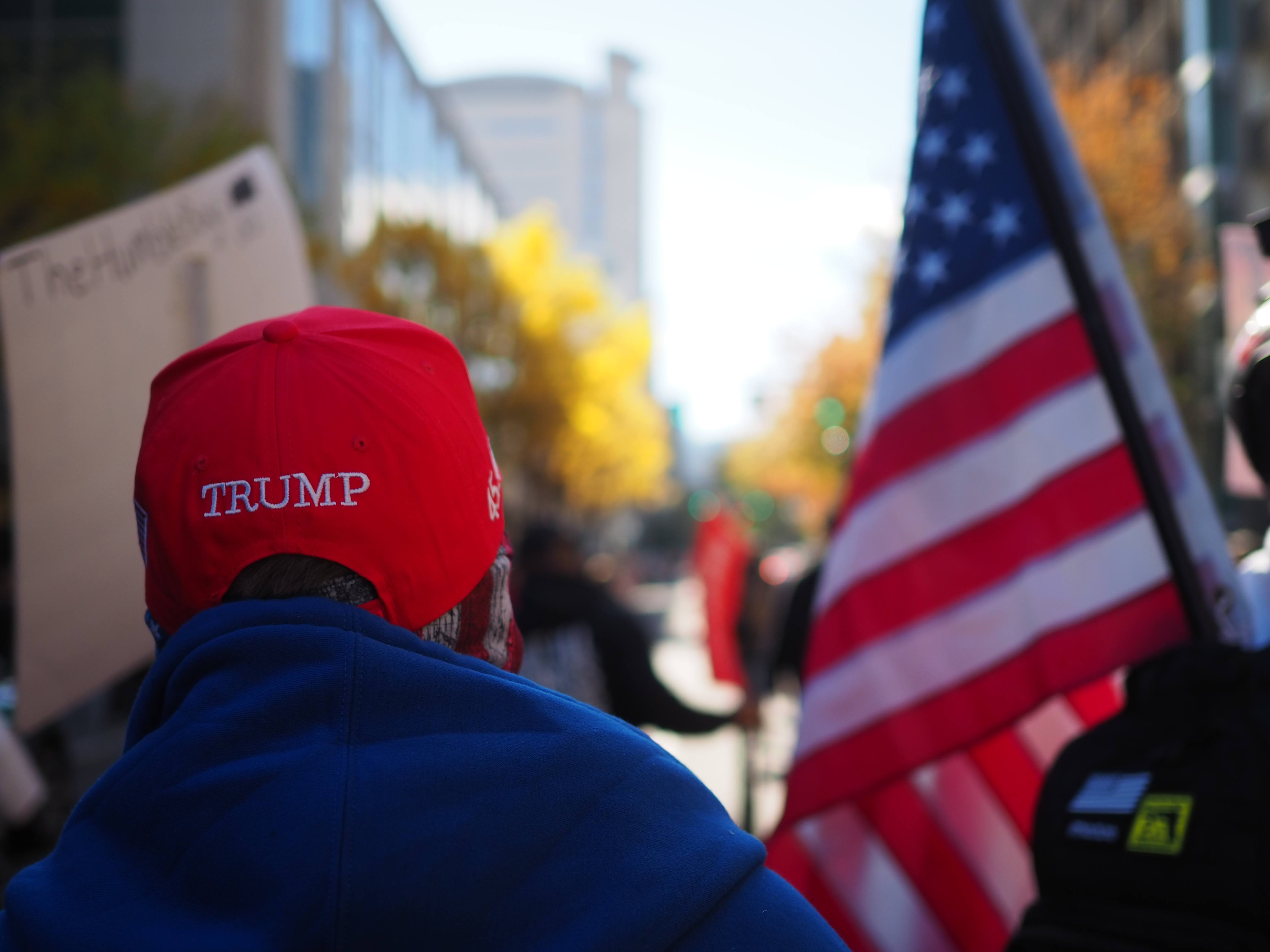
Photograph by Nathaniel St. Clair
What should be done about Donald Trump and the U.S. strikes on boats in the Caribbean and Pacific Oceans? Should we really be quibbling about who ordered the second strike on the survivors of the boat off the coast of Venezuela? By quibbling, “there’s a risk … of losing sight of the forest for the tree, because the broader campaign is really problematic,” an International Crisis Group expert told Robert Tait in The Guardian. Beyond the questions of who ordered the second strike or whether the drone strikes violated guidelines in U.S. military manuals, the larger issue is whether international law was violated.
How is “the broader campaign…problematic”? November 25, 2025, marked the 80th anniversary of the start of the 1945-46 Nuremberg trials against major Nazi leaders. The trials marked a turning point in trying individual heads of states and was a seminal moment for human rights and international criminal law. Today, by contrast, President Trump has welcomed International Criminal Court (ICC) indicted leaders Vladimir Putin in Alaska and Benjamin Netanyahu to the White House in Washington.
Where is international law today?
Arguments about whether the bombings of the boats – including strikes on survivors – violate U.S. military law miss the larger issue of violating international law. As Professor Gabor Rona correctly pointed out in a letter to the New York Times: “No responsible expert in international law could conclude that these attacks are part of a war, despite the Trump administration’s claims to the contrary. The use of epithets like terrorist and narcoterrorist to describe alleged drug traffickers changes nothing. These killings are simply murder — extrajudicial killings in violation of United States and international human rights law because the boats’ occupants are not attacking the United States, nor do they pose an imminent threat of attack…While it is true that killing an incapacitated person is an especially heinous human rights violation, the initial use of lethal force against these boats is just as unlawful.”
Looking beyond the illegality of the boat bombings to events in Ukraine, Israel/Palestine, Sudan, and elsewhere, it is worth asking the broader question about the role of international law today. An eminent legal expert tried to be positive: “[W]hile some rules are undoubtedly being flouted, and gravely so, the vast majority of the rules of international law continue to be respected and to operate and apply in a manner that is fully effective,” Professor Philippe Sands of University College, London, is quoted in The Guardian. As evidence, Sands points to a “host of international treaties” that made his recent train journey from London to Paris possible. He also notes that international courts and tribunals are busier than ever.
Is the glass half full or half empty? Is international law relevant in getting trains from London to Paris but ineffective in stopping Russian aggression in Ukraine, Israeli genocide in Palestine, famine in Sudan, Putin and Netanyahu visiting the U.S., and American extrajudicial bombings of small boats?
International law is a misleading title. International is simple; it means between countries. Law suggests obligations states and individuals must follow. International law has its own courts and tribunals, but they cannot enforce their rulings like domestic courts. The United Nations has no regular police force or army. After issuing indictments, the ICC has been unable to bring Putin and Netanyahu to trial, and probably never will.
Trump 2.0 and international law
The problem with all Trump’s actions, like the boat bombings, is one of threshold. Everything with Trump is XXL – extra-large. “To every terrorist thug smuggling poisonous drugs into the United States of America, please be warned that we will blow you out of existence,” he declared, undiplomatically, at the United Nations General Assembly. Like the size of Trump’s East Wing ballroom, the size of his ego is ever-expanding.
There are several reasons why Trump is against multilateralism and the United Nations. According to the latest National Security Strategy (NSS 2025), the U.S. [Trump] “will chart our own course in the world and determine our own destiny, free of outside interference.” Rather than worrying about Trump’s physical age and his naps during Cabinet meetings, people should be concerned about his outsized ego.
The new U.S. National Security Strategy reflects egocentrism and the Administration’s disdain for international law and institutions. It answers the question “What do we want?” with: “First and foremost, we want the continued survival and safety of the United States as an independent, sovereign republic whose government secures the God-given natural rights of its citizens and prioritizes their well-being and interests.” In the section on “Sovereignty and Respect,” 2025 NSS says, “the U.S. will unapologetically protect our own sovereignty” as part of a national effort that “includes preventing its erosion by transnational and international organizations.” In very clear terms, the strategy declares; the U.S. will stand “against the sovereignty-sapping incursions of the most intrusive transnational organizations, and for reforming those institutions so that they assist rather than hinder individual sovereignty and further American interests.”
Compare 2025 NSS U.S. national power, sovereignty-centric, transactional vision – “The days of the United States propping up the entire world order…are over” – with the 2022 NSS referring to a “free and rules-based international order.” That NSS presented international law, and multilateral institutions as central to U.S. foreign policy. At the time, the U.S. was committed to working with “any country, including competitors,” as long as that country “is willing to constructively address shared challenges within the rules-based international order.” NSS 2022 took other countries’ interests into account.
Secretary of Defense Pete Hegseth confirmed Trump’s/U.S. egocentrism last week in California when he said; “President Trump can and will take decisive military action as he sees fit to defend our nation’s interests. Let no country on earth doubt that for a moment.” (italics added) As “he sees fit,” excludes any consideration of others, and certainly of international law.
When I received my first evaluation in elementary school, my mother pointed to the two sides of the report card. The first side had “academic” notations – reading, writing etc. The second side included grades and comments on behavior. My mother said;” The first side will be easy for you. The second side – which includes ‘works and plays well with others’ – is the difficult one.”
What about the United States, Trump and international law? Respecting international law and multilateral institutions requires countries working and playing well with other countries; it is the second side of the global report card. Two years into Trump 2.0, he and his administration have failed miserably.
The post International Law and U.S./Trump Egocentrism appeared first on CounterPunch.org.
From CounterPunch.org via this RSS feed
You must log in or # to comment.