

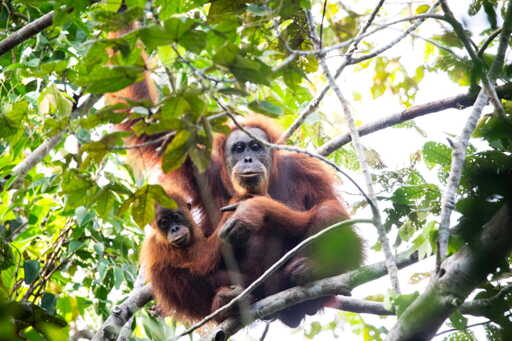
JAKARTA — A Tapanuli orangutan, the world’s rarest great ape, has been discovered dead in mud and log debris in a village in northern Sumatra — a grim sign of how severely recent floods and landslides may have devastated the species’ fragile habitat. A group of scientists has described the catastrophe as an “extinction-level disturbance” for the apes. Humanitarian workers found the body on Dec. 3, a week after cyclone-driven storms triggered destructive floods and landslides across Sumatra, according to Panut Hadisiswoyo, founder of the Orangutan Information Centre (OIC). The carcass reportedly had the flesh torn from its face and that its condition was consistent with having been swept away by the cascading debris. “It shows that the habitat has been impacted, and likely some individuals were swept away by landslides or floods. That is entirely possible,” Panut told Mongabay. He said the landslide struck the western side of the Batang Toru ecosystem, a biodiversity stronghold that hosts one of three known Tapanuli orangutan (Pongo tapanuliensis) populations, as well as other vanishingly rare species such as the Sumatran tiger (Panthera tigris sumatrae) and Malayan tapir (Tapirus indicus). “With the size of the western block being around 50,000-60,000 hectares [about 124,000-148,000 acres], it is very plausible that parts of the habitat collapsed, dragging orangutans along with it,” Panut said. Flood survivors use logs to cross a river in Batang Toru, North Sumatra, Indonesia, on Dec. 2, 2025. Image by AP Photo/Binsar Bakkara. A spatial analysis by Erik Meijaard, managing director of…This article was originally published on Mongabay
From Conservation news via this RSS feed