

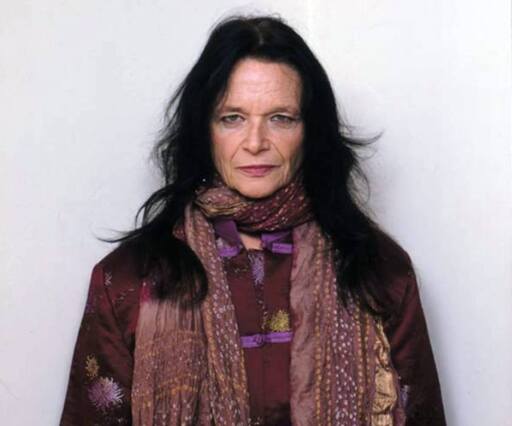
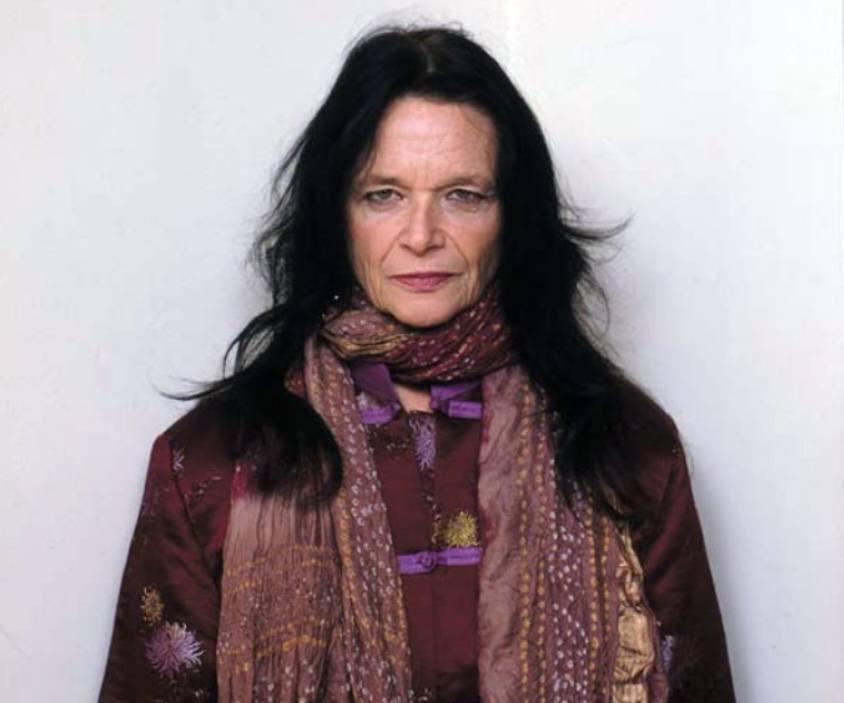
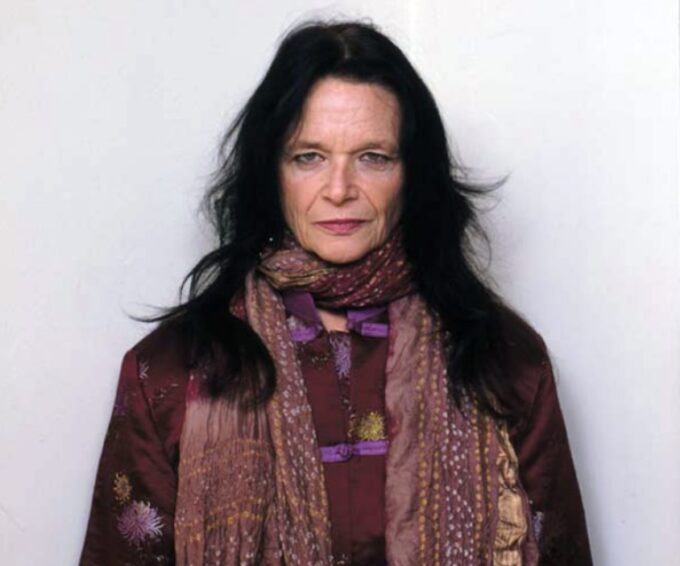
Anne Waldman. Photo: Greg Fuchs, for Coffee House Press, 2011. CC BY 4.0
It was the first Saturday night in December and it was bitter cold by San Francisco standards. The credits rolled on the big screen at the hip Roxie Theater on 16th Street in the Mission District. The house lights came on and Anne Waldman, wearing one of her signature scarfs, sauntered to the front of the auditorium where she greeted her fans and autographed copies of her new book, Mesopotopia, a kind of mosaic that defies logic except the logic of the imagination. The word “Mesopotopia,” which sounds like it describes a messed-up utopia or dystopia, is a word that Waldman has invented to capture the complex contemporary world she struggles to comprehend in verse.
At the edge of the stage, I told Waldman that I liked Outrider, a movie which is about her and her poetry. It comes with the subtitle “Take the whole ride.” There has never been anything half-way or middle-of-the road about Waldman, whom Percy Bysshe Shelley might have had in mind when he said that “Poets are the unacknowledged legislators of the world.”
To the “outrider” herself, I added, “Now, in addition to everything else, you’re a movie star.” Waldman smiled. She is definitely the star of Outrider, a new documentary written and directed by Alystyre Julian that runs about 90 minutes and that takes viewers through the life and times of a poet who often felt, as she says on screen, “like the only woman in the room.”
If Waldman felt that way, and no doubt she did, it was probably because she was at times the only woman in the room, whether it was at St. Mark’s Episcopal Church— a gathering place for poets on East 10th Street in New York— or at Naropa University in Boulder, Colorado, home of the Jack Kerouac School of Disembodied Poetry, which she co-founded.
The men in the rooms have included Allen Ginsberg, William Burroughs, Bob Holman, the founder of the Bowery Poetry Club, and her own son Ambrose Bye, who appears in the movie and who she calls “my anchor.” Of all the Beat men, she’s probably closest to Burroughs.
Of course, there were other women in the room, such as Diane di Prima, Joanne Kyger and others who appear in Women of the Beat Generation, edited by Brenda Knight. A team player, Waldman has never been alone.
Now 80 years old, she has mostly been read and appreciated by other poets and avant-garde writers, not by a mass audience. She is best known for her 1974 book, Fast Speaking Woman. She still speaks fast and she is definitely a woman for the ages. Outrider might introduce her to a wider readership than she has so far enjoyed. Her new book, Mesopotopia, might also help her transcend the label “cult writer.”
Put into print by Penguin, Mesopotopia is Waldman’s first book that has not been issued by a small publishing company. Coffee House Press, a nonprofit independent press in Minneapolis, is perhaps the most notable company to put Waldman’s work (her memoir, Bard, Kinetic) in print. Waldman has been as independent and as nonprofit as Coffee House.
My dictionary defines an “outrider” as “a person in a motor vehicle or on horseback who goes in front of or beside a vehicle as an escort or guard.” One had best not take the title of the movie literally. Perhaps Julian, the writer and director, meant to say that Waldman has been ahead of the pack of contemporary poets, though her film shows her following rather than leading or influencing.
Still, she has carved out a unique space for herself as a matriarch, a gnostic, an oracle, a Buddhist, a magician, a mystic and a humanist. She is also, as Publishers Weekly called her, “a countercultural giant.”
On the website for the movie, Julian describes it as “a cinekinetic portal.” She also describes it as a “love letter.” She writes that Waldman “has been guided by ancestors of the Beat Generation and poetic kinships with radical female musicians.” Waldman definitely belongs in the Beat orbit.
One of the great values of Julian’s documentary is that it shows Waldman in action, performing her own work with passion and intensity. At City Lights Bookstore two days before the screening of Julian’s movie, she read for an hour without stopping. One might describe Waldman as a “force of nature,” but that’s a cliché and there’s little if anything that is clichéd about Waldman. Indeed, she’s an American original.
The other great value of Julian’s doc is that it depicts the communities that have gathered around Waldman, and that she has also gathered intentionally for support and for mutual creativity. Those communities, she says, are organic entities to which she feels a sense of moral and ethical responsibility. Some of Waldman’s affinity groups are composed of poets, others are composed of musicians like Patti Smith, and still others are made up of anti-war protesters and activists who take on the patriarchy and much more.
Waldman is an unusual figure at demonstrations in that she rejects ideology. She’s not motivated by Marx or Mao, Camus or de Beauvoir. Over the past 50 years she has not needed or wanted an ideology to fuel her protests against the manufacture of nuclear warheads, the murder of George Floyd, anti-semitism and “the slaughter in Palestine” as she calls it.
If ideology doesn’t drive her, what does? The exploration of darkness for one thing and all of human experience for another. An alchemist as well as an artist, her primary loyalty is to poetry. Julian’s film, like Waldman herself, wanders across the twin boundaries of time and space and becomes a kind of mosaic.
Near the end of the film, the star of the show herself says, “I feel very exposed.” Outrider shows her on stage, behind the stage, and in the wings of the stage, but it does not reveal any secrets or uncover hidden facts about Waldman life, though there is some information about the poet’s bohemian mother. One wonders if Waldman rebelled against her or followed in her mother’s trajectory. Perhaps a bit of both.
A rebel and a traditionalist who was raised in Greenwich Village listening to Lead Belly, Odetta and Nina Simone, Waldman is not all one thing or all another. She’s a living, breathing mosaic. Julian’s film shows as many different sides of her as can be shown. If Waldman has a private life it’s not revealed. Another writer/ director might make another film about Waldman. But for now Outrider is the best account of the life and time of the quintessential fast-speaking woman as there is. If it comes to a theater near you, see it. Readers of Counterpunch may find Waldan obscure and difficult, but they will probably find the effort to comprehend her work rewarding.
The post Poet Anne Waldman’s Star Turn appeared first on CounterPunch.org.
From CounterPunch.org via this RSS feed