

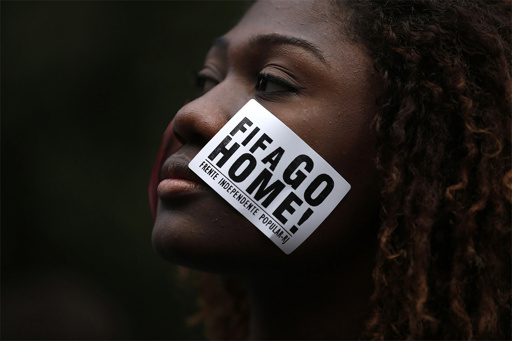
This editorial by La Jornada’s editorial board originally appeared in the December 12, 2025 edition of La Jornada. The views expressed in this article are the authors’ and do not necessarily reflect those of Mexico Solidarity Media*, or the* Mexico Solidarity Project*.*
Tickets to any of the 104 matches of the 2026 World Cup have reached astronomical prices even though there are still six months to go before the start of the tournament hosted by Mexico, the United States, and Canada. Initially, the tickets offered by FIFA last September (when the names of many participating teams and all the matchups were still unknown) ranged from 1,092 to 122,000 pesos, but they sold out immediately through official channels. On the resale market, prices have already reached a minimum of 64,900 pesos1 [$3,603USD], with a maximum of almost 23 million pesos [$1,276,810USD] for the final, which will be played in New York-New Jersey on July 19.
Only two types of people can afford to spend 23 million pesos to see a soccer match: organized crime bosses and the beneficiaries of labor exploitation, tax evasion, financial deregulation, and the harmful concentration of wealth.
It should be noted that even the legally issued prices have tripled what the organizers offered in their bid document published in 2018: at that time, they promised the cheapest ticket would cost $21 (it actually cost $60) and that the complete package to follow a team from its first match to the final would cost around $2,242 in the cheapest category, but it’s now clear that it won’t be possible for less than $6,900. For this reason, the Football Supporters Europe (FSE) group yesterday asked FIFA to “stop selling World Cup tickets, hold consultations with all affected parties, and review the prices” until they find “a solution that respects the tradition, universality, and cultural importance” of this event, which for decades has been the most watched by television viewers and fans worldwide. In particular, the FSE points out that tickets for the competition in North America are five times more expensive than those for the 2022 edition in Qatar, a completely disproportionate increase from any perspective.
The exorbitant prices imposed for the World Cup are part of a phenomenon known as funflation; that is, inflation in entertainment costs far exceeding the general inflation rate. This affects the most popular live shows, as well as other forms of entertainment such as movies, bars, and trendy restaurants. The figures are very telling, both globally and in the case of Mexico: in 1985, an American student with a summer job (earning minimum wage) could afford a ticket to see the most famous singers of the moment with three or four hours of work, while today, access to a similar artist would require 60 hours of work. Returning to soccer, what was once the quintessential popular spectacle now demands enormous sacrifices from the working class, or is simply out of their reach. The most expensive ticket for the Mexican soccer league final cost 150 pesos in 2002, while in 2024 it rose to 4,000 pesos, not counting resale: from four to 16 days of minimum wage, even though in the last seven years the base salary went from 88 to 315 pesos.

FIFA’s bloody footprints stain the globe.
Funflation is explained, to some extent, by the rise of the “experience economy,” in which consumers value events more than the acquisition of goods and are therefore willing to pay much more than before to attend an event they can showcase on their social media. The consolidation of monopolies like Ticketmaster, Live Nation, and Ocesa also plays an undeniable role, as they eliminate competition by controlling both venues and ticket sales. Of course, FIFA itself is a global monopoly in the realm of professional football. The advent of the digital age has given monopolistic companies new tools to fleece their customers; for example, through “dynamic pricing”: instead of setting a price and allowing the most devoted fans to camp out to secure a ticket, companies raise the price based on demand, turning sales into frenzied auctions.
A superficial glance might suggest there’s nothing inherently wrong with the scenario described, as it’s simply the law of supply and demand in action. But the fact is that artificially inflating the price of mass entertainment violates the human right to culture and leisure. Furthermore, it’s inextricably linked to the parallel rise in inequality and the criminal economy, since it’s clear that only two types of people can afford to spend 23 million pesos to see a soccer match: organized crime bosses and the beneficiaries of labor exploitation, tax evasion, financial deregulation, and the harmful concentration of wealth.
Mexico’s monthly minimum wage is 8,475 pesos [$470USD]  ︎
︎

An Exclusionary & Elitist World Cup
December 12, 2025December 12, 2025
The World Cup is a business and does not benefit the working class in any way. On the contrary, resources are lost to football stadiums that should be used for education and health.

Mexican Farmers Protest Again Next Week
December 12, 2025
Campesino organizations are proposing the government creating a Strategic Food Reserve to stabilize prices, strengthen food sovereignty & help thousands of farmers facing ruin from the agricultural crisis.

Ejido Members “completely shut down” Canadian Mine in Guerrero
December 12, 2025December 12, 2025
Carrizalillo community members don’t understand why the Mexican government allows the Canadian corporation to continue committing environmental offenses for which Los Filos mine was previously shut down.
The post An Exclusionary & Elitist World Cup appeared first on Mexico Solidarity Media.
From Mexico Solidarity Media via this RSS feed
The World Cup is a business and does not benefit the working class in any way.
panem et circenses
The left would have better results if they accepted that their voters also have emotions.