

La Palestinización del Mundo: Día de Muertos con la Asamblea Oaxaqueña por Palestina
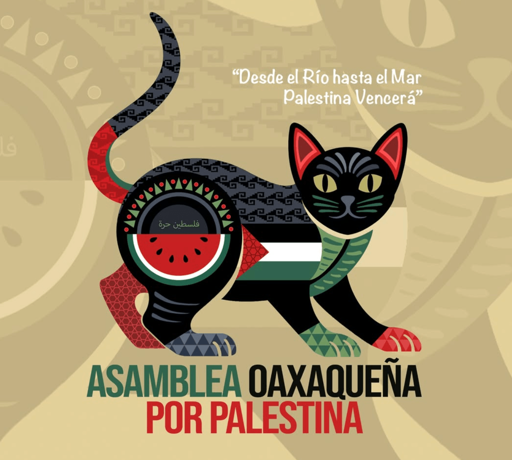
Rebecca Maria Goldschmidt habla con miembros de la Asamblea Oaxaqueña por Palestina en el Día de los Muertos en Oaxaca, México. Hablan sobre cuestiones locales como la gentrificación, la militarización, la narcoviolencia y el sionismo religioso, así como los vínculos políticos y económicos de México con la ocupación colonial de Palestina. La Asamblea Oaxaqueña por Palestina es un espacio autónomo, apartidista y solidario formado por personas de Oaxaca que nos unimos para acompañar la resistencia del pueblo palestino.
The Palestinization of the World: Day of the Dead with the Asamblea Oaxaqueña por Palestina
Rebecca Maria Goldschmidt speaks with members of the Asamblea Oaxaqueña por Palestina on Día de los Muertos in Oaxaca, México. They discuss local issues of gentrification, militarization, narco-violence, and religious Zionism, and Mexico’s political and economic ties to the colonial occupation of Palestine. Asamblea Oaxaqueña por Palestina is an autonomous, non-partisan, solidarity space formed by people from Oaxaca united to acompany the resistance of the Palestinian people.
Podcast in Spanish, see English transcript here!
**The Palestinization of the World: Day of the Dead with the Asamblea Oaxaqueña por Palestina**

Inside the patio of the Museo de Arte Contemporaneo y las culturas Oaxaqueñas (MACCO) in downtown Oaxaca city, I sat with two members of the Asamblea Oaxaqueña por Palestina to discuss the connections between Oaxaca and Palestine. Outside, the streets were full of festive *parsas*, groups of families in costume, faces painted like *calaveras*, parading down the cobblestone streets with marching bands and fireworks. Papier maché skeletons climbed walls spraypainted with *¡Alto al genocidio en Palestina!*, while pickups full of armed police cruised the streets around the Zócalo. Colorful strings of *papel picado* fluttered over every street and the Palestinian flag hung over the entrance of the museum, where Asamblea members stood with a bullhorn chanting. Over the course of four days, the museum patio transformed with handmade watermelons, paper flowers, handwritten signs, paintings, folded paper boats, photographs of Palestinian families and martyred journalists and doctors brought by the people of Oaxaca. Visitors were leaving flowers, fruits, offerings of bread, candles and incense, at a beautiful collective altar created by the Asamblea, and joining workshops, talks, and film screenings throughout the museum. The entire city was overflowing with orange marigolds and expressions of love for familiar ancestors. The Asamblea was determined that Palestinian martyrs were not only remembered, but that the public was welcomed in to learn about *why* expressions of solidarity with Palestine are so important now, and how *la lucha Palestina* is deeply connected to Oaxaca’s own struggles for dignity and self-determination.

This transcript is translated and slightly edited for legibility.
[Listen to the Spanish version of the podcast here](https://www.counterpunch.org/2025/12/13/the-palestinization-of-the-world-w-asamblea-oaxaquena-por-palestina/).

**Rebecca:** Good afternoon, we are here in Oaxaca, on Día de Muertos, Day of the Dead, with the Asamblea Oaxaqueña por Palestina. We’ve been here for a few days talking, lighting the altar, doing workshops, and today there’s a small market. Maybe you can tell me a little bit about what the Asamblea does, since when, and how the movement for Palestine feels right now in Oaxaca.

**Quetzal**: My name is Quetzal and I am part of the Asamblea Oaxaqueña por Palestina. In Oaxaca, activities were carried out in the first few months [since October 2023] started by another group of comrades, but they were no longer able to organize. So in August, we resumed the activities and decided to form the Asamblea. We believe it is important that Mexico and the people here in Oaxaca be more informed and take to the streets for Palestine, since it is something that concerns us all, the whole world, because Zionism is everywhere. And in Mexico, as in other Latin American countries, it also has a huge impact on us and the government is involved in its crimes.

On this occasion, we were invited to the Museo de Arte Contemporaneo y las culturas Oaxaqueñas (MACCO) to carry out activities in the space. They gave us these days of Muertos to do something in honor of the peoples who resist in Oaxaca, which is also a very brave people that has suffered many attacks and even lost their lives for resisting injustices, and of course, for Palestine. We want the people of Oaxaca to have more information about how Mexico relates to Palestine and to stop repeating this prominent media discourse that it is not our responsibility or that it is very far away. In Mexico, the media is particularly co-opted, so they constantly repeat this narrative that we don’t even know where Palestine is, that fighting for Palestine is fighting for a place that doesn’t exist, that we’re just making fools of ourselves. I hear people on the street repeating exactly the same thing out of ignorance or because they’re steeped in this misinformation and pro-Israel propaganda.

Today we have workshops and we’re showing the documentary, *Israelism*, which talks about the education that Israelis receive from childhood to instill in them, on the one hand, hatred towards the Palestinian people and, on the other hand, that this land is theirs and belongs to them and that the Palestinians hate the people of Israel and want to kill them all. There is a fear and hatred that is generated, which is part of the structure and the system that wants to sustain this theft and appropriation of territory.

All this colonization and theft of territory and resources and so on from the native peoples has been dragging on. So Palestine is something that has been done before and is now being taken to other places. What is happening in Congo, in Sudan right now, Haiti, Brazil a few days ago, is the same thing. The same system, the same ways of murdering, of stripping peoples of their identities and their resources, it’s all part of the same intention.

**Rebecca**: We talked about Israeli tourism here, but there are so many links between Zionism and Oaxaca. Maybe you could tell us a little bit about what campaigns you’re working on right now?

**Quetzal**: Just a month ago, the acquisition of Israeli weapons for the Oaxaca police was announced with great fanfare. Millions of pesos are redistributed to the states, they place their order, and in this case, Oaxaca received theirs about a month ago. The training of the police and the army is also purchased from Israel. The [surveillance technology] Pegasus, also became very famous for the students of the Normal school, the 43 students who were disappeared [from Ayotzinapa in 2014]. [The state began to implement this system of locating, investigating, and spying on the parents, the members of the group who did the independent investigation](https://citizenlab.ca/2022/10/new-pegasus-spyware-abuses-identified-in-mexico/), so all of that, the technology, the weapons, the training—that’s what we should be most aware of happening to us.

Since Israel has existed and Mexico has had a relationship with Israel, economic and diplomatic relations exist. In fact, [the dirty wars of the 60s and 70s](https://www.aljazeera.com/news/2003/6/5/israels-latin-american-trail-of-terror), Israel was also involved in the training, the shock troops, the planes that threw people into the sea, as happened in Argentina and Chile, also happened in Mexico. So there is a very strong link with Israel, and there are many things we are involved in and all the repression that exists in the country, because it’s like a replica of how they do it in Palestine — the dispossession of land, forced displacement. It’s exactly the same, it’s terrorism. Globalization is not that you can buy sneakers from a certain American brand. Globalization is this whole system that is an expansion of repression, of dispossession, of death, of destroying identities, destroying native peoples. Because the less social cohesion there is, the easier it is to destroy a people and steal their land. You destroy all capacity for organization and collective work, for community, for identity — and it is done in secret.

**Rebecca**: And in Oaxaca, for example, what kind of weapons are they buying?

**Quetzal**: “Armas largas” (assault rifles). On this occasion, I think [they received 70 or so assault rifles](https://mexicosolidarity.com/oaxaca-government-acquires-israeli-weapons-for-state-police/), the weapons that the police carry. And also training. In fact, when the [Nochixtlán incident happened in 2016](https://itsgoingdown.org/nochixtlan-attack-denied/), [800 police violently dispersed a highway blockade by the teacher’s union, resulting in 6 deaths and 108 injuries], the weapons, the helicopters and all that were from Israel.

**Rebecca**: In Chiapas, I don’t know if there’s something like this in Oaxaca, but there are training camps for Israeli soldiers, and there are also volunteer Israeli soldiers who come to Chiapas to work in the communities [check out [our podcast episode with Acción Palestina Chiapas](https://www.counterpunch.org/2024/11/21/accion-palestina-chiapas-from-resistance-to-revolution/)].

**Queztal**: I don’t know, it’s possible, we would have to investigate. There are many [Israeli] organizations in Oaxaca who are involved in culture and the universities. But for example, with the tourism in Oaxaca, there has been a lot of struggle against gentrification. Both on the beach and here in the city there is a lot of Zionist tourism, and many owners are buying on the coast. All Israelis at a certain age reach a point where they have to do their military service. It’s required. So men and women, the settlers, are prepared to defend what they are stealing, so none of them are innocent, they are all trained to kill. We have even seen images of them walking around the streets armed, with their babies’ prams in the supermarket, so they are all dangerous and extremely violent. There are a lot of Israeli tourists in yoga groups.

**Rebecca**: Yes I saw that “Make Love Not Intifada” sticker.

**Quetzal**: They have that veil of peace, love, hippie, traveller, I do yoga for peace, but I’m a murderer. It’s a terrible contradiction…. They always cause trouble in places, they’re violent, they disrespect traditions. Yes, it’s really a bigger problem than that, it’s a social problem.

**Rebecca**: I also wanted to ask you about the church. What about that religious context in Oaxaca? How does this all fit in with the church and how is is also being taught in the communities?

**Quetzal**: Yes, that’s something really, really strong, and I think there are more Christian Zionists than Zionist Jews. The [evangelical] Christian community has grown impressively, and unfortunately in Mexico they have gotten into the communities. For example, in the neighborhood where I live here in Oaxaca, I have seen three or four Christian temples, so they are getting into the most remote parts of the cities and are growing a lot. I know that in Chiapas too, these churches have penetrated the communities. They are evangelicals with this manipulation and brainwashing that Israel is the promised land, so obviously they defend Israel. In Mexico City, they hold a march every year. Before the Palestinian march, there was the march of thousands of evangelicals all carrying Israeli flags. There were probably just 100 of us in the march for Palestine. The United States evangelical community has a lot of power and has supported the Trump administration. Apart from the Jewish Zionists, really it was the evangelical community here in Mexico that supported AMLO. Nobody says that or is going to say it, but he is a Christian [evangelical].

**Rebecca**: But they are not Catholics. I don’t know much about religion in Mexico, but most Mexicans are Catholics, like in the Philippines. But we also have Christian evangelicals and the people really do believe that Christ is going to return.

**Quetzal**: Yes, all this messianic mythology. You see that Bolsonaro is also part of this Brazilian church, there are several branches, but I know that they derive from the evangelists. In Mexico, evangelical Christianity also arrived years ago, and there are huge congregations with impressive, powerful brainwashing, this messianic ideology that Israel has a right to exist, that they are defending themselves from terrorism, that the Palestinians are terrorists and are bad. It’s very strong, and over the years it’s growing.

**Rebecca**: From what I see on social media is that in Mexico there is also a movement of Mexican Jews, anti-Zionists, who are doing something.

**Quetzal**: There are a few, but yes.

**Rebecca**: Because I also come from the Jewish anti-zionist movement in the United States, we think, “Oh, how great!”

**Quetzal**: Yes, exactly. It’s important to us too. They’re the first ones who should be taking to the streets.

**Rebecca**: The Jewish community in Mexico does have quite a lot of power, connections and its very strong culture. And it has a very important history in Mexico. But it also stays on the Zionist side. That also has to be broken, and that’s a generational issue. And informational, as you said. How do you see the Oaxacan struggle alongside the Palestinian struggle? How are they growing together?

**Quetzal**: Well, that was precisely the motivation for the assembly. We have a lot of work to do.We have to be constantly out on the streets making this visible and find a way to reach people. They say that Oaxaca is a town of artists and that we have to reach people through art. But it’s not just art. We want to find those turning points where the people of Oaxaca feel that they also have to take to the streets. It’s something that affects us all. That’s the intention of the assembly, to raise people’s awareness. It’s important to be on the streets. But in the end a museum or any other space they give us is something else, and we have to take all the spaces they offer us, wherever they may be. We are no longer at a point where we can afford to wait. Our political convictions are firm. And if this space opens up, then we have to use it. We have to use everything we can. But we mustn’t stop taking to the streets.

At one point, there were a lot of foreign tourists, but when you arrived, I started to see a lot of people who are clearly Mexican. And you can see that they know something is happening, but are just starting to understand. Watching the video, reading the wall texts — it explains a lot. Like what I’m seeing is wrong, but now I know why, or it’s clearer to me. So that’s why it’s very important to be in different contexts. On the street, people also think, “What is that?” But inside the museum with books, with art, it also opens your mind much more.

Oaxaca, Día de Muertos are also very important days in Mexico. It’s very family-oriented. If you live in Oaxaca, you go home to your communities. Or you work a lot during this time.

**Rebecca**: And what does it mean to spend the Day of the Dead like this with Palestine? How does it feel? Because you’ve been doing other activism for Palestine for a while now.

**Quetzal**: Well…it’s mixed feelings… I’d better put my energy into the museum altar, and that will be my contribution this year. Let’s hope this is the last year we have to do these things. The struggle is not over. Because there is still more to come, and it’s going to get worse for everyone.

For Palestine, it can’t get any worse. But the rest of us, we are still here fighting. So we have to be firm. Like the Palestinians. It’s what they teach us— to be firm in defending what we love. It’s something we have also learned from them, I believe. Sumud. Determination.
Charlene: My name is Charlene Curiel, I am an anthropologist and a professor at the Institute of Sociological Research at the Benito Juárez Autonomous University of Oaxaca. I am a member of the Asamblea Oaxaqueña por Palestina and have been an activist for two years, denouncing the intensification of the genocide against the Palestinian people. I think it is very important to move beyond provincialism and local analysis in order to better understand how what has been happening in Palestine for 78 years is connected to all colonised and post-colonised peoples around the world and the strategies of post-colonialism. What happens once colonialism ends, but in reality leaves a trail of economic dependence, a trail of coloniality, of power, of knowledge and of being. This has been the result of the expansion of a white Western paradigm that has sought to impose itself on the world.
In the case of the Middle East, a highly coveted territory, first by the British Empire and then American Empire, Israel is a kind of backyard located in the middle of the Arab, Muslim countries of the Levant. A kind of colonial enclave that pushes the agendas of the West in the Middle East. This is clearly a form of contemporary colonialism, from the end of the second half of the 20th century onwards, which always has had the extermination of the Palestinian people on its agenda. I think it is now clearer than ever that behind the invention of the State of Israel there was always the idea of exterminating the Palestinian people and removing them from their territory, pushing them towards other countries or simply removing them. I believe that this is the issue of the Palestinian question and what is happening right now sums up very well the oppression, discrimination and violence that capitalism is capable of in this phase of its history.
We are facing a financialised capitalism that is absolutely linked to war economies, to the arms industry, to the war industry, and we know that capitalism is an economic model that generates crises from which it always emerges thanks to the invention of, shall we say, wars. That is, the First World War, the Iraq War, etc. All the wars that are generally sold to us as wars to bring democracy and freedom to the people, in reality are mechanisms that capitalism uses to reactivate economies closely associated with the arms industry and the war industry. So, what is happening now seems to me to have a lot to do with that.
On the one hand, the United States is faced with the collapse of its own hegemony, confronting the possibility of a more multipolar world where there are other powers such as Russia, China, India, the BRICS. And in its struggle and competition for resources and for world domination, it is supporting the expansion of Israel as its colonial enclave. It activates a place that has been, historically, a place that has been illegally occupying territories, dispossessing people, but now it is intensifying this in the context of this competition that the United States has. So how does that affect the rest of the world? Well, it affects us in different ways, because ultimately, if they are willing to commit genocide, in the terms in which they are doing it, broadcast in real time on our phone screens, without any consideration, filter, censorship or anything else—we have been watching genocide live and direct for two years. If they are doing it this way, it means that they are very willing to assume the political costs of it, and that implies that they are going to give themselves licence to do this anywhere in the world when a people gets in the way of the expansion of their colonial, imperial, capitalist interests.
So, beyond the solidarity that I have felt for many years for the Palestinian cause, as with the Sahrawi cause, or the Kurdish cause, or many other causes around the world, the important thing here is to think about the fact that in Mexico there are many peoples resisting megaprojects and colonial and economic expansion agendas. So, if we allow the Palestinians to be treated as they are being treated now, in an open and obvious genocidal strategy that is killing mainly unarmed civilians on a daily basis, that means that once we cross that threshold, there will be no turning back. That will be the way the United States will solve its problems from now on, and that is obviously connected to what is happening in the Congo, what is happening in Sudan, which are also genocides. There is no occupying power, but behind those genocides there are also imperial powers and imperial and colonial agendas. So I do think it is very important that people, even if they feel that Palestine is very far away in terms of kilometers, think that the struggle for self-determination and the end of colonialism is a struggle that we should embrace because it is not certain that we will live in sovereign countries in the future.
I think Donald Trump came in this last year to accelerate a process of imposing these agendas, where the Democrats were a little more discreet, but he no longer cares about being discreet. He clearly says, “I want Venezuela’s oil, and I’m going to get it, and that’s that.” He doesn’t care that there is a government, that it is a sovereign country. He wants to go and arrest Maduro and impose a right-wing candidate so that they will sell him oil, basically give it to him for free. So that kind of thing leaves no room for doubt. There’s no interpretation, no “maybe we heard wrong” or “maybe he doesn’t mean that.” He’s not saying it, he’s telling us that he’s a global dictator and that he wants the United States to be great again, and that means the world should give them its resources.
So that vulgarity of thought of a spoiled child who wants toys for himself and his friends is what the world now has in this situation. It is no coincidence that that is what is happening, that we have two years of counting the dead killed with impunity by Israel in Palestine, but now we also have people being killed with impunity on boats in the Venezuelan and Colombian Caribbean, without anyone knowing why the hell they are shooting at people on boats. Or now with this operation in the favelas of Rio de Janeiro where they are also killing people in an operation that is seeking to dismantle an organized crime group, but in the midst of that they are taking 200 people and cutting off some of their heads.
So this type of extreme violence, where there is no real plan to dismantle organized crime with intelligence or other means, but rather deliberate “capitalismo gore”, as Sayak Valencia says, tells us that there is already a brazenness, that is, they have already taken upon themselves the right to kill, the ownership that Rita Segato talks about, they feel like they own the world and so this is going to continue to happen.
Right now, Trump has also just issued a decree to support the Moroccan regime in denying the Sahrawi people their self-determination in Morocco, a struggle that has also been going on for more than 50 years. Donald Trump has just intervened once again, with the United States interfering in the internal politics of countries that do not do what he wants, as in Argentina, which just happened with Milei. If they don’t do what he wants, he doesn’t give them money, or he sends his soldiers, or he does something else to them. So the truth is that the situation is quite complicated, and I am very concerned because it obviously involves Palestinian lives. Palestinian lives matter, of course, but it also involves the future…
We are witnessing the expansion of this imperial agenda of death in countries that have already undergone processes of colonialism and neocolonialism, where life is devalued in order to guarantee the accumulation of capital by a few, the 1%. The Palestinian struggle is connected to all these movements, the Indignados in Spain, Occupy Wall Street in the United States, Black Lives Matter, all these movements I believe found their interpretation in the Palestinian cause. In other words, Palestine is giving us the elements of analysis to understand why all these struggles are connected and why all these peoples can be affected in the same way by an interventionist, imperialist agent that is now coming for everything.
In other words, it is clear to us, it is clear to me, that it is coming for everything and that there is no longer any legal, institutional, or international power to stop it. That fiction has been shattered, the fiction that there were human rights, that there was international law—which was always a law applied to countries where the population is racialized, obviously to continue building the idea that the West, the global North, are the ones who hold the banner of democracy and freedoms and human rights. Now we know that this is not the case. The problem is that if there is no longer international law, if the UN is not really an assembly of countries that can stop this kind of thing, who is going to do it? That is the question I ask myself: who is going to do that?
And that is where we, the people, the movements, the organizations, the students, the unions, the peoples in defense of the territory, have to step in to articulate struggles that transcend identity politics and put at the center the fact that this is a new order that we all have to fight against. Students, unions, peoples defending their territory, to articulate struggles that transcend identity politics and focus on the fact that this is a new order that we all have to fight against, because it will affect everyone: women, Black people, Indigenous people, impoverished people, the LGBTI+ community—in other words, everyone.
So we do have to be very alert and very aware that what is coming will change us. It is already a door we are crossing, and there is no turning back, unless we truly dedicate our vital energy to organizing and creating community and collectivity.
Rebecca: I feel that politics in Mexico has changed a lot since I lived in here 13 years ago. Obviously there are links and people are supporting the Palestinian people, but how exactly does Palestine connect with what’s happening in Mexico right now? On the left, how are people getting involved? It seems to me that Mexico has also gone through, is still going through the drug war, the femicide and extreme violence. How are people here connecting their experience to Palestine? Obviously with the weapons and the Zionist tourism…
Charlene: Well, the violence we see in Mexico today is very particular because it began to take shape when Felipe Calderón declared war on organized crime in 2006. So, once again, we have a revival of Nixon’s war on drugs, which was really always a pretext for intervention in Latin America. What they did in Colombia with Plan Colombia was transferred here through Felipe Calderón’s war on drugs. And so that type of violence, that process, triggered a diversification of violence in the sense that instead of really ending organized crime, what happened was that it became stronger.
In other words, we are talking about a parastate that is a structure similar to the state, parallel to the state, which intervenes in the state and operates in many regions of the country as if it were the only law, the only authority—Michoacán, Nuevo Laredo, Tamaulipas, Sinaloa. This violence that manifests itself in disappearances, femicide, migrant trafficking, human trafficking, all of this, is violence that is absolutely associated with the arms agenda, imperial war agenda of the United States, where they sell us this security paradigm, where there is no comprehensive view of the problems of violence that are really poverty, inequality, injustice—but rather it is sold as a security problem. That what matters is to strengthen the security forces through the purchase of weapons, training, and control, surveillance, and espionage technology.
So securing the border, both the northern and southern borders, better training the police forces, giving much more importance to the army’s role in public security, something that they should not have because the army is supposed to defend the country in case of war, that is what armies are for in the world, but for many years now, the army has been on the streets carrying out public security activities. So this is a paradigm.
Right now, Trump is deploying the military and the National Guard to carry out public security operations. So it is clear that the securitization paradigm is strengthening perhaps the most repressive organs of the state, which are the armed forces, because those people are trained for war, they are not trained to maintain security or ensure that people are well cared for—they are trained for war. So these institutions, such as the military on the streets, are contributing to the repressive strategy, but clearly the securitization strategy has not worked in the almost 20 years that we have been implementing it. Securitization has shown time and time again that it does not solve the problem of violence, on the contrary, it causes more violence, it promotes more violence. It does not stop the budget of the Ministry of Public Security and the Ministry of National Defense from growing. It is clear that we are paying a little bit for the fact that the United States intervenes in the agendas of all the countries in Latin America, all the countries in the world, but above all, by imposing this model of securitization.
Many people may believe that this is the right thing to do, because, of course, there is a lot of violence and the violence seems uncontrollable and it seems that everyone is exposed to it, so, of course, people want to feel safe and believe that the army or well-trained police will bring us security. And the problem is that there is already the issue of corruption, the issue of impunity, we are talking about structures that are deeply rotten at their roots. It is very difficult for these institutions to truly fulfill their duty to dismantle organized crime cells. And so what is happening is that both the armed wing of the state and organized crime are joining forces to terrorize communities that organize and resist megaprojects. So we have a combination of a semi-paramilitary structure, the army, but also supported by organized crime, which between them will take on the task of terrorizing people, disappearing defenders of the territory, defenders of human rights, intimidating communities that organize themselves, and monitoring social movements.
So, if the police aren’t watching you through spyware, then the organized crime cell is spying on you, watching who’s moving around and who’s coming and going. If we add to that the fact that Israel is the eighth largest arms exporter in the world and that it is Mexico’s most important trading partner in the Middle East in terms of trade, and what we import from Israel is nothing more than weapons—because that place only has weapons, it has nothing else, nothing belongs to them. The olive trees belong to the Palestinians, the olive oil belongs to the Palestinians. They have nothing to export except weapons. That is their merchandise, that is their local craftsmanship. So, that’s where everything connects. We are implementing a security agenda that, until very recently, was still very strongly influenced by the United States, where we are benefiting from the accumulation of capital from the war economy and the arms industries that are linked to Israel. Through the Department of Defense, we are contributing to the massacre economically, because we know very well that the only way to stop Israel is to stop financing it. That is the only thing that will stop it: boycott, divestment, and sanctions.
And so, unfortunately, Mexico contributes to this through its free trade agreements on arms and training and so on, and we also know that there are people from Israel, security experts and such, who come here to train the armed forces and local police, but we also know that there are members of organized crime who go to Israel to be trained there. So, the violence they go and learn there, how the Israelis treat the Palestinians, the torture, the things they do to them, those are ideas that are then imported to Mexico, and that is the violence we are also seeing—a violence that is learned through the Israeli army. The connection seems quite obvious to me, but many people don’t have all these elements to understand how imperative it is for Mexico to break relations with Israel and for us to continue demanding that all countries cease trade relations and derecognize the existence of that… well, that spawn of the devil that this colonial enclave has become.
Rebecca: I have been thinking a lot about Sayak Valencia’s book Capitalismo Gore in how it relates to what is happening in Gaza and the absence of a limitation for the violence. Within Israel, there are levels and tricks to maintain the culture of oppression of the Palestinians. They keep the young people in that mental state of fear, like you say how you say that everyone wants to have their “security”, but that’s not security. So, as I see it in Mexico, like everywhere else, we also have people who join the police or become soldiers. For example, in Hawaii, the police are also Hawaiians, and in Mexico, I imagine in Oaxaca there are police who are indigenous. So, it’s this double-sided thing where we’re also fucking ourselves and our own communities over. It’s my relatives in Israel who are oppressing the Palestinian people. And there are so many people who are earning money for their families, for the state, by participating in it. It’s a violence machine. When I was in Tijuana, I thought about the complexity of that a lot, and like you say, in the end, the state and the arms business and the war business are eating everything and putting the people inside those posts of being a soldier, of being a police officer.
Do you want to tell us more about the signature campaign you are working on?
Charlene: Yes, there is a citizens’ initiative launched by the Committee in Solidarity with Palestine in Guadalajara. In September 2024, they launched a campaign to collect signatures from Mexican citizens demanding that the Mexican government break relations with the Israeli government. This means that the government has to vote on a decree, the Senate and the Chamber of Deputies have to vote on a decree of severance, but that will only happen if we, that is, if the people involved in the initiative manage to collect 130,000 signatures, which is what the law requires, a percentage taken from the total electoral roll.
Once the signatures have been counted, they will go to the Senate with a letter addressed to Claudia Sheinbaum, directly demanding a decree for the reasons that will be put forward in terms of genocide, in terms of the violation of international law, in terms of the fact that international law says that countries cannot have trade relations with states that violate human rights. All countries in the world that maintain relations with Israel are violating international law. We are doing so, the whole world is doing so, with the exception of Colombia, Venezuela, and Cuba, which I believe are the only three dignified countries that are not. The signatures must be validated by the National Electoral Institute. Once they are validated and if the number has been completed, then those signatures go back to the Senate which has the obligation to draft the decree and vote. So it’s a campaign that has taken us a long time, we’ve been at it for over a year and we haven’t even managed to collect half of them yet. As of now, November 2025, we only have 45,000 signatures, something like that, because no matter how hard we try, there hasn’t been a big embrace from large organizations, teachers’ unions or universities. We’re a little behind in terms of what we hoped to achieve. But we’re still on the register, we have no other choice, and we’re going to continue demanding the severing of relations in the streets and then through the legal channels available to us. In the Mexican Constitution, there is a decree, an article that says that the people of Mexico can demand certain things from the government through a very specific procedure, and that is what we are going to do—use the same law to force Mexico to take a position on this, because there the senators will vote yes or no to the break, and then we will see who supports the State.
Rebecca: Thank you. I was also thinking more about Chiapas and the Zapatistas, and the towns here in Oaxaca, which also have their own problems with water, with tourism, militarization, which seems very obvious to me, you see it on the streets. But that’s also people’s work. People need to know what’s going on in Palestine, but I suppose it’s also a learning curve, because I imagine that many people don’t understand what’s happening on a larger scale. Do you feel that there is support for the Palestinian people from more rural or indigenous communities in Oaxaca?
Charlene: Except for the EZLN and the Zapatistas, I can’t think of any group here in Oaxaca, or rather any town, or indigenous peasant organization that is demanding an end to the genocide or joining in the actions. I think there is a lot of information missing. They don’t connect the struggles here with the Palestinian struggle, and that has prevented there from being a broader articulation with regard to Palestine as the center, so to speak, of what we could be doing. And this is due to many things, that is, precisely because people have many problems, because they are dealing with very urgent and immediate issues, such as mining, water shortages, rising prices, everything, obviously the presence of organized crime in many regions of Oaxaca, such as the Isthmus, Papaloapan, the coast, where there are already very high levels of violence. So yes, it has been very difficult and there has been little understanding and little solidarity in relation to the Palestinian people, but we continue to do the work we can. In that sense.Rebecca: For us too in Japan it’s the same, and two years ago even the anti-nuclear movement knew almost nothing about Palestine. So for people who are getting involved in the movement now, there’s a lot more recognition, but we still have to get more coverage. Everything you just told me about why Oaxaca and Mexico have these ties and why it is so important that we break them. So I think, yes, it has been one of those amazing years as the movement rose up for the struggle of the Palestinian people, but it’s still not mainstream. In communities further away from city centers like Los Angeles or New York, Berlin, many people still don’t know. That’s why we’re making media, but I imagine that in Oaxaca it’s also difficult to draw the connections. But for me, seeing “Viva Palestina!” painted on the street, that’s just one way for people to see it. And I think what you’re doing right now in the museum with the workshops, the altar, there are a lot of people passing by and the art helps you recognize the connections between the struggles. I think that’s very important. Do you have any last comments you’d like to share with us?
Charlene: I think it is very important to continue opening up spaces for conversation where people can connect the dots and realize that precariousness, marginalization, social exclusion, injustice, discrimination, violence, are all more or less related to this complex web of economies of war, violence, and dispossession, which are responding to particular interests, and that we as people need to realize that there are many of us— there are more of us. So we have to organize ourselves, we need to promote the creation of bonds and community ties, strengthen the social fabric, and understand that what we need is to stand together on the same side of history in order to combat this 1% who, if we let them do as they please, will destroy the world as we know it. We need to create more spaces for conversation to do this, to connect the dots and understand how our daily lives are affected by plans, projects, and decisions made far from our homes, which impact us directly in every way. There is also the climate and environmental dimension, which is terrible, and the political dimension, where we are seeing more and more right-wing, fascism, and ultra-conservative movements advancing. There is all this violence against women, minorities, sexual minorities, dissidents, and racialized peoples. So there is a set of circumstances that are telling us that if we continue like this, then very likely the world will change forever, that is, in a very short period of time. And then the dystopias of some of these books, such as Brave New World or Handmaids Tale, will come true. We are already a little bit there.
We need to take into account that we need to open up more spaces and promote them by talking to our families in our classrooms, with the community, with our friends, and strengthening initiatives such as the Asamblea Oaxaqueña por Palestina, which is a group of very different people, but we have put aside those differences to unite for these causes.
The post The Palestinization of the World appeared first on CounterPunch.org.
From CounterPunch.org via this RSS feed