

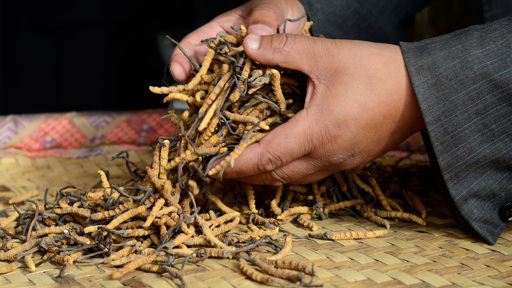
Gyatso Bista remembers the sacks of kutki. As a child learning to become a healer in Nepal’s kingdom of Lo Manthang, Bista would watch as heaps of the bitter-tasting herb, prized for treating fever, coughs and liver problems, arrived on horseback from the surrounding mountains. Bista is one of the few remaining practitioners of Sowa Rigpa, an ancient Tibetan healing system used for more than 2,500 years. He remembers harvests of up to 40 kilograms (88 pounds) of the high-altitude herb. But now, the kutki (Picrorhiza scrophulariiflora) has all but vanished. “Now you barely find 5 kilograms [11 pounds],” Bista said. What Bista has witnessed in his village reflects a global crisis. More than 80% of the world’s population relies on traditional medicine for their primary health care. Yet across every inhabited continent, plants that form the backbone of traditional healing are in decline, pushed out by rising temperatures, shifting rainfall, deforestation and overharvesting. Meconopsis grandis, also known as the Himalayan blue poppy, is among many other species are gradually on the verge of extinction. Image by Conall via Flickr(CC BY 2.0). “For many common illnesses, these traditional remedies are really our first aid,” Mingay Dakias, a member of the Manobo-Dulangan Indigenous community in the southern Philippines, told Mongabay. “We usually rely on these treatments first.” A recent global review published in Frontiers in Pharmacology found that of 367 medicinal plant species studied over the past two decades, climate change has reduced suitable habitats for 106 species. Another 94 species…This article was originally published on Mongabay
From Conservation news via this RSS feed