


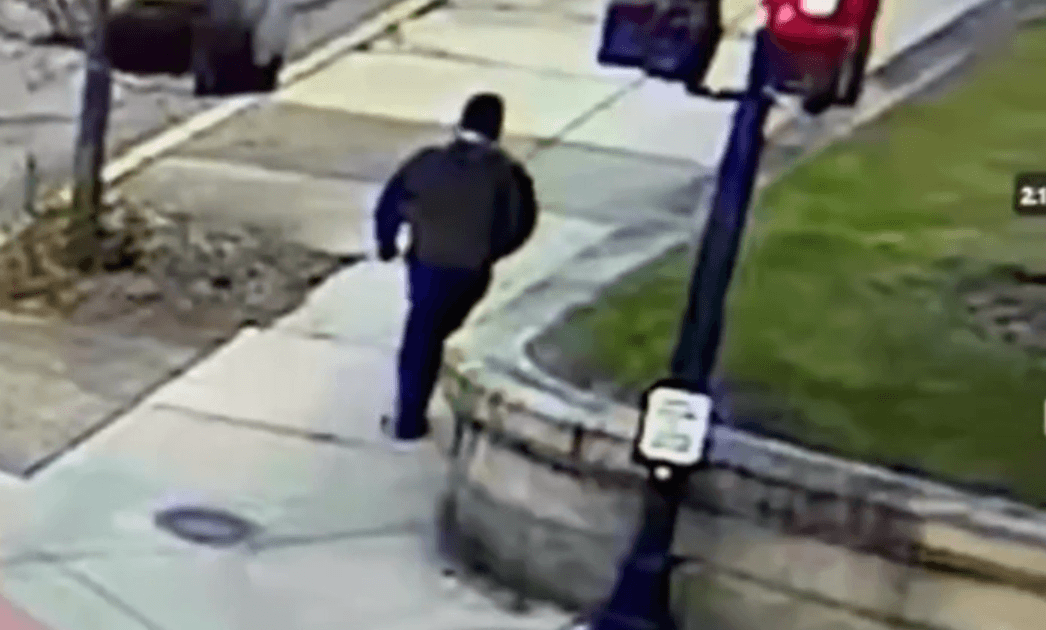
CCTV footage of Brown University shooting suspect.
Let’s begin with the fact that I have zero interest in glorifying this coincidental moment where my brother just so happened to be an ambulance tech at a mass shooting which occurred at Brown University on December 13, 2025. In reality, that relationship is its own story and it distracts from the larger point that I want to make here: regardless of whether or not my brother is enrolled in your university, he was present in an active crime scene and there was a legitimate question about his safety in those circumstances while the perpetrator was still at large.
We still know nothing about the perpetrator, or even if it might have been plural.
Let’s observe a few things, however, that are very obvious and useful. For instance, this didn’t happen at the Masjid, chapel, Hillel, or other location of religious observance, which does not suggest religious bias/animus.
So how to explain Brown University and Rhode Island…
Look, in the 1600s and 1700s, the WASP slave-owning founders decided to create Providence Plantations on College Hill. The closer to the bottom of the Hill you got, the lower the class standing. At the top of the Hill was…Rhode Island College (before it was renamed Brown). And right next to it was the Brown Brothers Incorporated and their Bank of Rhode Island, which was a giant pot of cash earned from slavery. (That’s right, the entire endowment is built of slavery…)
This is all to say that Brown has a very strict amount of segregation between its student body and the rest of Providence. The student body of Brown lives on top of a very tall hill with all the accoutrements required located within the campus. There’s Starbucks, CVS, Avon Movie Theater, burger joints, absolutely everything an undergrad could need is enclosed within the campus, a kind of foreshadowing of Disney World’s wraparound services. This is contra the state schools I went to, URI, RIC, and CCRI, which are integrated into the wider Rhode Island landscape as commuter campuses.
So we’re going to have a class question underwriting this tragedy. What pressures, dynamics, and inclinations led to this terrible explosion of violence? More pointedly, the first question for the investigating cops will be whether this was a student or a local, and likewise whether it was students, locals, or both who have been impacted by this?
Please understand that this is not a proprietary statement but this did actually involve a member of my immediate family. A friend posted the police scanner website link on Facebook.
About ten minutes into the broadcast, I heard that unmistakable brogue.
“Cúnaí!”
The progression of the police commands and their deployment of forces made it pretty clear that they were moving the students in one direction, into a green safety zone, while my brother’s ambulance was moving in the opposite direction, towards the red zone. The Brown University Alert system was constantly reiterating that they were still in lockdown because of having an active shooter in the vicinity. It is very concrete and visceral when you contemplate variables that can encounter any EMT moving through a live crime scene.
What if my brother had walked into the building where someone was hiding out? Those are concrete considerations for me. I’m not trying to imply anything remotely heroic or even admirable about either of us. Instead I am hoping to emphasize how Brown impacts the Greater Providence area despite aspirations to the contrary.
In the 1990s, my dad worked in the Brown HR Department. My mother was paralegal for an immigration law office that processed student visas for Brown students. I have made a documentary about the history of slavery at Brown. Despite attempting to alienate itself from the rest of the state, College Hill fundamentally impacts the livelihoods of the entire state, and sometimes in deeply contradictory ways. As just one instance, Brown’s gobbling up of high-value real estate effectively takes massive amounts of capital out of the City Treasury, thereby mandating a brutal austerity regime that includes attempting to turn the school district into a full-charter school network whilst breaking the Providence Teachers Union.
The student body is blissfully unaware of the tremendous poverty and inequality fostered by the real estate portfolio of their alma mater. Whether you go for the low-grade Marxist gruel about “capitalist ideology” or the refined postmodern debate about “performativity,” the ruling class send their oblivious undergrads to a theme park disguised as an Ivy League college. Thayer Street, the main drag on campus where the popular restaurants and vendors sell their wares, is a locus where a student can operate completely and effectively without having to ever descend into Downtown. Locals thrive on selling their goods to the student body, regardless of whether the items are legal or not.
One initial question was about whether this was perpetrated by a local, and if so, was it possibly a drug deal gone bad? Doubtful, there is a dimension of “street smarts” in South Providence that precludes contemplating such reckless adventurism. Going to try something like this on the Hill would be an invitation for community repression nobody welcomes home for the holidays.
I have a lot of complicated feelings about my brother. But I’m glad he is safe and that no EMTs were hurt. While I have a very concrete opinion about policing, I likewise have a very clear opinion about the people inside the ambulances like my brother. Before him, our uncle and grandfather both were active in their volunteer fire department in Illinois.
How many times have I talked about “settler colonialism,” the ideology that underwrites our mad-as-a-hatter gun nut culture? How often do you have to quote Aimé Césaire and his definition of fascism as “colonialism boomeranging” back unto the metropole, a kind of revenge against Europe after 450 years of imperial barbarism?
People are surprised, they become indignant. They say: “How strange! But never mind — it’s Nazism, it will pass!” And they wait, and they hope; and they hide the truth from themselves, that it is barbarism, but the supreme barbarism, the crowning barbarism that sums up all the daily barbarisms; that it is Nazism, yes, but that before they were its victims, they were its accomplices; that they tolerated that Nazism before it was inflicted on them, that they absolved it, shut their eyes to it, legitimized it, because, until then, it had been applied only to non-European peoples; that they have cultivated that Nazism, that they are responsible for it, and that before engulfing the whole of Western, Christian civilization in its reddened waters, it oozes, seeps, and trickles from every crack.
It seems vital to indicate that, at the bottom of College Hill is the Roger Williams National Memorial Park. On that spot, Roger Williams took captive Pequot prisoners of war and sold them into Caribbean slavery, the first instance of slave sales in the Northeast. Chad Brown, grandfather of John and Moses Brown, cofounders of the University, was a beneficiary of this newborn chattel bond slave market and built his family’s fortune from sales in Black flesh and Indigenous land expropriation. If you found a College upon such carnage and bloodshed…?
No, we must further investigate Snowtown.
As I mentioned earlier, the Hill is designed so that those at a lower altitude are in the lower classes. At the bottom of the Hill was Snowtown, a Black and Indigenous-mixed neighborhood. In 1831, European locals descended on the scene and rampaged for four nights. Like the earlier Hardscabble riot, which included a Chaffee amongst the perpetrators, white settler power had to be reasserted over a locality that failed to comply with the City’s particular standards of acceptable racial behavior codes.
We must understand the violence of a society in order to understand the violent perpetrators it creates. We must understand how these systems dictate impacts and outcomes for individuals that culminate with such antisocial tendencies. This is not “Marxist” or “socialist,” it is rudimentary anthropology and sociology. We stand upon the ruins of an ancient civilization that was destroyed in service of expropriation-cum-primitive accumulation. That symbolism was so powerful that Herman Melville named Ahab’s boat, The Pequod, after the aforementioned chattel bond slave sales made by Roger Williams. The author of Moby Dick opens his book in New Bedford but he has Providence on the mind of his maladjusted narrator Ishmael. At the time he published, the locus of New England industrial activity was moving out of Providence and Newport into Massachusetts, where ports were more open and expansive for boats carrying whale oil. After slavery was outlawed in the North, Providence confronted the limitations of its shallow river banks and watched merchants migrate into the Commonwealth. Melville’s novel was published two decades after Snowtown was razed. Did he understand this economic contraction, caused by Abolition and the replacement of slavery with whaling, as catalytic for these anti-Black/Indigenous pogroms at the bottom of College Hill?
If we perceive these structures of feeling within the matrix of a settler colonial society, we can recognize patterns and tendencies demonstrating social habits that recur again and again. The crassest kinds of Marxists extrapolate wild determinist notions from these considerations.
But then comes the reality check:
This happened the day before the anniversary of the Sandy Hook Elementary School massacre. One student was a Parkland survivor who explicitly stated that they selected Brown for the sense of security that the campus provided them.
We’ve reached a saturation level that makes surviving this sort of event a repeat event in your life. That doesn’t happen with car accidents.
Want to know the other repeated trauma event this resembles? A teen slasher film. Maybe a Godzilla or Jurassic Park movie. Our society sits back, mildly bemused like when they watch exploitation movies, and tells trauma survivors “Maybe we’ll see you again in the sequel.” When it happens, when one of the characters from the earlier movie makes a cameo in the newest film, we respond with a morbid facial expression.
Nobody should be forced to live in such a video game version of reality. This doesn’t happen anywhere else on earth and they get on well enough without the Second Amendment in Australia and Canada. Regardless if you are a student or a local resident, this impacts everyone and we need to recognize this as an opportunity to make Providence education more properly integrated. It is statistically impossible to avoid the coincidences so we need to embrace them.
The post My EMT Brother Was at the Brown University Shooting appeared first on CounterPunch.org.
From CounterPunch.org via this RSS feed
You must log in or # to comment.