


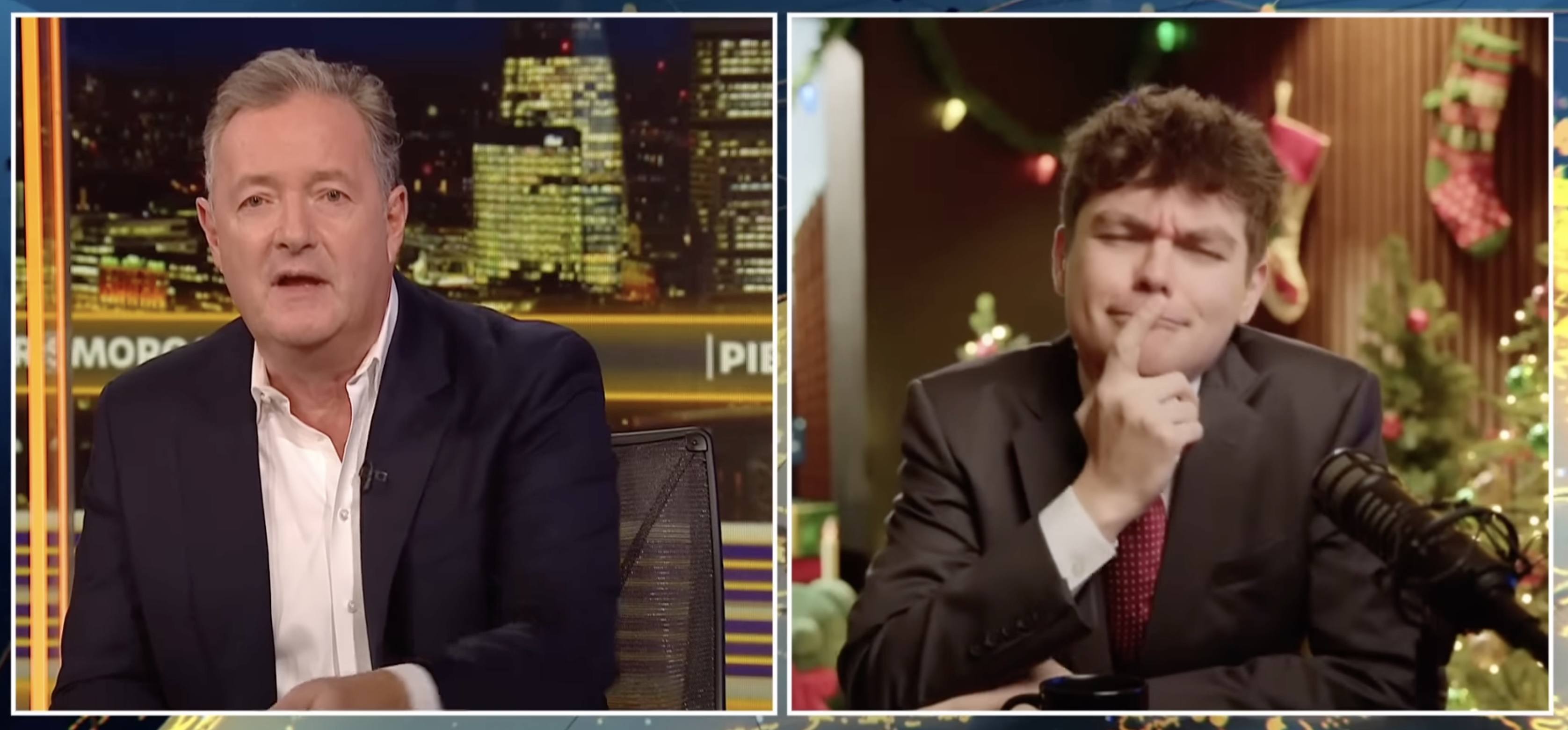

Screengrab of Piers Morgan’s interview with Nick Fuentes on Uncensored.
The fascist types are frequently called hysterical. No matter how their attitude is arrived at, their hysterical behavior fulfills a certain function. Though they actually resemble their listeners in most respects, they differ from them in an important one: they know no inhibitions in expressing themselves. They function vicariously for their inarticulate listeners by doing and saying what the latter would like to, but either cannot or dare not. They violate the taboos which middle-class society has put upon any expressive behavior on the part of the normal, matter-of-fact-citizen. One may say that some of the effect of fascist propaganda is achieved by this breakthrough. The fascist agitators are taken seriously because they risk making fools of themselves… Hitler was liked, not in spite of his cheap antics, but just because of them, because of his false tones and his clowning.
– Theodor Adorno
Nick Fuentes is very funny. The other night he continually cracked jokes and mugged for the camera while running circles around a befuddled and overmatched Piers Morgan. Watching the interview brought to mind the 2016 GOP primary debates, in which Trump mauled traditional politicians such as Jeb Bush and Marco Rubio, who could only feebly respond with an anachronistic political vocabulary and the dated optics of “decency” and “maturity.” Perhaps Morgan thought it was the 1980s and he was Jerry Springer or Geraldo, and that, like them, he could browbeat his Nazi guest with the reliable backing of editing crews and a disapproving audience.
Of course, those episodes take on a different meaning in light of today’s ascendant fascism. The infamous Geraldo skinhead fight, for example, is today populated with YouTube comments siding with the Nazis. Using the old skinhead script (“I’m not anti-Black, I’m pro-white!”) and having honed his skills in a lifetime of online debate, Fuentes ceded no formal advantage to Morgan’s live one-on-one format and repeatedly exposed a stark political divide expressed in generational terms, with Morgan’s “boomer” lectures sounding as out of touch as an aging parent who insists that you can make it if you just work hard and have the right attitude.
Indeed, this is why liberals shouldn’t debate fascists. Every time Morgan responded to Fuentes’ racism and sexism with guilt tripping and personal appeals, it reinforced Fuentes’ main point that he and his millions of followers, like rebellious teenagers who have permanently tuned out their hectoring father, no longer give a damn.
There is, of course, a way to repudiate racism and sexism, but it is a political-economic one that identifies these ideologies’ origins and uses within the context of capitalist class warfare. In distinguishing reality from appearance, the correct critique ultimately emphasizes not that racism and sexism are offensive but that, as incorrect explanations of social reality, they are fundamentally stupid.
Committed to preserving capitalism, liberals’ default reliance on the shopworn and hypocritical morality of political correctness, tolerance, and kindness was never built to last. When someone like Morgan, who is wholly implicated in the sundry miseries of the present, invokes it, it leaves estranged and miserable youth like Fuentes’s followers in stitches, further fueling the iconoclastic zeal with which they seek to forcibly restore what they believe has been taken from them. One can think of the Freikorps’ revolt against the fathers who “betrayed” them, like a serial killer, the violence begins close to home.
While their discussion of Fuentes’ visceral hatred of women, which is right out of Klaus Theweleit’s Male Fantasies, helped expose the misogyny that is at the core of fascism, Morgan and Fuentes’ discussion of the Nazi Holocaust illustrated the ultimate futility of the interview. Following a clip of Fuentes cracking jokes concerning the genocide’s death toll, Morgan responded: “I just find it extraordinary that you would think the Holocaust could ever be something that we could joke about.”
A smirking Fuentes mirthfully replied: “Why? Too soon?”
Morgan later attempted to pin Fuentes by asking, “So you concede that six million Jews died in the Holocaust?” “Oh, it’s at least six million, but it could be 100 times more than that,” mocked Fuentes, with Morgan oblivious to the fact that his guest was speaking a different political language and scoring yet another joke at his expense.
Morgan is far too interested in ratings to recall that there is no engaging with a Holocaust denier (or, for that matter, deniers of other atrocities, including climate change) since the very acceptance of a debate in which there are two legitimate opposing sides already grants the denier, who seeks above all to mystify reality and our ability to understand it, victory. Similarly, fascists deploy an incommensurable language in which “truth claims” are either cunningly deployed or else dismissed as naive or irrelevant, the prima facie unacceptable notions of “beta cucks” like Morgan.
One can, presumably, strategically score points off of fascists for the benefit of the audience. Morgan might have noted that there have been many times –contra Fuentes’ complaints that there has been no “debate”–in which the claims of Holocaust deniers have been torn to shreds, such as during David Irving’s failed libel suit against Deborah Lipstadt.
Meanwhile, Morgan should have avoided making the patently false claim that the Holocaust has never been politicized. If only he had remembered that Norman Finkelstein, who has written a whole book on the subject, has been a guest on his show, he might have preserved an ounce of his credibility. Unsurprisingly, these are not terribly erudite individuals. But erudition was never the point in an exchange between a host seeking to preserve an increasingly intolerable world and a guest seeking to replace it with one that would be horrifyingly worse.
The post Morgan’s Dinner With Fuentes appeared first on CounterPunch.org.
From CounterPunch.org via this RSS feed