

The other night I heard “Carol of the Bells” echoing from the gallery of a cathedral, and this most beautiful of our Christmas songs made me a little sad.
Long before I knew what the song was called, or anything about it, I thrilled to “Carol of the Bells.” It came to me in my little American capitalist childhood as the background for a television advertisement for André champagne. Even as a very young child, I could tell that there was something strikingly different about the enchanting melody, as though it came from another world. And so it does.
Most of the songs one hears around the holidays, at least in North America, are either arrangements of traditional songs from France, England, Germany, or Austria, or twentieth-century compositions. They have a wonderful variety of messages and meanings. But none of them has anything like the driving ostinato four-note melodic pattern of “Carol of the Bells,” nor its bold polyphony when sung.
“Carol of the Bells” stands out because it arises from a different tradition: that of Ukrainian folk songs, and in particular ancient Ukrainian folk songs welcoming the new year, summoning the forces of nature to meet human labor and bring prosperity. These are called shchedrivky, “carols of cheer” or, a bit more literally, songs to the generous one. The word “magic” is used a good deal around Christmas; this song has its origins in rituals that were indeed magical. And perhaps this is exactly why it reaches us.
Before the advent of Christianity, and for that matter for centuries afterwards, these songs orchestrated and encounter with the forces that could bring what was sought, which was the bounty of spring after the cold of winter. The pagan new year began, reasonably, in February or March, with the arrival of the swallows or the equinox; the carols of cheer were pushed back towards January or December 31st by Christianity – and one in particular was pushed deep into December by Americans, transformed into a Christmas carol.
The melody that I heard in St. Paul’s Cathedral in Toronto as “Carol of the Bells” is a Ukrainian folk song. It was arranged as “Shchedryk” by the Ukrainian composer Mykola Leontovych in the middle of the First World War, likely on the basis of a folk song from the Ukrainian region of Podilia. The four ancient guiding notes of the melody sound like the dripping of icicles joined by the singing of birds. Leontovych’s lyrics capture the earthy directness and incantatory purpose of the ancient songs. My English translation is no doubt inadequate and a little free – in Ukrainian, for example, a dark-browed woman is by definition a beautiful woman, and so I have rendered her.
Щедрик, щедрик, щедрівочка,
O generous, generous, generous one,
Прилетіла ластівочка,
The swallow of spring has finally come,
Стала собі щебетати,
It found a branch and began to cheep
Господаря викликати:
Summoning the farmer from winter’s sleep:
“Вийди, вийди, господарю,
“Come out, come out, my good man,
Подивися на кошару,
And see what’s happened in the barn
Там овечки покотились,
All your ewes have given birth,
А ягнички народились,
Lambs are welcomed by the earth
В тебе товар весь хороший,
The summer will be warm and sunny
Будеш мати мірку грошей,
Your crops will earn a pile of money
Хоч не гроші, то полова —
But money’s not the half of it —
В тебе жінка чорноброва“.
Your wife is beautiful and fit.”
Щедрик, щедрик, щедрівочка,
O generous, generous, generous one,
Прилетіла ластівочка.
The swallow of spring has finally come.
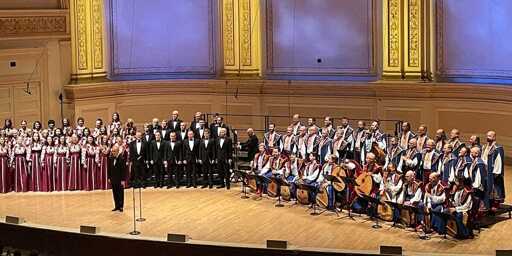
During and after the First World War, Ukraine was one of the most violent places in the world. Its rich land was contested by multiple armies. A new Ukrainian republican, seeking recognition, sent out a chorus to the world to perform Ukrainian songs. One of these, apparently the most popular, was “Shchedryk,” which was performed in Carnegie Hall.
By then the Ukrainian republic had been destroyed by the Red Army, and the composer Leontovych himself had been murdered, probably by an agent of the Cheka, the Bolshevik secret police. An American composer transformed the song completely with new lyrics in 1936: sentimental, much simpler, about bells and Christmas, without any reference to Ukraine and spring and gratitude. In the American version, the song is about itself and its own cheering effect, but the broader senses are gone. That is the version that we know, the one that left me melancholy in the cathedral.
Perhaps this is unrealistic, but I wish that the Ukrainian origins of the song would always be recognized. Ukrainian culture is very significant in our world, but our awareness of it is minimal: the assassination of Leontovych and the transformation of Shchedryk is just one minor example of this colonial history, one that is continued during Russia’s present invasion of Ukraine. In December 2022, ten months into the present invasion, Shchedryk/Carol of the Bells made a beautiful (and bilingual) return to Carnegie Hall, which helped a little.
Russia’s full-scale invasion of Ukraine has now been underway for nearly four years. This winter’s most spectacular performance of Shchedryk was in Paris where, sadly, the Ukrainian origins of the song were all but invisible. It is wonderful that we cheer ourselves up with this song. But we might, at the same time, acknowledge the debt to other people.
This is the fourth winter that Ukrainians have spent fighting a horrible war in horrible conditions. Ukraine resisted Russia’s invasion, and keeps resisting. In countless ways, this helps the rest of us to live normally: to treat Christmas conventionally, to sing songs unmindfully, to take for granted that spring will follow winter. The Ukrainians, to us, are the generous ones. It seems that the least that we could do is remember them while we sing their song.
Thinking about… is a reader-supported publication. Please subscribe.
Video…
The video above is from the 2022 Carnegie hall concert. It was the closing number, which brought together Ukrainian, American, and further international musicians for a version in which the lyrics of Shchedryk and Carol of the Bells were intertwined. The recording was from my phone, so apologies for the low quality. Much of the audience was weeping.
Gratitude…
I am personally helping to fundraise for trucks that are outfitted with drone-jamming technology that allows Ukrainian medics to evacuate wounded soldiers from the front. We are most of the way to our goal. If you would like to contribute, please follow this link. Such contributions are tax-deductible in the United States.
If you would like to contribute to the Ukrainian state’s defense of its population, please visit the website of United24.
Sources…
For a wonderful and accessible recounting of that first Carnegie Hall performance, more than a century ago, please see this article.
For a scholarly book that treats Ukrainian carols, please follow this link.
Here is a contemporary popular Ukrainian rendering of Shchedryk.
For a performance of Shchedryk by the Bel Canto Choir in Vilnius, Lithuania, click here.
For a bilingual solo performance meant to introduce Shchedryk, click here (in a different translation, of course!)
For NBA stars performing Shchedryk by dribbling basketballs, click here.
From Thinking about… via this RSS feed