
Video: Donald J. Trump/Truth Social
For weeks, we’ve been mired in a public debate about whether blasting shipwrecked castaways in the Caribbean Sea and eastern Pacific Ocean is a war crime. Secretary of Defense Pete Hegseth has overseen more than 20 missile strikes since September that have killed over 80 people; usually eager to flaunt the administration’s “warrior ethos,” he is suddenly hesitant to take responsibility. After a missile attack he had authorized killed 11 alleged smugglers on September 2, Hegseth proclaimed to Fox News that he “watched it live.” The secretary later hedged that he “didn’t stick around” for the whole mission, passing the buck to Admiral Frank “Mitch” Bradley, who commanded the operation and who Hegseth assured reporters “made the correct decision.”
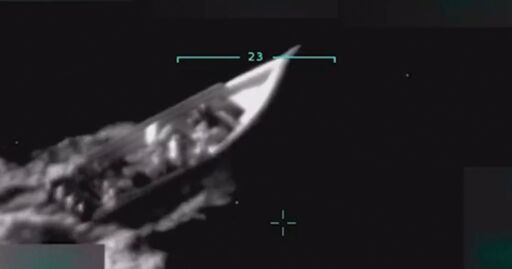
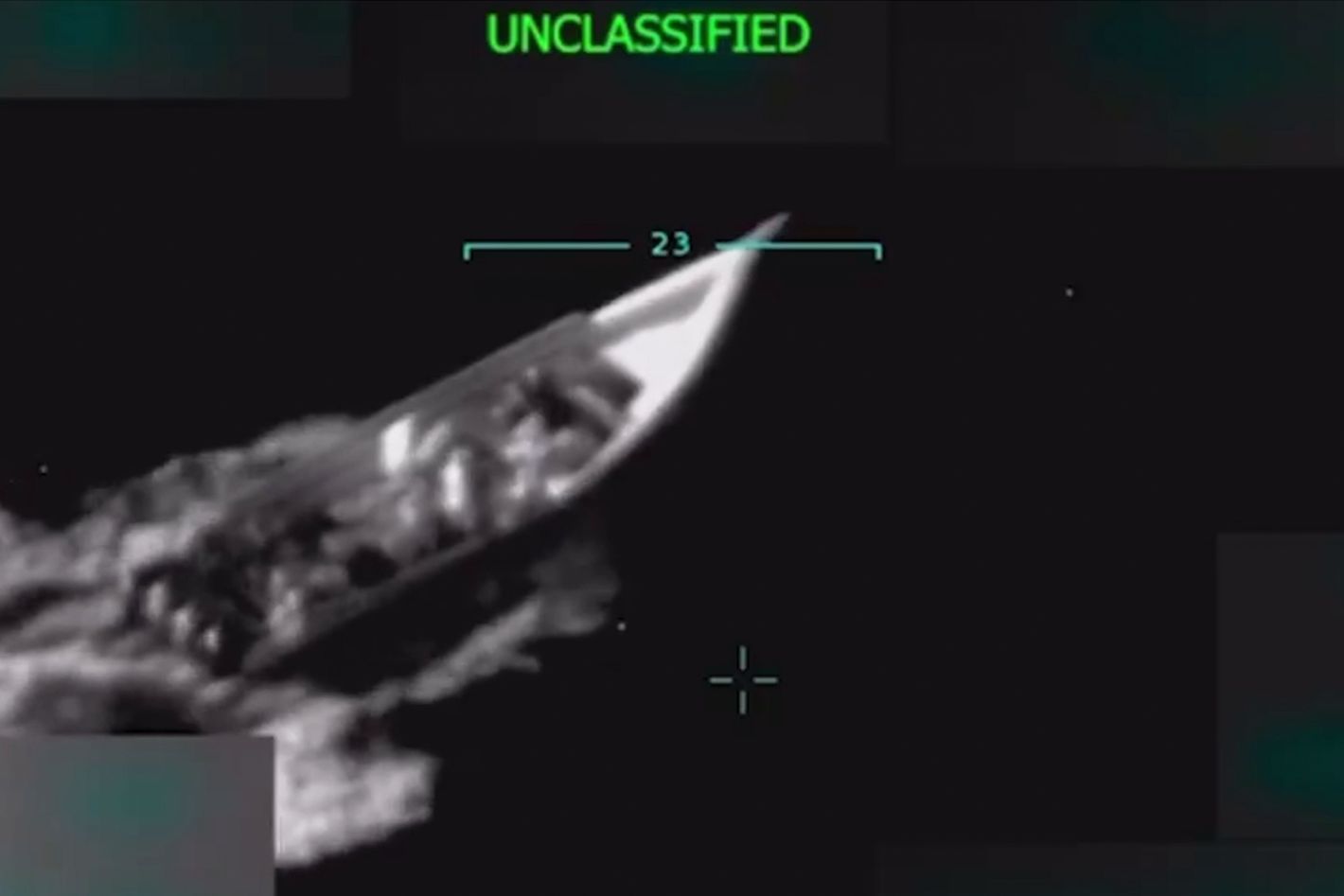
At issue was increased scrutiny of footage of the strike, reportedly showing two survivors of the initial bombing waving at the sky as they clung, shirtless, to the hull of their capsized vessel while Bradley conferred with a lawyer before ultimately ordering the second missile, which killed them. Democratic representative Jim Himes of Connecticut called it “one of the most troubling things I’ve seen in my time in public service.”
The justification for these attacks rests on purportedly stopping illegal drugs from entering the U.S. The Trump administration claims such drugs are weapons foreigners use to kill Americans, though fentanyl, by far the leading cause of overdose deaths in the U.S., predominantly does not enter the country by sea or from South America. But Donald Trump has not tried to obfuscate his ulterior — or, rather, primary — motive: setting the stage for military action against Venezuela, whose president, Nicolás Maduro, he has long sought to depose. Instead, the administration has reconciled these seemingly unrelated objectives by saying it is waging war on narcoterrorists. When Bradley was grilled by lawmakers from both parties in December during classified briefings about the strike, he defended his decision by claiming he wasn’t trying to kill the survivors at all but to destroy the rest of the cocaine the administration still has not offered proof was onboard.
Trump, for his part, appears to be blaming Hegseth — “I rely on Pete,” he said. “I wasn’t involved” — while promising more of the same and worse, announcing that such killings will soon expand to the land. In the midst of the congressional briefings, the U.S. seized an oil tanker off the coast of Venezuela, a provocation the Venezuelan government called a “barefaced robbery and an act of international piracy.” Trump more or less confirmed this assessment when asked what he planned to do with the requisitioned oil: “We keep it, I guess.”
The oblique, often baffling, and increasingly lawless ways in which Trump is trying to get the U.S. military involved in Venezuela have been eerily contiguous with the very national defense status quo he claimed to be turning the page on when he ran for office. Hegseth has clearly played a key role in the president’s embrace of his inner interventionist. A former National Guardsman who served in Guantánamo Bay, Iraq, and Afghanistan at the height of the “War on Terror,” Hegseth first endeared himself to Trump by insisting loudly and often that both the commander-in-chief and U.S. soldiers should be able to get away with basically anything. Despite being an accused sex pest who had allegedly mismanaged several smaller organizations, Hegseth won the Pentagon job in part because he relished the idea of unleashing soldiers against America’s perceived enemies overseas in much the same way Trump does to his domestic opponents. At home and abroad, both men believe simply claiming to be at “war” gives them license to circumvent the law.
In a passage from his 2024 book The War on Warriors, Hegseth recounted telling his fellow soldiers in Iraq to ignore a JAG officer’s legal guidance about whom they were allowed to kill. (“Men, if you see an enemy who you believe is a threat, you engage and destroy the threat.”) As a Fox News host during Trump’s first term, Hegseth lobbied the president to grant clemency to soldiers who had been charged with or convicted of war crimes, including former Army lieutenant Clint Lorance, who in 2012 ordered his platoon to shoot three unarmed Afghans, killing two of them. “He’ll really fight for me,” Trump reportedly told an adviser during Hegseth’s fractious confirmation process, foreshadowing the gleeful propaganda tour the secretary has since undertaken on his behalf. “Under the Biden administration, all four years, 100,000 Americans died from the use of drugs,” Hegseth told Fox News after the September 2 boat strike. “Now we’re sealing the border, but President Trump is willing to go on offense in ways that others have not been.”
The fact that the resulting military campaign is fundamentally insincere makes it no less deadly — or urgent for the president’s loosening grip on power. With his approval ratings trending downward and his party racking up electoral losses as the 2026 midterms loom, Trump has spent months urging the American public to see the solutions to our dissatisfaction in the troops that are patrolling Democrat-run cities and the immigration agents terrorizing Home Depot parking lots. We’re fighting a “war from within,” Trump proclaimed to a crowd of officers in September, the enemy reinforcements for which would now be arriving by sea were he and Hegseth not heroically ordering them slaughtered. Each front in this ginned-up war represents a testing ground for the other. “I told Pete we should use some of these dangerous cities as training grounds for our military,” Trump said at the same event. Hegseth’s national defense policy mirrors the president’s domestic agenda, his attitude of military impunity abroad aligning neatly with the authoritarianism Trump expects us to tolerate at home. That is clearly more important to the president than actually stopping drug smugglers: On December 1, he pardoned former Honduran president Juan Orlando Hernández, who was serving 45 years in federal prison for conspiring to traffic more than 400 tons of cocaine into the U.S. with the same cartels the administration recently designated as terrorist organizations.
Trump’s broader goal is simple — to devise novel ways to empower himself, often via soldiers, at the expense of everyday Americans. And he has correctly identified a less fettered military as one of the few organs of American power he can fully control; a secret memo from the Justice Department’s Office of Legal Counsel is said to have already given the green light to continue the boat strikes. It’s a good thing for him too since the scrutiny of lawyers seems otherwise to be a source of apprehension. The New York Times reported that the administration debated what to do about rescued survivors of its boat strikes, lest they end up in the U.S. judicial system. (The Pentagon has denied this.) If lawsuits filed by survivors make it to court, the administration might actually have to justify the president’s military bombardment, which he is carrying out without congressional approval.
As Trump draws us closer to a full-blown military intervention in Venezuela, it’s important to remember that he is not succeeding because Americans want this conflict, which they do not, or because they see Venezuela as a threat, which they also do not. It’s because nobody is stopping him and Hegseth from exploiting the fact that, dating back at least to the “War on Terror,” there is no meaningful accountability mechanism for the U.S. military during wartime. Now, with troops prowling our streets and missiles lighting up the sky over the Caribbean, Trump’s knack for speaking his own reality into existence has reached a calamitous inflection point. When he and Hegseth go on TV and claim their missile strikes are part of a war that’s already being waged on American soil, it’s one of the rare cases when you can believe them.
More on Venezuela
Marco Rubio Is More Dangerous Than Pete HegsethTrump Wants to ‘Kill People’ Without WarTrump Is Courting Catastrophe in Venezuela
From Intelligencer - Daily News, Politics, Business, and Tech via this RSS feed