

Friends,
I want to repeat a warning I issued a few weeks ago about both AI and crypto.
The question I asked was: What happens when huge amounts of money pour into a poorly understood and unregulated industry that promises spectacular profits for a few winners?
Answer: Many investors lose their shirts while the lucky ones make fortunes. At worst, the bubble bursts and takes the entire economy down with it.
In resurrecting that warning today, my purpose isn’t to worry you but to give you some information that may help you.
AI is worrisome enough as is — its insatiable thirst for energy and water, its capacities to override the wishes of human beings, its potential to destroy the planet.
The immediate concern is that AI is becoming a financial bubble whose bursting will harm lots of innocent people including, perhaps, you.
Anyone remember the dot-com bubble of the late 1990s? The housing bubble of 2006? The tulip-mania bubble of the 1630s? The South Sea bubble of 1720?
They all followed a well-worn pattern.
An asset generates excitement among investors because its value starts rising — mainly because other investors are also becoming excited and investing in it. Investors borrow piles of money to get in on the action.
The bubble bursts when it becomes evident that way too much has been invested relative to the potential for real-world profits.
Smart investors cash out first. Everyone else is left with worthless pieces of paper. Borrowers go broke. Those insuring the borrowers disappear. If bad enough, governments have to bail out the biggest borrowers.
AI has many of the characteristics of a bubble.
Market valuations of its major players — OpenAI, Anthropic, Nvidia, Microsoft, Google, Oracle, Amazon, Meta, and Musk’s xAI — have soared. Most of this is on the basis of hope and hype.
Shares of stock surrounding AI and its data centers account for a huge percent of the returns to America’s biggest corporations so far this year (an estimated 75 percent).
Taxpayers are footing some of this bill. Thirty-seven states have passed legislation granting hundreds of millions of dollars of tax exemptions for the building of data centers.
Stock investors, already nervous about the sky-high valuations of AI businesses, are starting to worry about weakness in the bond market as AI businesses issue a mountain of debt. And the cost of insuring those bonds using credit-default swaps is climbing (anyone remember what happened to credit-default swaps in the 2008 financial crisis?).
Meanwhile, factory construction and manufacturing investments in the rest of the American economy have slowed. Manufacturing has lost tens of thousands of jobs since the start of the year, according to the best data we can eke out of the Bureau of Labor Statistics.
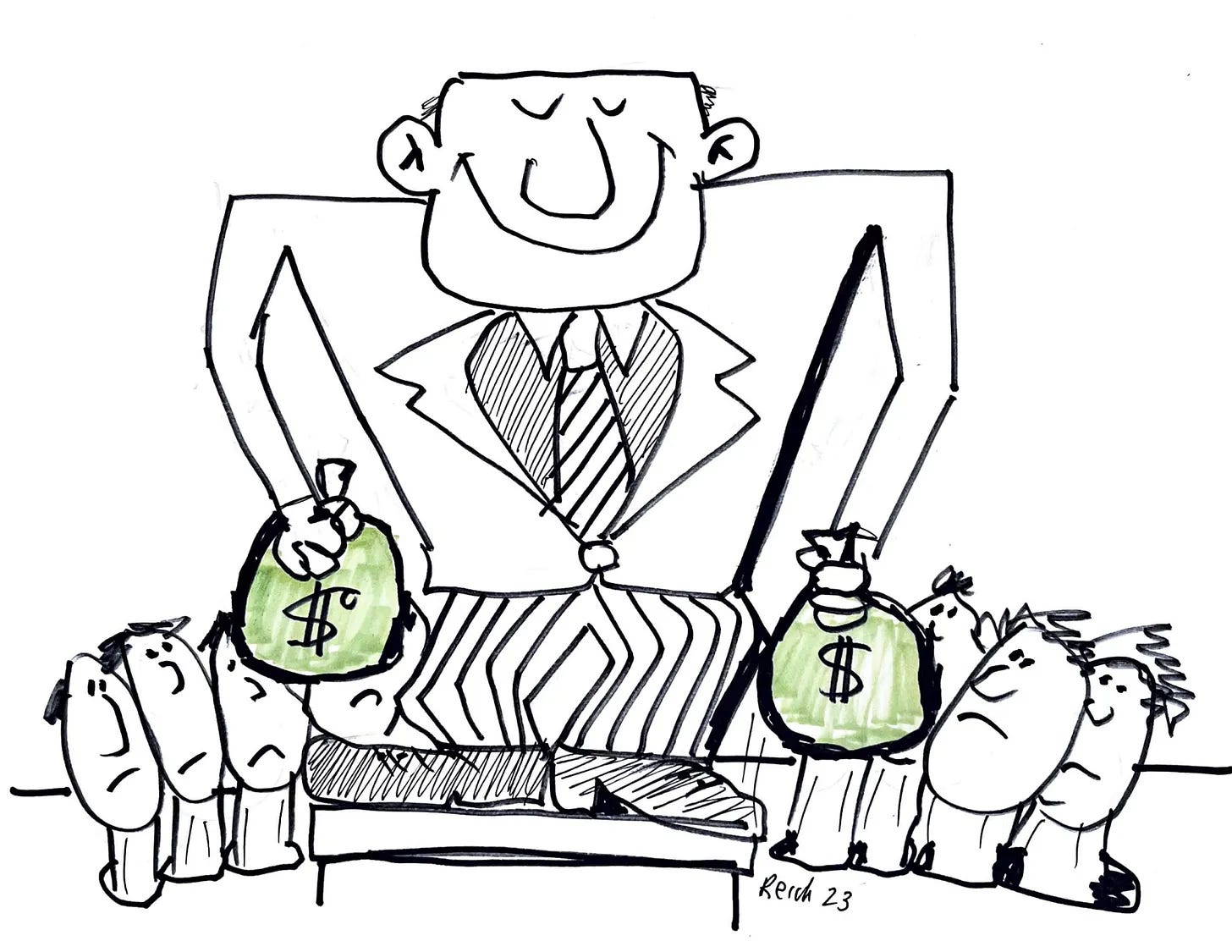
The flood of money into AI has made America’s billionaire oligarchs far richer.
By Forbes’ count, 20 of the most notable billionaires tied to the explosive growth in AI infrastructure have already added more than $450 billion to their fortunes since January 1.
Oracle cofounder and chief technology officer Larry Ellison’s wealth has increased $140 billion in the past year, as Oracle’s shares jumped 73 percent (compared to 15 percent for the entire stock market). This was due to projected revenue from Oracle’s cloud infrastructure to power AI.
The Ellison family is pouring some of this wealth into a media empire aligned with Trump.
The wealth of Nvidia cofounder and CEO Jensen Huang has increased $47 billion this year as shares of his chipmaking giant have risen 40 percent.
Will the AI bubble burst? The burst may have already begun.
Oracle is carrying more debt than ever, issuing another $18 billion of debt in September. The S&P’s credit rating bureau downgraded its outlook for the company to “negative” in July, citing concerns about free cash flow.
Other major players are also deep into debt.
Frankly, I don’t care which giant corporations or ultra-wealthy investors strike it big and which lose their shirts.
I worry about the economy as a whole — about working families who could lose their jobs and savings. The losses when the AI bubble bursts will ricochet across America.
Trump has put David Sacks, co-founder of an AI company and, of course, a fierce Trump loyalist, in charge of AI and cryptocurrencies. So far, Sacks has killed any restrictions and regulations that might stand in the way of either.
The Trump regime has been opening the doors for trillions of dollars in pension funds to be invested in AI, crypto, venture capital, and private equity. Even 401(k) plans have joined the flood.
Crypto is my second bubble concern. It’s a classic Ponzi scheme. It’s growing because investors believe other investors will keep buying it. And like AI, crypto’s meteoric growth has also been powered largely by the ultra-wealthy.
Trump and his family are said to have made $5 billion off it so far. Small wonder: An investigation by the New York Times found that the S.E.C. has eased up on more than 60 percent of the crypto cases that were proceeding when Trump returned to the White House. The agency has paused litigation, lessened penalties or outright dismissed the cases — often in ways that benefit those with ties to Trump.
Under Trump, S.E.C. dismissals came at a far higher rate for crypto firms than other cases. And although the particulars of the crypto lawsuits differed, many of these firms had something in common: financial ties to Trump, the self-described crypto president.
But Trump’s regulatory sweetness to crypto contributed to the crypto bubble.
Like AI, crypto uses up massive amounts of energy but doesn’t actually create anything.
Consider the online brokerage firm Robinhood, whose stock rose 284 percent in the year through September. What fueled this extraordinary increase in value? Trading in cryptocurrency and in betting on sports games.
Crypto tokens are even being sold as ways to get pieces of private firms like SpaceX and OpenAI.
Watch your wallets.
When will the crypto bubble burst? Maybe it’s already started.
Crypto tokens have lost more than $1 trillion in market value since their October peak, according to Deutsche Bank. This has generated fears that the rest of the crypto bubble will burst.
The recent sharp downturn in crypto values has exposed the huge amount of borrowing behind crypto’s nine-month rally, which began after the election of an administration seen as friendly to the industry.
**
The flood of money into these two opaque industries — AI and crypto — has propped up the U.S. stock market and, indirectly, the U.S. economy.
AI and crypto have created the illusion that all is well with the economy — even as Trump has taken a wrecking ball to it. When the AI and crypto bubbles burst, we’ll likely see the damage Trump’s wrecking ball has done.
Again, I’m not writing this to alarm you. You already have more than enough reason to be alarmed by what’s happening to America.
I want you to take reasonable precaution.
This isn’t an investment letter, but if you have savings, please make sure some are in low-risk assets such as money-market funds. As to your job, hold on.
From Robert Reich via this RSS feed
You must log in or # to comment.