


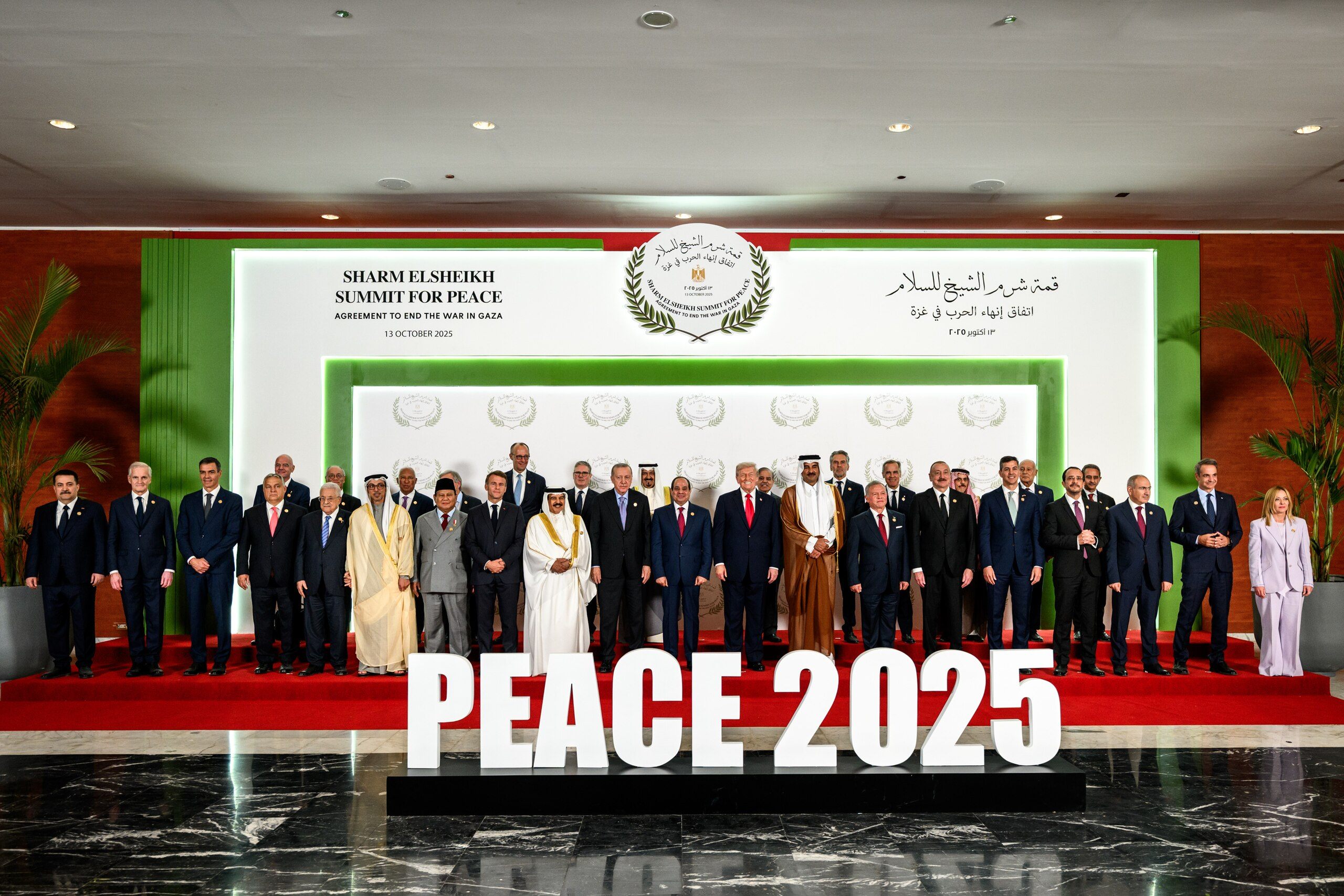
Photograph Source: Daniel Torok – Public Domain
Francis Wheen concludes his excellent biography of Marx with the old rascal’s death on March 14th 1883, an event barely acknowledged in the London Press. In the absence of an obituary, Wheen looked to Marx’s personal life, to his intimate disclosures, for some private assertion to stand as a fitting testimonial. Some years earlier, when Marx was asked by his daughters to name the worst human vice, one might have expected this life-long enemy of capitalism to have responded with ‘avarice’, or ‘oppression’ or some other feature evinced by the exploitative class, but actually it was ‘servility’ that he singled out for opprobrium.
Many of us probably felt something similar when we watched the Pakistan Prime Minister’s oleaginous address to Trump at the recent Gaza ‘Peace’ Summit. In fact, so gratuitous was Shehbuz Shariff’s fawning presentation, as he oscillated between hailing the gifts of this peace-loving wonder-worker and checking back for Trump’s response that even the European vassals looked embarrassed. Apart from Starmer that is, who made ready to applaud as Shariff crescendoed, only to pull back to an embarrassed self handshake when he realised he was on his own. It was the same week that the Nobel Peace Prize – went to Maria Corina Machado – a former Venezuelan politician who had asked for her country to be invaded by a genocidal regime. Presumably that wasn’t the reason she was selected, but it is impossible to know these days. And maybe that’s the point of these extravagant excesses: to deflect our attention from more sober compliances as constitutions, judiciaries, sovereign states and even international institutions like the UN and ICJ all bend themselves to the bidding of the hegemon.
Starmer may not appear much on the international circuit, but at home he’s been most effective in protecting the interests of Western hegemony. Not only has his government provided Israel with full support for its genocide in Gaza. But it has also established an astonishing legal precedent by proscribing a non-violent protest group as a terrorist organisation and inaugurating thought crime as an arrestable offence. To date, almost 3000 citizens have been arrested as terrorists simply for writing a sentence in Palestine Action’s support. And just when you thought executive overreach could not get any worse, last week the government effected a last minute judge-switch in the proscription’s Judicial Review hearing. Justice Chamberlain – the former sole judge who was familiar with all aspects of the case and had approved the hearing was unexpectedly removed the day before and replaced with three judges unfamiliar with the facts but presumed to be closer to the government’s views. You might have imagined headlines of ‘Stitch up’ and editorials about our ‘Slide into a Police State’ or even some comment about the implications for protest and civil liberties. But there was nothing of note. I don’t believe any mainstream journalist even attended the hearing.
It was Edward Said who drew attention to the relationship between Culture and Imperialism in his 1993 book with that title. Said wanted to show how the wealthy western metropole culturally reconciled itself with the violence and oppression meted out in its colonial spaces, which in 1914 comprised 84% of the planet. Because, as Said points out, the contest for land and resources wasn’t just about armies; it was “also about ideas, forms, images and imaginings.” And it was those ‘cultural forms’ that constituted the ‘mental element’ of western imperialism that Said wanted to bring to light. And he wanted to do that because he recognised that western imperialism is an ongoing process and just as the Victorian novel acted as a ‘cultural palliative’ enabling that society’s aggressive adventuring to be managed back home, similar cultural expressions today provide the same function. So it was in Nazi Germany when subsidised radio sets were provided to ensure that the subtle war propaganda – emphasising Germany’s fight for traditional western values – always bracketed between light entertainment and music – could be comfortably consumed. The essential point being, as Said emphasises, that it was not what was said that mattered, more often the most effective messaging was contained in what was left out.
As we see today regarding the ‘cultural forms’ relating to the genocide in Gaza which is portrayed as a sudden explosion of inexplicable violence rather than as an ongoing anti-colonial struggle for freedom. Compare that with the war in Ukraine, which the British populace are encouraged to get behind. Primarily because the defeat of Russia would further European imperialist ambitions and enable it to prop up the failing capitalist economy whereas the establishment of a free Palestinian state would signal the end of western influence in that region.
However, the most noteworthy cultural response to the Gaza genocide here in the UK has been a renewed, largely right-wing, emphasis on the importance of ‘Traditional Western Values’. Such calls might appear superficial, even hypocritical given the collapse of International law, the UN, the Genocide Convention and commitments to human rights generally, but such post-war international institutions are not deemed relevant by those encouraging a re-engagement with something more historically distant, nominally Christian and predominantly white. ‘Tradition’ has always been the repository of authority, legitimacy and, most importantly, stability. It has also invariably been contrived and fake and utilised for the purpose of stewarding the masses, as it is being so used now at this important geo-political juncture.
In his 1983 book on historical theory: The Invention of Tradition, Eric Hobsbawm defines tradition as ‘ a set of practices governed by rules of a ritual or symbolic nature which seek to inculcate certain norms, values and modes of behaviour which automatically imply continuity with a suitable historic past.’ And he explains how in the modern era, traditions – particularly those relating to the monarchy and those in the upper echelons of power – were often invented in order to acquire from the masses their symbolic assent to the de facto inequality evident in society.
The English tradition is undoubtedly perceived to be one filled with images of ancient lineage, opulent ceremonies, charismatic leaders, and all sorts of pageantry and pomp. Which is exactly the pseudo-feudal template the British transplanted onto India when it was part of its Empire, complete with made up heraldic crests, trumpeting minstrels, gun salutes, awards ceremonies and endless processions. There was even an order of Knights: The Most Exalted Order of the Star of India, created for suitably loyal Indian Princes – and rescindable in the case of transgressions. Barely an aspect of Indian life, from architecture to education to the production and curation of Indian art – what the British deemed of value – that escaped the demi-urge like talents of the British establishment. But fundamentally it was political theatre: an elaborate, visually stunning, multi-layered myth – with as much pompous ceremony as its choreographers could shoehorn in – created and sold to the newly subjugated elites. As Viceroy Lytton concluded at the time, ‘the further east you go, the greater becomes the importance of a bit of bunting.’
Tradition relies on myth and illusion, on the power of the imagination and on endless repetition, but ultimately it is just a mechanism for reconnecting with the past, because it is the past which is seen as the fount of legitimacy. Which is ultimately why the faux feudal system failed in India once Ghandi and other liberationists started to resist the imposed British ‘traditions’. However, according to English historian J.H. Plumb, in his appropriately titled work ‘The Death of the Past’, published in 1969, the past is no longer “the handmaid of authority” as it once was, because that particular source of legitimacy has run its course. Increasingly, it is the future and not the past that wields power over our present which suggests that the recent appeals to ‘Tradition’ evoked by today’s panicked elites trying to rally the polity to their cause probably won’t work ultimately, and authority – whatever form it takes – will need to seek its validation elsewhere, if it can.
According to Plumb, “the acquisition of the past by the ruling and possessing classes and the exclusion of the mass[es]…. is a widespread phenomenon through recorded time.” Or, as classicist Hugh Lloyd-Jones – quoted by Plumb- puts it, “all history is the history of a ruling oligarchy.” Historically it is how the property-owning class has protected its interests and maintained its authority over a state founded on the fundamental contradiction between freedom and inequality. As Marx points it in the Grundrisse “distribution is not determined by production, but the opposite, production by distribution.” Because the distribution of land and other wealth-producing assets was determined by the laws of the state prior to capitalism, and continues to be so maintained by them. It is this antecedent privilege of ownership which is obfuscated by the emphasis on laissez-faire economics which had no part to play in that prior distribution. As both Hobsbawm and Plumb point out in their respective works the past has been used to educate the masses into accepting their de jure inequality – by inculcating servility – largely dressed up as pride in the accomplishments of an imagined past – as a societal norm. And it is this well-ploughed tradition of subservience that today’s Imperialist elites are attempting to tap into once again.
Evidence of working class servility is easily found in the history of the British Labour Party who, even in power, proved incapable of freeing themselves from the shackles of deference.[1] Notwithstanding the fact that as elected officials they were drawn from poverty-stricken constituencies, once inside those august halls of power these new parliamentarians seemed to forget their socialist obligations and succumbed to the burdensome pomp. Between the two great wars the British working class suffered considerable hardship manifested in mass unemployment, hunger marches, strikes and mutinies and yet the radical leftist voices demanding fundamental change were ignored or even silenced by their own political party. Ramsay MacDonald, the first Labour Prime Minister set the tone with his insistence that rather than form a socialist party, Labour was on “a journey towards socialism”. It was a move that undoubtedly pleased the property-owning class, who viewed the presence of a Labour party in parliament more as a safety-valve than as any kind of threat. As Arthur Balfour, the former Tory Prime Minister observed, “Social legislation is not merely to be distinguished from socialist legislation but is its most direct opposite and its most effective antidote.”
Former Liberal MP, Hilaire Belloc agreed, but thought the consequences of such social reform would be disastrous for the working class and would effectively turn the country into a Servile State.[2] Writing in 1911 Belloc predicted that what was “approaching [was] a society in which the Capitalist class shall be even more powerful and far more secure than it is at present; a society in which the proletarian mass shall change their status, lose their present legal freedom and be subject to compulsory labour”. Belloc’s politics were Distributist – meaning that he believed that only a re-adjustment and sharing of the ownership of wealth-producing assets could save the country from that fate. But he thought such radical socialist reform unlikely. Because once the state had launched itself on the road of social and welfare policies and educated the masses to think in terms of opportunities given them for employment and security rather than the return of what was stolen from them in the form of land and resources, he believed it would be impossible to reverse direction; the working class would have ‘lost their memory of freedom’.
And the shift to institutionalised servility would come, he believed, because the fundamental contradictions on which capitalist society rested and which threatened to destabilise it would have to be resolved one way or the other. Either inequality would be resolved and a redistribution of assets would occur, or, more likely, there would be a response to the illusion of political freedom and positive law would intercede to negate that status. And the reason Belloc believed that this fundamental contradiction would ultimately come to light was because of what he identified as ‘the moral strain’ of trying to maintain stability in a society precariously balanced “between the realities of Capitalist society and the moral base of our laws and traditions.”
However, the real price paid for servility is not the grotesque obeisance observable in society or even the deepening inequalities, but the corruption of thought itself. Since it is by shackling one’s autonomy to that of another that intellectual freedom is sacrificed. But, because that ‘shackling’ is so interior to the person, having become so normalised as to be seen as part of their identity as a citizen, an individual, a subject in the general community, that it is not noticed as any kind of restraint at all. As Marcuse explains in his Study on Authority, in which he traces the philosophical origins of the Bourgeois conundrum between protecting private property whilst acknowledging the freedom of the individual, “The recognition of authority as a basic force of social praxis attacks the very roots of human freedom – it means the surrender of autonomy (of thought, will and action) the tying of the subject’s reason and will to pre-established contents, in such a way that these contents do not form the ‘material’ to be changed by the will of the individual but are taken over as they stand as the obligatory norms for his reason and will.” Put simply, prejudices are inculcated as a basic social norm. And the effect of those prejudices – which need to be secured through the constant production and reproduction of a suitable social reality – is to put beyond consideration the fundamental inequalities on which society is based.
Thus, “freedom and unfreedom are yoked in the same person” asserts Marcuse, as the topic of private ownership is turned from a reality into a non-negotiable a priori concept. At the same time society is presented as a community of free individuals sharing mutual subordination before the law. Marcuse also notes, following Hegel, the importance of society’s origins and purpose being perceived to be otherworldly and mythical, thus imbuing its members with some distracting transcendental significance. ‘It was essential for the constitution to be seen not as something made but as something simply existent in and by itself, as divine and constant, and so as exalted above the sphere of things that are made.”[3]
Back in 1993 Said saw himself writing about the connection between culture and imperialism for a ‘globally dynamic society’, perhaps imagining that the west was coming to terms with its colonial past. He rejected Samuel P. Huntington’s ‘Clash of Civilisations’ thesis which came out the same year because he didn’t accept that the collapse of the west’s imagined universality would result in the formation of distinct cultural or civilizational groups. For Said the modern world was inescapably fluid and mobile and he didn’t see how cultures could isolate themselves from each other. However, they both saw that international politics had now ‘moved out of its western phase’ and that the colonised peoples of the world who had formerly been the ‘objects’ of history were now its ‘movers and shapers’, as Huntington put it. But what of the working class of the colonising nations; have they not been objects of history too?
In Culture and Imperialism Said baldly states that the working class were largely pro-imperialist. Given the enticing power of Tradition and the way the past has been used to educate and direct the masses, it would be surprising if they were not. As Plumb points out, particularly with regard to British history which was sold as both a moral and political exemplar, the past’s educational uses have been suitably varied according to the audience – ‘jingoistic for the mob, more subtle versions for academics and as a source of comforting nostalgia for the bruised egos of the middle classes.’ But it would be wrong to conclude that because the working class fell in line with directions regarding their nation’s history that they are the beneficiaries of its imperial pursuits. After all, it was the English farmers and small holders who were the first to be dispossessed by the capitalist class – evicted from their land and reduced to poverty. It is no accident that Jeremy Bentham’s plans for the corporate management of paupers in the UK – ‘Pauper Management Improved’ – was modelled on the workings of the East Indian Company’s management of natives abroad.
All of this took place at the beginning of the industrial revolution and is what enabled it to flourish. As Economist, Michael Perelman states in his study of the beginnings of capitalism in Britain, “No society went so far as the British in terms of primitive accumulation,”[4] i.e., obtaining resources for free. We tend to associate primitive accumulation with the colonies, with the extraction of material resources and the exploitation of the indigenous people. But actually, it happened at home too. The reason being, as Police Magistrate, Patrick Colquhoun, – just one of many quoted by Perelman – pointed out in 1815, because poor people are necessary for capitalism to grow: “poverty is a most necessary and indispensable ingredient…without which nations and communities could not exist in a state of civilisation. Without poverty there would be no riches, no refinement, no comfort and no benefit to those who may be possessed of wealth.” How could self-sufficient farmers living in thriving supportive communities be forced into wage slavery unless they were deprived of their freedom and independent livelihoods and those communities destroyed? Which is precisely the wrong Distributism aimed to redress and why Belloc wrote The Servile State.
Said acknowledges that Imperialism is a cycle – and suggests that how its ‘residue’ is understood and interpreted is a reflection of changes in the wider world. A major change since he wrote that work has been the collapse of the west’s economic and social power and the emergence of a multi-polar world. What is yet to be seen is whether the emancipatory politics of former colonised nations will inspire similar ideas in the west, as new anti-imperialist alliances form. Certainly, the growing resistance to Zionism is having a global effect as populaces everywhere are dividing over their governments’ pro-genocide policies, which is no doubt why support for that particular ideology is now explicitly included in the Tradition/Imperialist couplet promoted by flailing western elites. However, with western governments beginning to repress and imprison citizens who oppose Zionism,[5] the ‘moral strain’ identified by Belloc looks greater than ever. And as those states continue to lean towards authoritarian solutions for their stability problems, it seems difficult not to agree with the conclusion of English radical Thomas Spence, who presented a talk on the redistribution of wealth at the Newcastle Philosophical Society in 1775 and was promptly expelled for it, that “It is childish to expect to see anything else than the utmost screwing and grinding of the poor, till you quite overturn the present system of landed property.”
Notes.
[1] Ralph Miliband, Parliamentary Socialism – A Study in the Politics of Labour, 1961
[2] Hilaire Belloc. The Servile State, 1912
[3] Marcuse A Study on Authority, 1936
[4] Michael Perelman – The Invention of Capitalism: The Secret History of Primitive Accumulation, 2000
[5] In the UK there are now 8 Palestine Action prisoners on hunger strike, protesting the fact that they have been held on remand for over a year, despite the fact that their offences amount to nothing more than criminal damage.
The post Servility and Traditional Western Values appeared first on CounterPunch.org.
From CounterPunch.org via this RSS feed
You must log in or # to comment.