

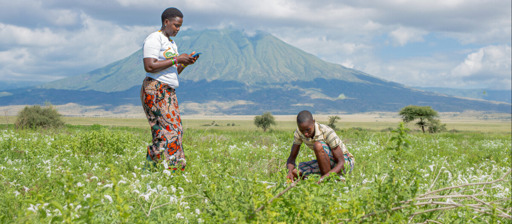
Pastoralists in rural Tanzania have been recognized globally for applying a blend of local knowledge and new technology in efforts to restore degraded land and provide pasture. The community-led project dubbed Sustainable Rangelands Initiative, developed by African People & Wildlife (APW), won in the NatureTech Stewards category at the inaugural IUCN Tech4Nature Awards, held during the IUCN World Conservation Congress in Abu Dhabi last October. The Sustainable Rangelands Initiative (SRI) has been implemented in Northern and Central Tanzania, in Simanjiro, Babati, Longido, Same, Monduli, Ngorogoro, and Mwanga districts. APW’s Director of Community Conservation and Environment Neovitus Sianga says this was because the areas are crucial for livestock and wildlife activities. Under this initiative by APW and the local community, local grazing committees and trained community grassland monitors use mobile phones to collect information about water sources, vegetation cover, grass growth rates, soil health and invasive species. Nasma Mustafa, a Rangeland Monitor from Engaluka Village, describes the key steps: “We use a measuring tape, a rope and a phone. The rope is stretched over 100 meters on the ground, at the same level with a measuring tape with five marks. We then observe which of the five marks touches vegetation and which ones touch bare ground. The information collected is transferred to a form through phones. This is repeated until a targeted area is covered. The collected data is transmitted to the community grazing committee for further steps.” The data is channeled to central village level technology centers and used to…This article was originally published on Mongabay
From Conservation news via this RSS feed
You must log in or # to comment.