

Today, the UN Educational, Scientific, and Cultural Organization (UNESCO) released its quadrennial report on World Trends in Freedom of Expression and Media Development. What follows is a lightly-adapted version of the contribution on climate disinformation I was invited and honored to make. It seems especially salient towards the end of 2025, in which the Trump administration has removed access to climate information, replaced it with disinformation, derailed the National Climate Assessment, ignored and fired a broad range of experts, and sought to undermine public trust in the utility of expertise. As the UN Special Rapporteur on Climate Change in the Context of Human Rights has put it, “protecting the right to science is a collective imperative” that is undermined by disinformation.
One bright spot from COP30 was the launch of the Declaration on Information Integrity on Climate Change, which 20 countries from Austria to Uruguay have now signed. Here’s to a 2026 in which we continue to fight for that right, ever more effectively, together.
Silencing science
As the Earth continues to warm [primarily because of human activity] and the impacts on our climate grow increasingly severe, the science that seeks to warn and guide us is being silenced. Powerful global leaders and major corporations are ignoring or denying science in a deliberate attempt to mislead the public and delay urgent action needed to protect the planet’s habitability.
While the evidence is clear, some are working hard to undermine public understanding of it, often via online harassment or disinformation. Here is an example from 2024: In June 2024, a climate denier with more than 150,000 followers attacked ‘climate hoaxers’ for suggesting heat waves are getting worse. He used temperature data from only one country in North America to deceive the public about a clear global trend that the country is also experiencing.
Just a few days later, an extreme heatwave over nine days affected almost five billion people worldwide, a heatwave made at least three times more likely because of global warming.
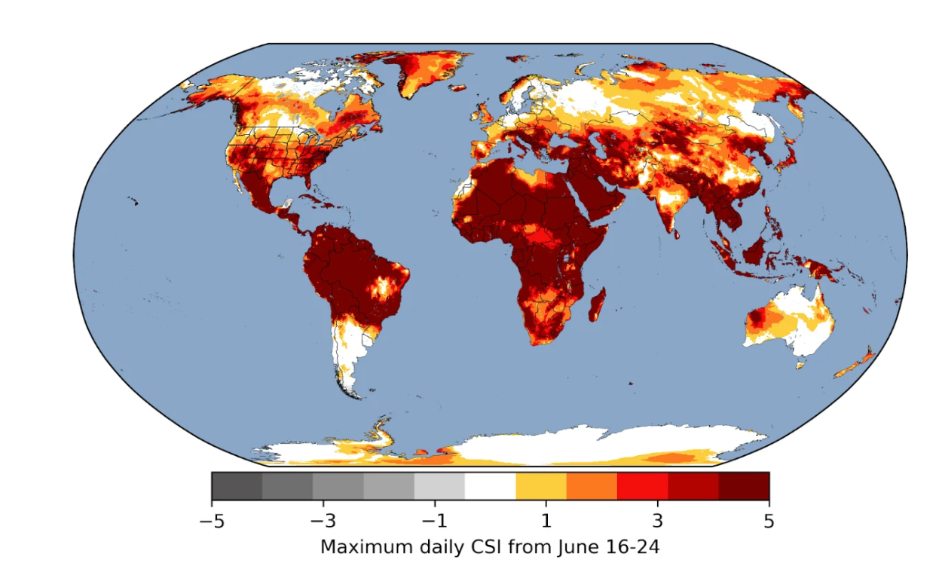
Figure 1. Highest daily Climate Shift Index® values reached in each location during June 16 – 24. The Climate Shift Index indicates how climate change has altered the frequency of daily temperatures in any location around the world, every day. Analysis: Global Extreme Heat in June 2024 strongly linked to climate change.
Meanwhile, accurate information about the climate is becoming increasingly difficult to find. For example, governments in North America and Latin America over the last 15 years have removed climate resources from their websites or have discredited scientific findings. Examples from 2025 include the removal of climate risk assessment tools, agricultural adaptation guidance, and national climate reports. Even long-standing databases on extreme weather and its economic impacts have been taken offline. This has forced researchers, farmers, and the public to rely on archived copies or independent institutions to access information that was once openly available.
The suffering
This is a story about human suffering from global warming, specifically from extreme heat; the pace of scientific progress; the motives, means, and accomplices of those who thwart climate action and undermine information integrity; and the silencing of science.
More than 60% of the world’s population experienced prolonged extreme heat in 2024. The World Health Organization cites the 2024 Lancet Countdown on Health and Climate Change finding that “Heat-related mortality for people over 65 years of age increased by approximately 85% between 2000-2004 and 2017-2021.” [The 2025 Lancet Countdown is now available.]
The state of the science
The current and projected impacts of global warming are based on a body of research conducted over decades, which has established a strong scientific consensus.
In 1995, the second Intergovernmental Panel on Climate Change (IPCC) report concluded that “the balance of evidence suggests a discernible human influence on global climate.” An April 2025 article in the journal Nature linked the emissions from specific sources to the economic burden of extreme events, finding that “between $791 billion and $3.6 trillion in heat-related losses over the period of 1991 to 2020” were caused by a single integrated energy company.
In only 30 years, climate science has advanced from being able to discern human influence on global climate to being able to calculate the cost of one specific impact (heat) caused by one company’s emissions. Humans are influencing the climate, and we even can trace those impacts to the emissions of specific fossil fuel companies. This is the state of the science that climate deniers seek to silence.
The motive
The danger that everyone is facing is largely due to the fossil fuel industry and their allied political and corporate interests, who kept their own science from the public while conducting strategic campaigns to block policy change.
In a 2023 paper in the peer-reviewed journal Science, Dr. Geoffrey Supran and his co-authors wrote that “In private and academic circles since the late 1970s and early 1980s, scientists employed by one of the largest integrated fuels, lubricants and chemical companies in the world predicted global warming correctly and skillfully,” while in public, the company “worked to deny [global warming] – including overemphasizing uncertainties, denigrating climate models, mythologizing global cooling, feigning ignorance about the discernibility of human-caused warming, and staying silent about the possibility of stranded fossil fuel assets in a carbon-constrained world.”
The evidence that fossil fuel companies silenced their own high-quality science in favor of efforts to confuse the public and block policies that would require them to change their business model is also growing stronger.
The means
The efforts of corporate, political, and other allied interests to deny climate science, deceive the public, and delay action already have caused real-world harm. In different countries around the world, corporations and politicians deploy the “disinformation playbook” against science-based policymaking. A process that allows science to inform policy has three stages, but each of these stages faces a predictable set of disinforming tactics designed to undermine policy action (Figure 2). Indeed, many of the same people previously tailored and deployed the disinformation playbook on behalf of the tobacco industry.
Research from the Union of Concerned Scientists and others demonstrates that the fossil fuel industry has used every tactic in the disinformation playbook:
Hiring a scientist who used discredited methods and did not disclose industry fundingManufacturing doubt by exaggerating uncertainties in climate change science and targeting teachers and studentsHarassing climate scientistsBuying credibilityManipulating government officials
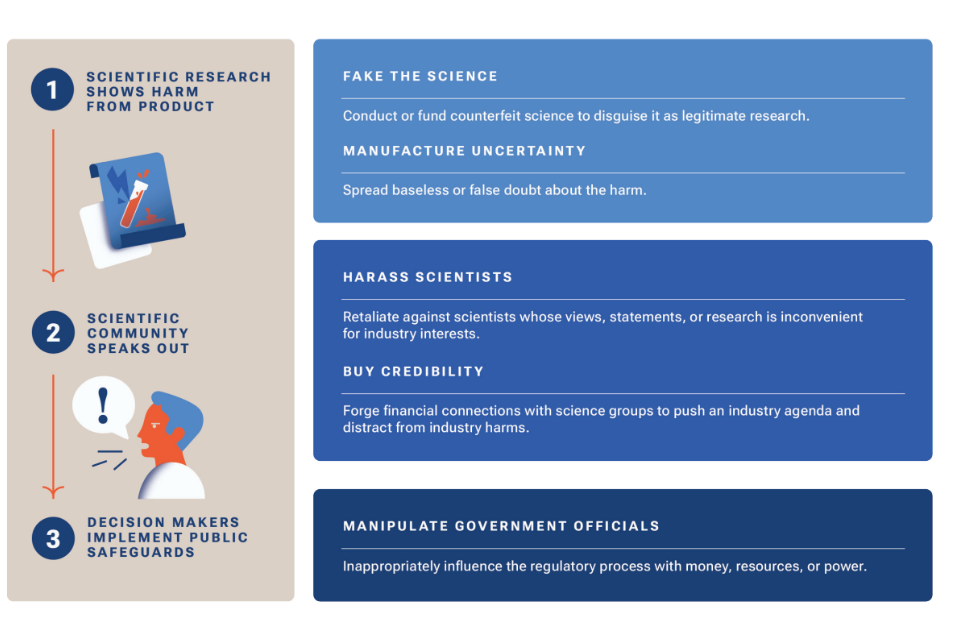
Five tactics used by industry to undermine science. The disinformation playbook tactics are employed by industry during the scientific process and the science-based decision making process. Adapted from a peer-reviewed journal article written by current and former UCS staff: The Disinformation Playbook: How industry manipulates the science policy process—and how to restore scientific integrity.
The accomplices
Social media platforms and online search engines join the fossil fuel industry in profiting from spreading climate disinformation to capture users’ attention and sell more advertising. An interactive database launched in April 2025 found that climate denier posts grew by 24% on one of the largest online video sharing platforms from 2021 to 2024. Claims that climate policy is an instrument of control now represent around 37% to 40% of climate denier posts on different platforms.
The silencing
Industries that are responsible for most of the world’s global warming emissions have not silenced merely their own scientists. They influence and obstruct academic and government research, as well. In some countries, they hold sufficient sway over elected officials to undermine scientific agencies and funding and to block or roll back policies that support greenhouse emissions reductions or measures to adapt to climate change. And in many cases, they fund or are otherwise affiliated with the owners of social media accounts that regularly cast doubt on clear science and attack scientists and the scientific enterprise.
In 2023, the public interest group Global Witness published a survey of climate scientists that revealed “online harassment and abuse against them imperils their work and ways of communicating.” Two graphs from that study illustrate the attacks on scientists’ credibility and the negative impact on their productivity.
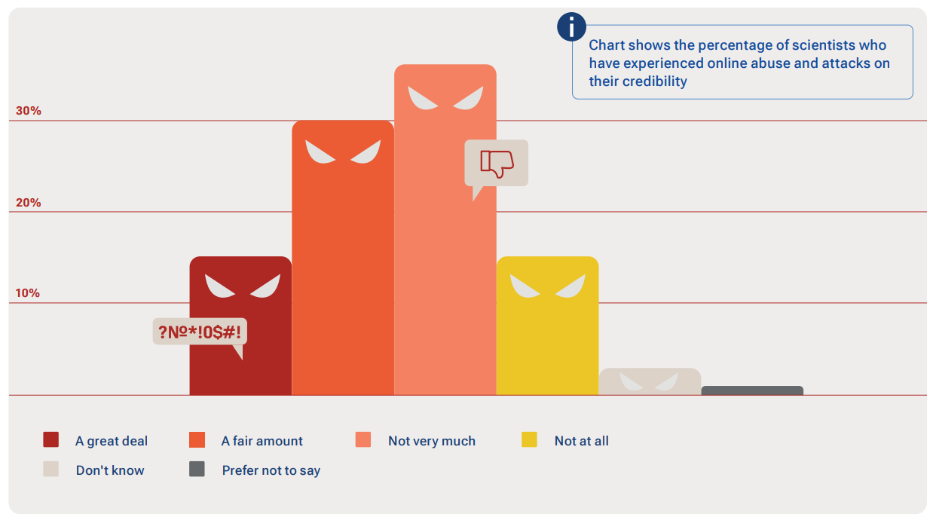
Targeting of credibility. Chart shows the percentage of scientists who have experienced online abuse and attacks on their credibility. Adapted from Global Hating: How online abuse of climate scientists hinders climate action.
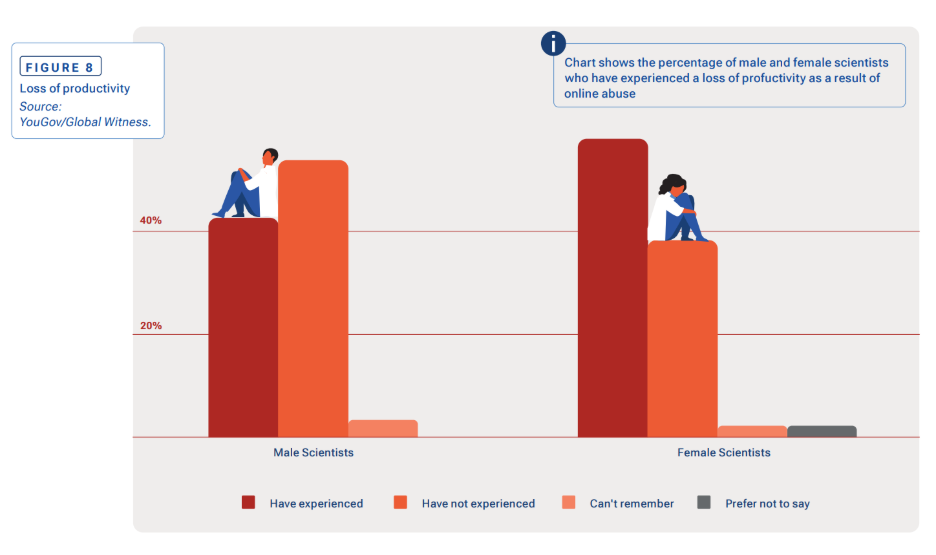
Loss of productivity. Figure shows the percentage of male and female scientists who have experienced a loss of productivity as a result of online abuse. Adapted from Global Hating: How online abuse of climate scientists hinders climate action.
So, what is next?
Action to promote information integrity anywhere supports climate progress everywhere. In September 2024, the UN launched the Global Digital Compact to bridge digital, data, and innovation divides. Soon after, at the G20 in Rio de Janeiro, the UN, UNESCO, and partner nations introduced the Global Initiative for Information Integrity on Climate Change. It seeks to restore trust in science, hold social media platforms and search engines accountable, and help journalists understand the disinformation playbook. Such multilateral initiatives are a positive step toward reducing the capacity of climate deniers and their allies to block progress toward a more just and safe future.
From The Equation via this RSS feed
You must log in or # to comment.