

“What a terrible thing it is,” said Donald Trump, “And all we can do right now is pray for the victims, and for those that were very badly hurt.” Such was the president’s reaction to the mass shooting at Brown University. We are inured to these clichéd formulations. But they are an essential element of a regime change from the rule of law to the rule of blood. The president’s statement is a betrayal of the very purpose of government and a confession of indifference to that purpose.
Of course there are things that the president, personally, could do. He could fire the incompetent people he appointed to run our national police service, the FBI, and replace them with competent people. He could personally stop lying, and tell his people to stop lying, about the existence of an all-powerful antifa conspiracy. That ridiculous fiction diverts the resources of the FBI and other agencies away from actual domestic terrorism threats. He could order the FBI and other agencies to prioritize domestic terrorism, rather than eliminating the relevant units and sending their personnel to back up ICE.
He could propose gun control legislation that aims to restore the status quo before the era of mass shootings began, which would include a ban on assault weapons. He could do all of these things. He could have done all of these things in the hours after the shooting. He won’t do any of them, of course.
Yet issue here is deeper than Trump. The notion that all elected officials have are their thoughts and prayers, regardless of by whom it is uttered, is a direct attack on the purpose of government itself. It is not a response to the anarchy of gun violence. It is a normalization of it and one of the preconditions to its repetition and spread.
The gesture towards divine power invokes an American taboo – we are not to criticize anyone who invokes God, no matter how obviously hypocritical and self-serving, as in this case. The taboo, once summoned, prevents us from seeing the obvious, fundamental thing: a basic reason that we have government is to prevent us from becoming a society in which we simply shoot one another all the time.
That is a strand of the tradition that leads to the rule of law. Without law, every conflict is regulated individually, with whatever tools come to hand. With the advance of technology, this becomes ever more problematic. Government, for example the kind established by the United States Constitution, is designed to extend law such that both “the blessings of liberty” and “domestic tranquility” can be preserved. Law brings freedom and security together at a higher level than we can achieve as individuals without it. This means, though, that we concede the monopoly on violence to the government.
In order to have a constitutional order, in other words, we accept a strong presumption against the use of violence, and reserve it for law enforcement and national defense — as necessary. We accept that it is wrong to hurt and to kill others. As a result, we are all both more secure and more free than we would be otherwise. This entire version of politics depends on the idea that violence, unlike for example art or commerce, is not part of the private sphere of life. There cannot be a right to kill someone else, or a right to make money by enabling murder.
This logic, unfortunately, has been lost. Mass shootings serve as advertisements for the gun industry. The NRA, the gun industry lobby, portrays mass killing as a reason why more people should own guns. Like other industries, its concern is to sell its products, which are marketed through anxiety as emblems of safety.
Guns are an unusual product. When you study economics, you are taught that there is a balance between demand and supply. Demand is supposed to match supply. But in the case of guns, the supply creates further demand: the more we kill one another, the more Americans decide that they need guns to protect themselves. When a president says that all that he can do is pray, then what else are people supposed to conclude?
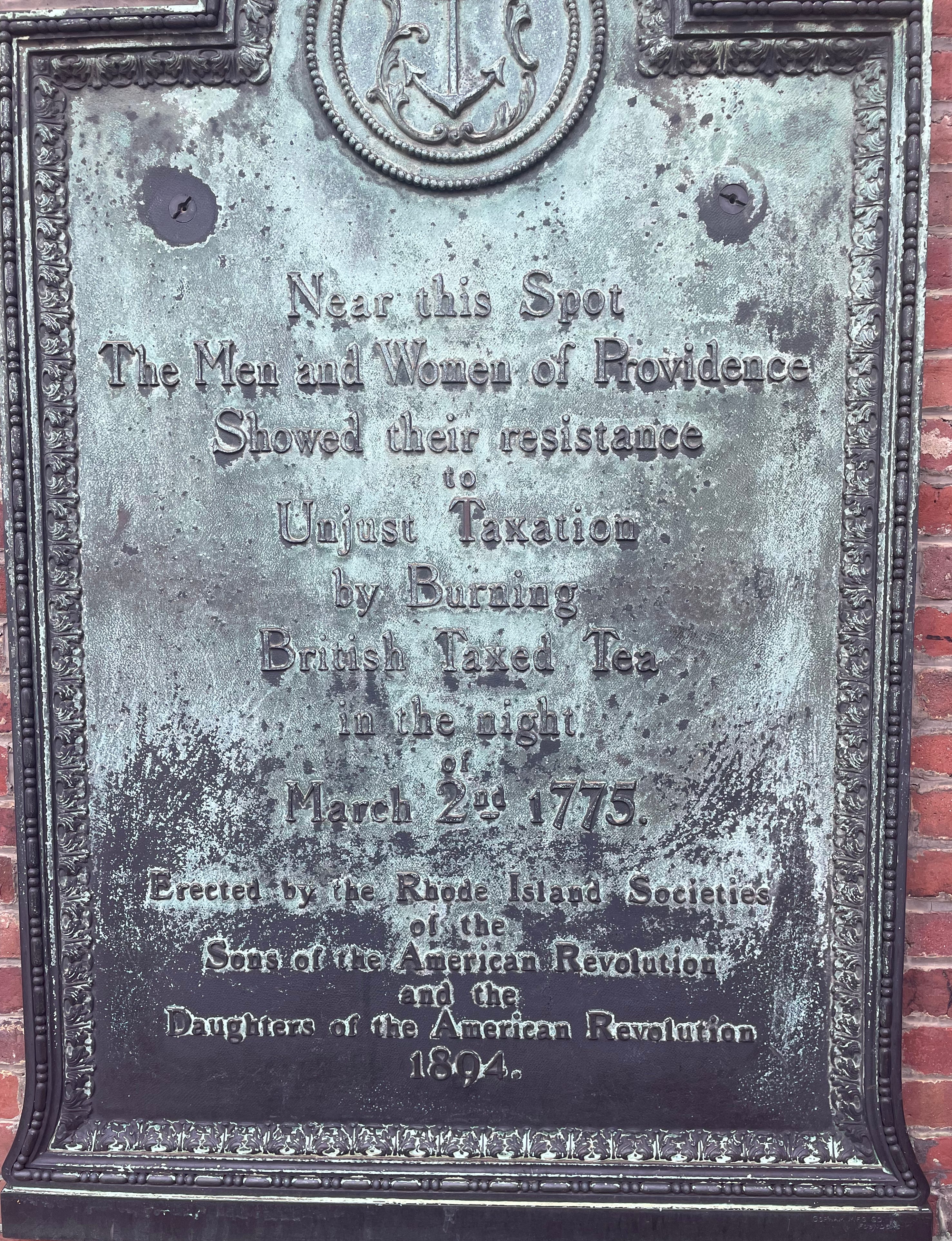
Memorial of revolutionary action, Brown University, photo May 2025 TS
There is endless debate about the Second Amendment of the US Constitution, on the right to bear arms. Here is the problem, put simply. In recent decades, the Supreme Court decided that the Second Amendment means something that it plainly does not mean. It is clearly there to help “provide for the common defence” by way of a “well regulated militia.” The Second Amendment is part of a larger document that is meant to establish freedom and safety together by establishing the compact of non-violence known as the rule of law.
The error made by the Supreme Court is obvious in both principle and practice. If justices invent a right for everyone to have the means of easily killing anyone else, they are betraying a basic purpose of government, understood by the framers of the Constitution, which is to prevent a war of all against all and thereby make both freedom and safety possible.
In practical terms, the Supreme Court privatized violence, vastly enlarging an unregulated market for instruments of death. The bigger that market is, the more powerful its lobbyists become. They then artificially generate a nation where death seems normal and the only protection seems to be the ability to deal death oneself. And that is not only horrible in itself, but a very different kind of political system: the rule of blood not law, the angry anarchy that one ordains and establishes a Constitution to prevent.
We are all more free and more safe when we are not living in the shadow of mindless death. And so around the country, in municipalities and in states, laws are passed that would reduce this horror. They are overturned because the Supreme Court has misunderstood the traditions some its justices so ostentatiously claim to venerate, as well as the logic of the rule of law which is the basis of their office.
The president can, of course, do much personally. But we all know that he is far, far too weak for this even to be imaginable. For now, he is nothing but a minor instrument in a larger process, and his language is only interesting insofar as it reveals the kind of regime change that gun violence is helping to bring. When we have the rule of blood rather than the rule of law, we invoke a deity, because we accept that life and death are out of our hands, subject to a capricious and unpredictable fate.
These invocations of God are not all innocent; they are confessions of guilt. They have nothing of the sacred about them; they partake in the sin of murder. They have nothing of the American about them; they undermine the country’s constitutional order and work towards its replacement with the rule of blood. And they are unfair to God, at least as Jefferson and the other framers understood Him: that he gave us the opportunity to govern ourselves. God is not to blame when we choose to throw that opportunity away.
Thinking about… is a reader-supported publication. Please subscribe.
PS: The video below is from a happy moment at Brown, the early morning before last spring’s graduation. The bagpipes are warming up to celebrate the students and the alumni.
PS: I was prompted to write this when I saw that fellow Brown alum Will Bunch, whose columns are inspiring, had written an excellent (and more personal) column on the same question. Please read his essay and consider subscribing to the Philadelphia Inquirer, which has been doing important work in this time of crisis.
From Thinking about… via this RSS feed