


Friends,
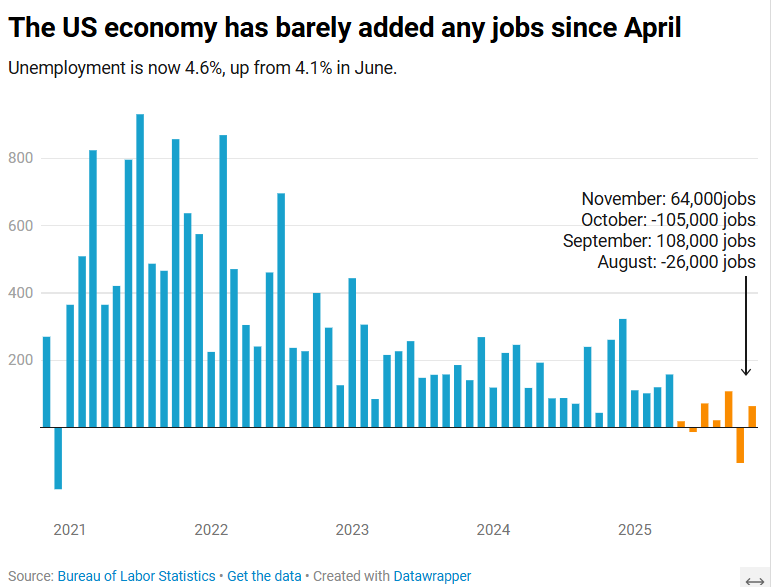
The Bureau of Labor Statistics — which can still be trusted! — reports today that just 64,000 jobs were added to the economy in November.
That’s not enough to keep up with the number of people looking for jobs. Hence, the jobless rate rose last month to 4.6 percent — up from 4.4 percent in September and from 4.0 percent in January.
But the bigger news is that almost no jobs have been added to the American economy since April.
In fact, 710,000 more people are unemployed now versus November 2024.
Take a look:
It would be one thing if wage gains were growing, but they aren’t. They’re slowing.
What accounts for this dismal record? Trump wants to blame the Fed, which he claims has been too slow to reduce interest rates. But in addition to creating jobs, the Fed also has a mandate to fight inflation — and prices continue to rise.
The two main reasons for the dismal economy are:
1. Trump’s tariffs. Employers aren’t willing to expand or add news jobs due to the added costs of the tariffs, which they have to absorb or pass onto their customers. The tariffs are also creating wild uncertainties about the future, further discouraging hiring.
2. Efforts by employers to cut costs. Payrolls are about two-thirds of all the costs of doing business, so employers squeeze payrolls as much as they can. They’re doing it now just as they have over the last several decades — by outsourcing abroad (although this has become trickier, given the tariffs) and by substituting technology for labor. What’s new — and making it far easier for them to substitute technology for labor — is Artificial Intelligence.
Bottom line: Between rising prices and no new jobs, most Americans are struggling to pay their bills. Hence, the affordability crisis.
Hence, a political reckoning for Republicans, particularly if Democrats focus on affordability in next year’s midterm elections. Key planks of such a platform should be: (1) eliminating many of Trump’s tariffs, (2) busting up monopolies, (3) giving workers more power through unions, (4) raising the minimum wage, and (5) lowering the costs of healthcare, housing, and childcare.
From Robert Reich via this RSS feed
You must log in or # to comment.