

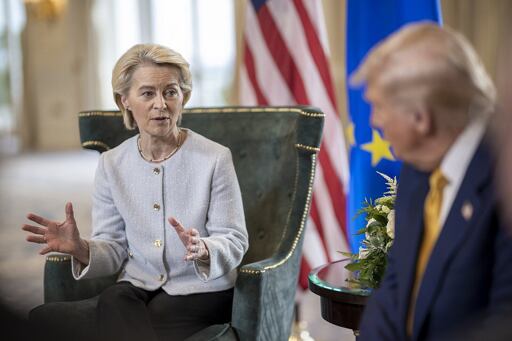
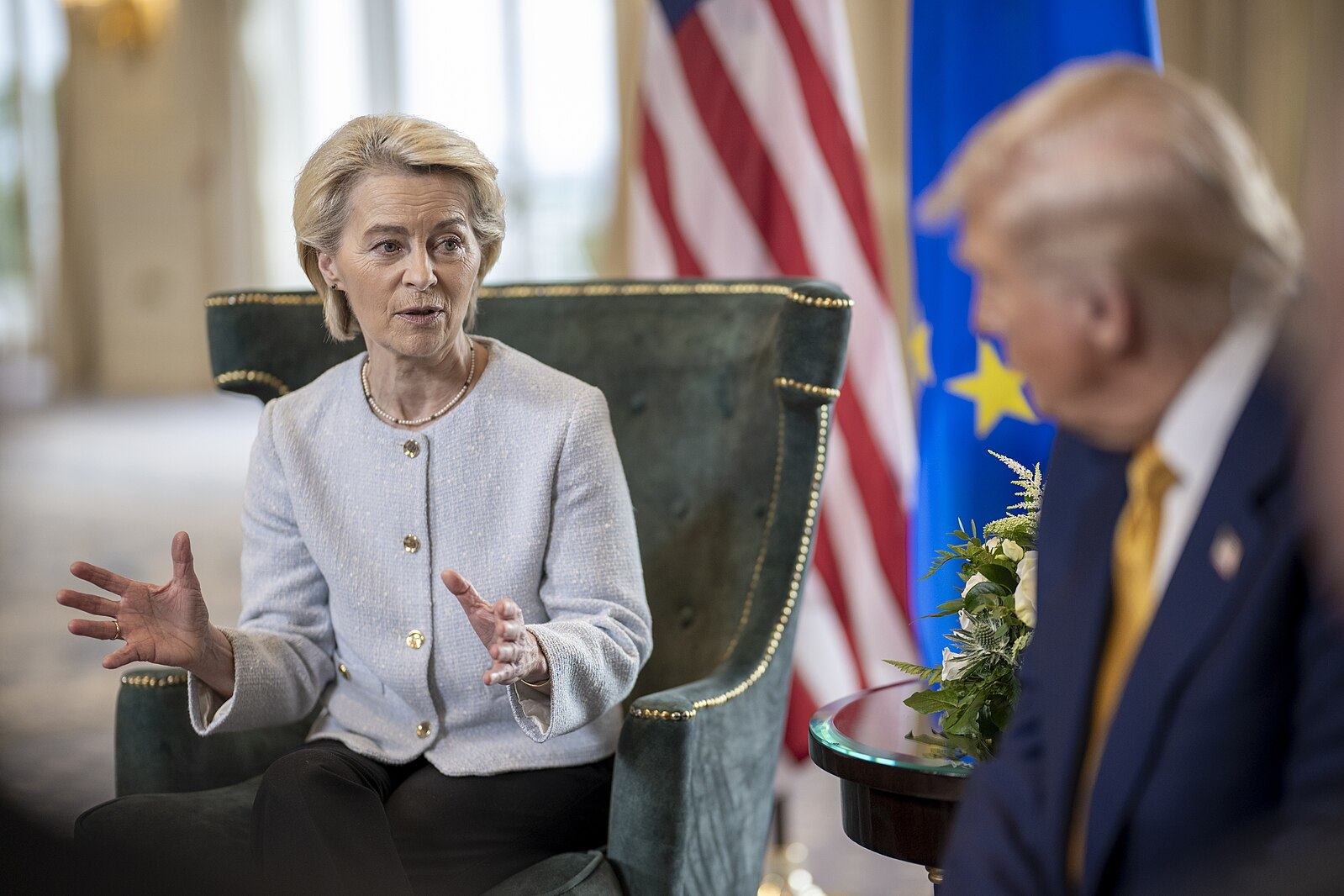
Photograph Source: The White House – Public Domain
I have been thinking about what non-sensational facts about Europe may be overlooked in Washington—particularly as recent reporting suggests that Donald Trump may seek to pull Italy, Austria, Hungary, and Poland away from the European Union. Italy’s prime minister, Giorgia Meloni, has already applied pressure on Kyiv on Trump’s behalf, while Trump himself continues to accuse most European leaders of weakness. Meanwhile, Sweden’s Dagens Nyheter warns: “We should be aware that the US is not only on the path to leaving Europe—it is practically becoming an adversary, similar to China and Russia.”
Three points seem to matter here. Europe is structurally misunderstood by the Trump administration. That misunderstanding is already damaging alliances. And Europe is more resilient and autonomous than US rhetoric suggests—or assumes.
“The beauty of the universe consists not only of unity in variety, but also of variety in unity,” wrote Umberto Eco. Europe is not one country. Beneath its shared ambition to co-exist sit over forty nations with deep political differences. Americans often speak of “Europe” as if it were governed by a single authority. It is not. The European Union consists of 27 sovereign states—it would rise to 28 were Ukraine to join. Each sets its own taxation. Each maintains its own defence, education systems, and media regulation.
I accept that the European Union has a limited ability to act decisively and cohesively at times. Companies in Europe suffer from too much red tape and sky-high energy prices. But it remains the largest trading bloc in the world. Collectively, the EU rivals the US and China in economic output—even if one good offshore friend sees it as flawed. “The Eurozone has been a disaster,” he insists. “It laid waste to Southern Europe’s economies.” He is one of many pro-American Europeans to have fled the continent. Yet Europe remains a major export market for US technology, aerospace, agriculture, and finance, and should not be written off.
“None of us alone can save the world. But each of us can help make it possible,” wrote Václav Havel. He understood that reliability within alliances matters. NATO remains the cornerstone of European security and still depends heavily on US commitment. Since 2022, however, Europe has accelerated its own defence mechanisms, while American reliability—a word doing considerable conceptual work these days—has grown increasingly questionable. Denmark’s Defence Intelligence Service has gone further, warning in public assessments that the United States should now be considered a potential security risk. It is as if the US both wants and does not want Europe to stand on its own. “Europe has more to gain than it seems, and the US has far more to lose than it admits,” wrote recently retired Portuguese colonel Fernando Figueiredo. Even the British Armed Forces minister and former Royal Marine, Al Carns, has said that the UK must stop relying on the United States for its defence.
Europe’s energy policy is considered more advanced. In several well-documented cases, European countries generate between 30 and 60 per cent of their electricity from renewables. The US compares differently by state, but continues to lag behind nationally—both in policy coherence and infrastructure.
European democracies, too, are facing polarisation. This is not unique to the United States. But in Europe it plays out through very different political structures. While the US is dominated by its familiar two-party system, most European countries operate under proportional, multi-party systems. These produce coalition governments, which can slow policymaking but usually avoid the winner-takes-all dynamic now fuelling extreme polarization in the US.
It is rarely acknowledged in Washington that European countries invest heavily in social safety nets not out of ideology, but because they see them as economic stabilisers. Universal healthcare, subsidised childcare, worker protections, and public transport are not dismissed as “socialist experiments” in Europe. They are regarded as mainstream, cross-party expectations—and as tools of national competitiveness.
Contrary to the Trump administration’s barbs—rhetoric that may function domestically but travels poorly internationally—immigration in Europe is openly and fiercely debated. It is not brushed under the carpet. All 27 EU member states are currently seeking revisions to post-Second World War human-rights frameworks to make it easier to deport migrants and foreign criminals. US border politics differ; that is all. European immigration debates focus less on walls and more on asylum management. The politics are complex, as they tend to be when policy is approached with seriousness and constraint. But they are fundamentally different from the dynamics of the US–Mexico border.
It is also rarely recognised in Washington that Europe has become America’s closest technological regulator. US technology companies operate under EU rules on privacy, digital competition, AI governance, and content moderation. Even an America-First administration eventually adjusts, because the EU quietly sets de facto global standards.
Then there is JD Vance, now risking alliances by taunting Europeans for “arresting people for tweets.” He overstates the issue, misreads legal contexts, and invites dangerous hypocrisy—particularly as Europeans are increasingly denied entry to the US after critical views of Donald Trump are reportedly discovered on phones or social media. A French scientist was denied entry while travelling to a conference in Houston after messages critical of Trump’s research policies were reportedly found on his device. Members of the UK punk band UK Subs were similarly denied entry following public criticism of Trump, according to reporting at the time. Many Europeans are now cancelling trips altogether amid growing talk of having to surrender years of digital history before entering the so-called Land of the Free.
Separately, it was Russia’s invasion of Ukraine that turned Europe’s worldview. It injected a deep melancholia into the bloodstream. Also, lasting political resentment. As some of us wrote with during the Balkan wars, for the first time in decade Europe again faces large-scale war on its continent. Defence spending has risen sharply. There is more to come. NATO has strengthened and expanded. Dependence on Russian energy has been dramatically reduced. Only a small number of countries—such as Hungary and Slovakia, whose governments are aligned with Trump—continue to purchase Russian oil.
Yet most Europeans still consider the United States as their most important global partner. Many of us value our many close American friendships. Despite disagreements over trade, technology, and the increasingly bullish tone of US foreign policy, European public opinion continues to see the US as a cultural ally.
But for how long?
Europe is not without contradiction or failure. Yet it remains a coherent democratic project capable of self-correction in ways that many larger powers now struggle to sustain. It is simply not a natural bedfellow for the more extreme racial and cultural rhetoric now drifting across the Atlantic.
This leaves one unavoidable question. Does the Trump administration even care what it stands to lose or what Europe will do if the answer is no?
The post Melancholia in the Bloodstream: Europe, America, and the Weight of Misunderstanding appeared first on CounterPunch.org.
From CounterPunch.org via this RSS feed