

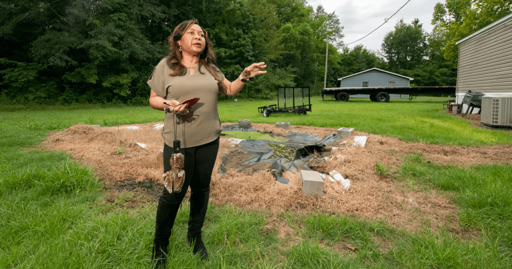
For many Americans, proper sanitation and clean water seem like issues for developing countries. But much of rural America—and even parts of US cities—still struggles to provide the basics we all need to survive. And as infrastructure ages and strains under the threat of climate change, the problems will likely get worse.
Environmental justice activist Catherine Coleman Flowers has been on the forefront of these issues for decades. And she says that while a lack of sanitation is often found in poor, Black regions, especially in the Deep South, these basic environmental issues cut across racial lines.
&Subscribe to Mother Jones podcasts on Apple Podcasts or your favorite podcast app.
“We have to expand the definition of environmental justice, because we can’t let people think that because if you are not Black and poor, you are not going to be victimized by this,” she says. “That’s not true.”
On this week’s More To The Story, Flowers sits down with host Al Letson to talk about her years working to achieve “sanitation justice” in the South, how biblical lessons apply to climate offenders, and her book of personal essays, Holy Ground: On Activism, Environmental Justice, and Finding Hope.
Find More To The Story on Apple Podcasts, Spotify, iHeartRadio, Pandora, or your favorite podcast app, and don’t forget to subscribe.
This following interview was edited for length and clarity. More To The Story transcripts are produced by a third-party transcription service and may contain errors.
Al Letson: So I want to zoom back a little bit because I think that if you do not live in a rural area, you can kind of not think about these issues. It feels like it’s a world away and not something that is happening in the United States, but in the United States, we are actually dealing … And not just in rural areas, but all across the United States. We’re dealing with issues with clean drinking water, open sewage, all of those things. As an environmental justice activist and someone who works in this field, can you kind of lay out big picture like what’s going on in America that we just don’t talk about enough?
Catherine Coleman Flowers: Well, first of all, let me just expand to talk about what’s happening in urban America. A lot of our wastewater treatment systems, the big pipe systems, have only been built to last for 50 years, and they’ve already gone beyond where they should be in the first place. So a lot of places are having problems now with sewage raining back in people’s homes. That’s true in Detroit. When it rains a lot in Detroit, people are having problems with sewage backing up in their basements.
We saw the same thing in Mount Vernon in New York, outside of New York City. We’ve been told, we’ve been contacted by people in the Bronx that talk about when weather events, they have sewage running back into their homes as well. So it’s not just in rural areas. Our infrastructure has not been designed to keep up with the demands of a changing climate. And some of them haven’t been built to keep up with the demands of population growth, and that’s a problem as well.So we’re finding sanitation issues around the country, and we’re not just hearing from poor people in Lowndes County. We’re hearing from people in Malibu. We’re hearing from people in affluent areas in Florida. There are people in Atlanta metropolitan area that are on septic tanks. So a lot of people in metropolitan areas that are not deemed rural communities are also on septic tanks. But not only are we finding that as an environmental justice issue, but we recently went to East Palestine and Ohio where a train derailed two years ago, the area is probably about 95 to 97% white, but they’re poor. They’re powerless. And consequently, a lot of people that were exposed to the toxins from that derailment are complaining about their health. They’re complaining that they still feel that the land and air and water is contaminated. So what we saw there were people screening for help. They want the same kind of help that people in Lowndes County are asking for.
We talk about what’s happening in Memphis and what is happening there when they build a data center that did not deal with the environmental harms that is causing in that community. I think that we have to expand the definition of environmental justice because we can’t let people think that because if you are not Black and poor, you’re not going to be victimized by this. That’s not true. We all drink the same water. The people in Flint, when I went to Flint and I understood that environmental justice, we can’t narrowly look at environmental justice. If you’re white in Flint, you drank the same water. It didn’t treat you differently because you were white. Everybody is impacted by it. It’s just that the communities that have the greatest impact tend to be those communities that are poor.
And maybe if you’re not a billionaire and you only have a few meetings, you could be marginalized too.
Can you tell me, how did you come to this work?
I came to this work, it was kind of an evolution. Initially, I was a teacher. Well, first of all, I was an activist in high school, and at that time the issue was education, my education.
But can you take me back to where you were in high school? Because I feel like that’s an important part of it. It’s not just that you were an activist in high school. You were a Black girl who was an activist in the deep South.
Yeah. Also, I was living in Lowndes County, Alabama, which is between Selma and Montgomery. And my principal at the time would stop school at 12:00 so that we could have parties. And everybody was happy about that because that meant there was no class. I was unhappy about it because I wanted to go to college and I felt like my education was being short-changed. So I was approached by a group that was organized by the American Friends Service Committee who was at that time looking at education in the South because there were a lot of issues around the desegregation of public schools. And they approached me and started teaching me what the Alabama law was. And based on the Alabama law, I was documenting things in my high school that were in violation of that law. Based on the documentation of those violations, we were able to bring charges against the principal, saying that he had violated the Alabama code as related to education. And ultimately he was removed.
And then later I became a teacher. And then after I moved back to Alabama, I didn’t teach in Alabama. I started working doing economic development and found out it was not easy to do without having infrastructure. You can’t recruit businesses into a community that don’t have water infrastructure, sewage infrastructure. In some cases, natural gas, that’s one of the requirements. So in that process, I met a gentleman named Bob Woodson who was helping me with the economic development side. When he came to visit for the very first time he came to Lowndes County, a county commissioner called me and said,” You should take him by this family’s home. “When we went there, we saw raw sewage running down the side of the road from their compound where they live, and we found out that the husband and wife had been arrested because they could not afford onsite septic that worked. And that’s how I came to this work around sanitation. That was the beginning.
So sanitation isn’t sexy. When you’re talking to people about the sanitation issues in rural counties, specifically like in Lowndes County, how do you get people to engage in this?
Well, the way I get people to engage in sanitation issues, you’re right, it’s not sexy, but everybody has to use a bathroom. So whether it’s sexy or not, it’s a requirement that no matter where we go in the world, people, this is one thing we all have to do. And when we talk about it and we’re talking to rural communities, whether they’re rural communities of people that are Black, rural communities, people that are Hispanic, or whether we are talking to people from more affluent communities that are using septic, we hear the same complaint. It doesn’t work well, and nobody likes it coming back into their homes. Straight piping is one thing. Straight piping is when you flush your toilet and go straight out onto the ground, there’s no kind of treatment whatsoever. However, there are a lot of people that have paid for onsite septic and it doesn’t work.
And so can you just give me, before we dive deeper into that subject, can you give me an understanding of what Lowndes County is like right now?
So Lowndes County is still very rural. And when we talk about rural, I think when people think about a rural community, they think about people living five miles from the nearest house. That is not true. What we find in a lot of rural communities is that the settlement patterns are, if you look in Lowndes County right now, we were recently, last week we were in Lowndes County and we were on Macpherson Street. Everybody on Macpherson Street is related to each other. So the settlement patterns in these rural communities is that a lot of people that live in these areas, they know each other. They’ve been there for years. So there’s a special kinship to the land. There’s also pride in land ownership. There’s pride in the history of Lowndes County in that the original Black Panther Party was founded there. People there are very prideful, but they’re also very poor.You have people there that are very poor and the septic systems that we were looking at while we were there last week averaged around $26,000 each.
Yeah. I used to be on a septic system in the house, an older house that I had, and maintaining septic systems are hard, but also just getting a septic system put in is really cost prohibitive, especially if you’re in an economically depressed area.
Yes, it is cost prohibitive. We’re trying to figure out ways in which we can fill that void that has been a void since I’ve been doing this work since 2002. It’s figuring out how to make sure families not only have access to septic systems, but septic systems that work because I think the popular narrative has been when they fail, the families are blame. So what we’re seeing is that it is that the climate change is impacting these septic systems, but the septic systems haven’t changed in terms of the designs to deal with the fact that the climate is also changing, that we’re getting more water.
In Lowndes County, what’s the regulation? Because earlier you said that you went to a house and you saw the sewage coming down and the family, the husband and wife were arrested because they did not have a septic tank. So what is the regulation? How long has that been in place and why hasn’t the state been able to help people get into a septic system?
Well, first of all, the regulations are written by the state and the state enforces them. The state is also responsible for training the installers. They train the people that pump the septic systems. The state is involved in every step of the process and it’s not free. You have to pay for it. And then the tank itself is a completely different animal that’s separate, but you have to pay for that as well. When we first moved to Lowndes County, people had outhouses and they went from outhouses to sex pools and from sex pools to septic tanks. And what we are finding is that the septic tanks, even if you have a septic tank, they fail. But when the septic tanks fail, it’s not the onus is on the homeowner. The liability is transferred to the homeowner. And I think that is part of what the problem is.
Now, the state itself, in Alabama, they don’t have money to put in septic systems, but we found that in other states they have revolving loan funds and so forth where they actually help people get septic systems and then they pay it back and then they help someone else get septic systems. That was not the case in Alabama. It was left up to the homeowner. And what we tried to do, first of all, is bring this to the attention of people beyond the state that forced the state to do something, which led to our filing the complaint. That was one of the reasons why we filed the complaint with DOJ and Health and Human Services against the State of Alabama over this issue.
And how did the State of Alabama respond to that?
We did a parasite study in 2017, and once it was peer reviewed and published in 2017, the Alabama Department of Public Health responded by putting on their website that our parasite said it was not valid because we used PCR technology, which had not been approved by the FDA. Now, keep in mind, three years later, PCR technology was used to diagnose COVID. I guess they were trying to minimize our findings. And we found during this parasite study, we found hookworm and other tropical parasites that were associated with raw sewage. And it was that that led to us filing this complaint because they get their funding. A lot of their funding came from Health and Human Services. And instead of them trying to mitigate the problem, they instead were trying to minimize our study that raw sewage was on the ground. And that led to an investigation by DOJ.
I got a call from them saying that they would investigate our complaint, which they did. And there was a resolution that was signed between the Department of Justice, Health and Human Service Services and the Alabama Department of Public Health. What was noteworthy about the complaint that this was the first time DOJ had used civil rights law to investigate environmental justice issues. It was also the first time ever in history that there was a mitigation of this where there was a resolution in that regard. And when that happened, the state started allocating funding to deal with as part of the resolution, allocating funding to deal with the problem in Lowndes County. That ended in February of this year when the current administration took office and put on their website for DOJ that they were backing out of the agreement because it was illegal DEI.
So the people in Lowndes County who desperately need this sanitation work done were denied it because the Trump administration has deemed this as DEI.
Yes, but I have to also give the state some credit because what the state’s response was, as long as we still have money, and I don’t know how much money they received, but they said as long as they still had money, they would continue to try to work on resolving the problem. So I have to give them credit for that.
I want to pivot back to your latest book, Holy Ground, and this book is a collection of very personal essays. What inspired you to write it?
When I wrote Holy Ground, I wanted to lead people with positive messages to talk about my own experiences and for people to know that at the end of the day, I was still hopeful because a lot of times people give up, especially young people. They give up when they run into adversity instead of trying to push through it. And that was the point. And also to show people that if you make a bad mistake, you don’t have to wally in it. You change, you move on. And I did that by showing examples of people in history that made mistakes, but they changed. And I wanted people to know that we didn’t have to stay in a state of wrongdoing or unrighteousness.
And the first chapter really struck me because it’s actually something I think about a lot, and that is the 30 pieces of silver. So I should say that I am the son of a Baptist preacher. I’m a PK.
So I know it resonated.
Exactly. Exactly. So the things that you were talking about how, for those of our listeners who are not preacher’s kids, Judas Iscariot took 30 pieces of silver to betray Jesus Christ in the Bible. He took the 30 pieces of silver and he betrayed Jesus with a kiss. And you take that metaphor at the beginning of your book to talk about the place that we are in America, not just in environmental justice. You focused on the problem of America, which I loved. Can you talk to me about that? Why does that metaphor seem to fit in so many different ways when we think about the issues that are plaguing America today?
The whole point of it was when I talked about America, not specifically about environmental justice, because sometimes when we talk just about environmental justice, people think we’re only talking about Black people when that’s not true, where the environmental injustices that are impacting people’s lives are happening around the country. And the one thing that they tend to have in common is that they’ve been marginalized primarily because they don’t have money. So I thought the best way to help people to see this was to use that common understanding of the story of Judas and then try to get them to apply it to what’s happening today.
Yeah. How did you feel on election day watching the country decide to put President Trump back in office?
I was confused. I was confused. But then I think back to the Old Testament where Moses led the Jewish people out of bondage, but they wandered in the desert for 40 years. Hopefully we won’t be wandering for 40 years, but maybe in the next four years, we decide we don’t want to be in the desert anymore.
I think that we have taken a lot of things for granted. We took democracy for granted, we took freedom, we took the right to vote for granted, and now people are seeing that we can’t take it for granted, that we can’t stand on the sidelines and let things happen. We thought we would never have a king. We thought that you could go to the courts for justice all of the time, but now other people are saying that it’s not just that when we talk about justice, you’re not just talking about black people, we’re talking about being an American citizen.
On the flip side, I think that a lot of people that voted for Trump would say the opposite, that they believe that Trump is acting on behalf of God, that he is the divine intervention that this country needed.
Well, I would tell them to read Revelations. I would also tell them that everybody that cloaks themselves in God are not of God. So I believe that a lot of those people now are questioning their own faith. They’re questioning their own decisions because it has not been consistent with the things that are Christlike. And recently we were in Italy and a lot of the conversations were around how we treat migrants. And it made me wonder, I’ve said it numerous times that if Christ were to come across the southern border right now, would ICE place him under arrest? And clearly, when I speak to people that are supposed to be part of the Christian family, I call upon them to question their faith if they believe that this is the right thing to do and the right way to do it.
In your opinion, what does environmental justice look like under the Trump administration? Is this a partisan issue under Trump?
I don’t think that environmental justice is a partisan issue. I think that environmental justice under the Trump administration is going to help people to understand why it’s not a partisan issue because a lot of people that will be impacted by no regulations will be those same people that thought that they would benefit from this presidency and the decisions that they’re making. I believe that we are going to see more people protesting environmental harms because they’re going to see the effects of making decisions without regulations being in place to protect the communities that they live in.
Who or what industries do you consider to be the biggest offenders against environmental justice?
Oh, wow. There’s so many of them. It depends on where you are in the country. Who are the biggest offenders? It depends on where you are. If I was in Eastern Carolina, I would say the factory farms, because they’re polluting the air, the water and the soil. If I was in Cancer Alley, I would say the multinational corporations that exist there that are producing lots of chemicals that are also contaminating the air to water and the soil. So it depends on where you’re located and the new kid on the block are the data centers. I don’t even think we know the impact of the data centers yet because that’s a new thing. So we’re going to have to revisit that to see. Unfortunately, we don’t really seem to wake up until the harms are already done and they’re irreversible.
Exactly. I think with the data centers, the only thing that may shine a little bit of light on it is that people are beginning to notice that their electric bills are significantly higher wherever these data centers are. And a lot of times when the middle class or when people who have money, their pocketbooks are affected, suddenly those issues kind of move to the forefront.
Yes. I think that whenever people’s, as you said, their pocketbooks are impacted, then of course they start asking questions and complaining because I read recently that the power that’s used to power a data center could power 80,000 homes. But I’m also seeing that there’s not an equal way in which they’re being built because there’s a data center that’s being built in Alabama where a lot of the power is being generated by solar.
That’s not what’s happening in Memphis. They’re using technologies differently based on who is negotiating, but apparently whoever was negotiating on behalf of the people in Memphis were the people that were living in those neighborhoods that are being impacted by it. And consequently, that’s why we got it. And I think that what’s going to be very important going forward in the future, no matter who’s in the White House is community engagement so that the communities can be a part of designing what it looks like. The communities would know firsthand what kind of jobs are coming out of this or are there jobs beyond construction jobs? Because the way they generally sell it to the community is all the jobs that are coming. But how many people are actually going to be employed working at these locations? And who’s going to pay the bill? As you’ve mentioned, in a lot of communities, people are seeing that their power bills are going up. Why? Why are they paying for this?
And if a data center is making your electric bill go up and they’re getting to make all the money off of it, they should be breaking you off. You should get a check as well. Why should they get all the profits and you get nothing?
Well, and again, it goes back to how we need to redesign what economic prosperity looks like. And part of that should go to the communities. I think they could still make billions of dollars and communities can prosper as well too.
From Mother Jones via this RSS feed
You must log in or # to comment.