

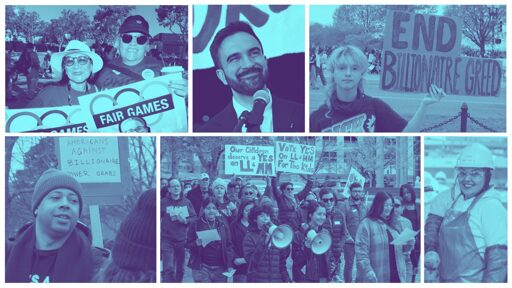
Ooph. What a year. We were tempted to skip our annual tradition of tallying up top inequality victories and pretend like 2025 never happened.
Instead we decided that in dark times like these, lifting up signs of hope is more important than ever. In 2025, we found those signs outside Washington. In fact, federal-level tax giveaways for the rich and the gutting of public services and labor rights seem to have invigorated efforts to “Trump-proof” local economies and workplaces.
Hopefully we’ll continue to see innovative inequality-fighting solutions bubble up from the base to the national level in the coming years.
In 2025, we also saw remarkable pushback from the people against authoritarian and billionaire class forces bent on capturing our economy and our democracy. We saw this resistance by the millions in the streets, by the tens of thousands at “Fight the Oligarchy” rallies, by the hundreds at Tesla dealerships, and by brave individuals of conscience.
May the pushback continue to grow — and deliver many more wins — in 2026.
Fighting inequality at the ballot box
1. Mamdani victory
Zohran Mamdani’s ascent from a little-known Democratic Socialist Assemblymember to the Mayor-elect of New York City was one of the biggest inequality storylines of 2025.
Mamdani’s promises to make one of the most expensive cities in the world affordable captured a deep desire for egalitarian politics. His most popular proposals include freezing the rent for stabilized units and raising taxes on the rich and corporations to help pay for fast and free buses and expanded universal childcare.
Wall Street CEOs and other billionaires spent more than $40 million trying to defeat this agenda. On the other hand of the equation, Mamdani’s campaign was able to marshal tens of thousands of volunteers to knock on doors across the city. This success should be a model for people-powered anti-inequality efforts nationwide.
2. Democracy reform pays dividends
An underrated aspect of Mamdani’s successful mayoral campaign was the role that democracy-reform initiatives played in his victory. Mamdani was partially able to withstand the billionaire spending spree because New York City has an 8-to-1 small contribution match program that helps level the campaign spending field for average New Yorkers.
The ranked-choice format of the mayoral primary, which allows voters to list five candidates in preference order, also helped avoid splitting the progressive vote and built coalitions in real time.
Similar reforms aimed at curbing the influence of the wealthy on politics helped eke out a victory for Katie Wilson in Seattle’s mayor race this year as well. Since 2015, Seattle residents have received $100 in “Democracy Vouchers” to donate to local candidates. That boost to the election spending power of residents helped Wilson defeat an incumbent backed by a real estate industry PAC.
Building worker power
3. Starbucks workers keep the pressure up
One of the biggest labor organizing stories of the 2020s — Starbucks baristas — continued to generate headlines in 2025. On “Red Cup Day,” November 13, members of Starbucks Workers United went on strike demanding that the coffee chain come to the table and negotiate a first contract. A little over a month later, the strike has now expanded to 130 cities and nearly 4,000 participating workers. To learn more about the last five years of Starbucks labor fights, check out our Q&A with founding organizer Jaz Brisack on their new book.
While the national Starbucks fight rages on, baristas in New York City notched a major win this year when the company agreed to pay out $38 million after the city’s labor and consumer agency found the coffee giant committed systemic violations of local scheduling laws. The payment is the largest single worker protection settlement in New York City history.
4. LA’s $30 minimum “Olympic Wage”
Mega-events tend to exacerbate inequality in host cities. In Atlanta, for example, tens of thousands of low-income residents were displaced by the demolition of public housing in the lead-up to the 1996 Olympics and the rapid gentrification that followed.
With the Olympics coming to Los Angeles, unions and other advocates are fighting to reverse this trend with demands for affordable housing investment and wage hikes. In May 2025, they won approval of an “Olympic Wage” for hotel and airport employees. By the time the games kick off in July 2028, the city’s minimum wage for these workers is scheduled to rise to $30 – the highest in the country.
In the face of efforts to water down the wage ordinance, unions countered with a ballot initiative to raise the minimum to $30 for all workers in the city.
5. Utah and the U.S. House of Representatives bend to pressure on union rights
The Utah legislature adopted one of the most restrictive labor laws in the country in February 2025. Less than a year later, those same lawmakers pulled a 180. Why the switcheroo? Sustained union protests and a ballot campaign to put the matter before voters had clearly given them the jitters.
The now-repealed Utah law banned collective bargaining rights for teachers, firefighters, and other state public employees. President Trump’s executive orders to do the same for more than 1 million federal workers are now also facing real opposition.
In rare bipartisan action, 20 House Republicans joined Democrats on December 9 to pass a bill to repeal Trump’s bargaining rights bans. Calling this a “seismic victory,” the American Federation of Government Employees is now demanding similar action in the Senate.
6. Immigrant and red state workers vote union
Despite rampant aggressive anti-union tactics, the labor movement notched some significant victories in 2025. The United Food and Commercial Workers International Union (UFCW), for example, won a first-ever national contract with JBS, the world’s largest meat processor. The contract covers the company’s heavily immigrant workforce of 26,000 and includes wage increases, paid sick leave, and the first pension benefits offered by a meatpacking employer since 1986.
A recent National Nurses United win showed that victories in the deep red, anti-union south are possible. After a successful election in early December, the union now represents some 750 registered nurses in the St. Joseph Health hospital network in central Texas.
Increasing taxes on the rich to pay for human needs
7. Taxing excessive CEO pay
Seattle voters passed a ballot measure in February to tax excessive executive compensation to fund affordable housing. Corporations will now owe a 5 percent tax on any annual compensation for a Seattle-based executive that exceeds $1 million. The measure passed by a 26-point margin, despite a well-funded opposition campaign.
Seattle activist-economist John Burbank declared the vote a victory against “the oligarchs, Amazon, Microsoft, the local Chamber of Commerce, the real estate industry, the coup makers and backers, the Muskites, and the Trumpiphiles.”
In 2026, we’ll be closely following ballot initiatives in Los Angeles and San Francisco to increase taxes on companies with huge gaps between their CEO and worker pay.
8. Colorado tax on high earners to pay for universal free school lunch
Colorado voters passed a pair of ballot measures in November to fund a universal free school lunch program, paid for through a tax hike on households making more than $300,000 per year. The initiatives will benefit farmers by allocating dollars for purchasing locally grown food and increase cafeteria worker wages as well. “It’s a win-win-win,” writes author and TV host Sonali Kolhatkar.
9. Taxing fossil fuels to fund universal child care in New Mexico
As of November 1, all New Mexico families are eligible for universal, no-cost child care. Families will save an average of $12,000 per year — a true game-changer for low-income households in one of the country’s poorest states. The state is funding the program through taxes on oil and gas extraction from public lands.
“Taking care of our children and setting them up for success is the best thing we can do for our families, our communities, and our nation,” writes child care teacher Rita Bee.
10. Hiking taxes on the rich to fill federal funding gaps
As state governments feel the squeeze of federal funding cuts, progressive revenue raisers are gaining momentum. Maryland, for example, adopted a new 2 percent capital gains surtax on individuals with income above $350,000 and raised income tax rates on people making more than $500,000 per year.
A State Revenue Alliance report details other progressive tax wins in 2025, including property tax increases on high-value homes in Maine, Montana, New Jersey, and Rhode Island. Illinois reforms will crack down on corporate offshore tax dodging, while Washington raised rates to make their state estate tax more progressive.
Our Institute for Policy Studies colleague Omar Ocampo has produced data dispelling the myth that state “tax the rich” reforms lead to an exodus of wealthy residents. In Massachusetts, for instance, the ultra-wealthy population has actually increased since the state introduced a four percent surtax on incomes above $1 million in 2023. Surtax revenue is now funding early learning and childcare programs and free school lunches and community college.
The post 10 Inequality Victories of 2025 appeared first on Inequality.org.
From Inequality.org via this RSS feed