

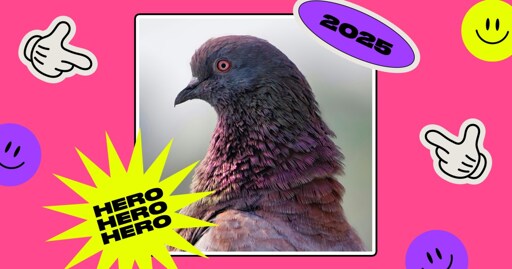
The staff of Mother Jones is, once again, rounding up the heroes and monsters of the past year. This is a non-exhaustive and totally subjective list, giving our reporters a chance to write about something that brought joy, discontent, or curiosity. Happy holidays.
About a month ago, a clip of Sarah Paulson found its way into my Instagram feed, and I haven’t stopped thinking about it since. Speaking on the podcast Las Culturistas, the Emmy winner called on the world to show some respect for the humble pigeon.
“Pigeon hate must be stopped,” she said. “People run them over. They don’t care. They don’t feed them. They give them their trash,” Paulson vented to the hosts, comedians Bowen Yang and Matt Rogers. “They are talked about as if they are disgusting.” In reality, she argued, pigeons were bred by humans to dwell in cities, carry messages to loved ones, and serve in times of war. They also often mate for life. “How could we treat them so terribly?”
Darwin wrote that observing pigeons is “the greatest treat, in my opinion, which can be offered to human beings.”
The rant seemed to resonate beyond my slice of the internet. The clip has been viewed about 7 million times since November, with a top comment by Grammy-winning artist SZA, who replied with a simple but effective, “YEA!”
In ordinary years, an endorsement from Paulson (or SZA, for that matter) would’ve been a big deal for the widely maligned birds. But even before the viral interview, 2025 was a banner year for pigeons.

Nguyen Quan/Unsplash
First, there was the New Yorker, which advised readers in May to “Pity the Barefoot Pigeon,” its feet vulnerable to all sorts of dangers—vehicles, predators, “hot lighted signs,” “jagged concrete,” debris, infection, and more. In June, a piece in the New York Times Magazine crowned pigeons the “unsung hero of every major city in the world”; in August, a surprisingly profound Guardian op-ed noted, à la Paulson, that pigeons have survived by “rooting through our trash” and “taking shelter in our nests.” “We loved them, once,” the piece reads. “We might not remember that, but pigeons do.” Then, in November, PBS released a documentary on the “secret lives of pigeons” titled Nature: The Pigeon Hustle, which (re)brands the birds as the “epitome of street smart: social, intelligent, agile, and tough.” Take that, doves.
(In all seriousness, “doves” and “pigeons” are part of the family Columbidae, which includes hundreds of species, and there’s no real scientific distinction between the two bird groups.)
Plus, their proximity to humanity aside, pigeons are remarkable creatures in their own right. As Smithsonian magazine reported earlier this month, new research suggests that pigeons use their inner ears to sense the Earth’s magnetic field, which may help solve the mystery of how birds navigate. Studies also show pigeons are able to identify breast cancer images, differentiate between Monet and Picasso, and even recognize human faces. It’s about time someone showed them a little appreciation.
In 1855, in fact, Charles Darwin wrote to a friend that observing pigeons is “the greatest treat, in my opinion, which can be offered to human beings.” The famed biologist and OG pigeon stan would later write in detail about the birds’ “astonishing” diversity in his groundbreaking 1859 book, On the Origin of Species. (According to the Cornell Lab of Ornithology, Darwin’s fascination with pigeons also informed his famous studies on finches.)
So why all the pigeon love this year? I have no idea, and please email me with theories. But senseless or not, I say, let’s make 2025 the year we officially embrace the pigeon. As “mother of pigeons” Sarah Paulson put it, “Next time you look at that bird, in life, just remember that pigeon used to do your work for you.” They carried our messages, fought in our wars, and thrived in our mess. Pigeons might have been the first birds we domesticated, dating back to ancient Mesopotamia. For a bird that’s stuck with us that long, it’s the least we could do.
From Mother Jones via this RSS feed