

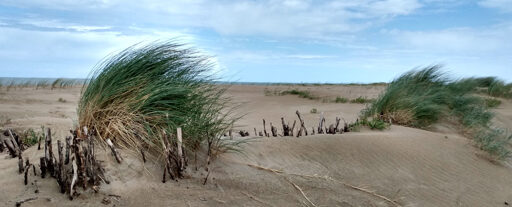
OSTEND, Belgium — In late October, Storm Benjamin blew across Belgium and other parts of Western Europe, bringing strong winds and rain that knocked down trees and damaged homes. Powerful waves pummeled Belgium’s shoreline, eroding some parts. Jagged, cliff-like formations appeared on certain beaches. Eventually, contractors reshaped the sand to prevent further erosion and to keep the public safe. Yet some stretches of the Belgian coast fared far better. Among these was a 750-meter (2,460-foot) strip of beach in Raversijde, a neighborhood in the coastal city of Ostend, where a series of constructed dunes stand seaward of a promenade that doubles as a dike. I drove to Raversijde on a rainy afternoon in late November to visit these dunes, which are part of a “dune-by-dike” system. The dunes and dike are meant to work in tandem to create a double buffer between the sea and the coastline: The dunes form a soft barrier that dissipates wave energy, while the preexisting dikes play back-up as a hard barrier, should the dunes succumb to a storm. This particular site is a project of a Flemish government initiative called Living Labs. Nieuwpoort, West-Vlaanderen, Belgium, October 25th, 2025, rough waves crashing onto shoreline under heavy storm clouds. Image courtesy of Bjorn B/stock.adobe.com After parking along the sand-swept road, I crossed the tram tracks that run along the coast to reach the promenade. There, I met Toon Verwaest, a coastal engineer at the governmental agency Flanders Hydraulics Research, who helps coordinate the Raversijde dune-by-dike project.…This article was originally published on Mongabay
From Conservation news via this RSS feed
You must log in or # to comment.