

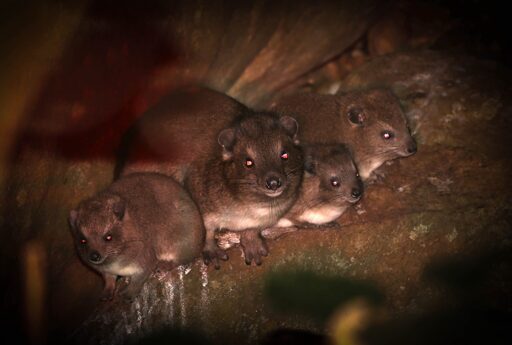
Despite their name, tree hyraxes — small, furry, nocturnal African mammals — don’t always live in trees. In Tanzania’s Pare mountains, near the border with Kenya, they’ve adapted to life on steep rocky outcrops as forests disappeared over the centuries, a recent study has found. Eastern tree hyraxes (Dendrohyrax validus) are known to inhabit the Eastern Arc mountains, which stretch from southern Kenya across eastern Tanzania, and the Zanzibar archipelago. They prefer old-growth evergreen forests, sheltering from the heat inside the cavities of large trees. But after centuries of agriculture, mining and logging, the Eastern Arc’s Pare mountains retain less than 3% of their original forest cover. Hanna Rosti, a conservation biologist from the University of Helsinki, Finland, and colleagues observed hyraxes and recorded more than 700 hours of their calls at 18 sites across the Pare massif. Across all sites, the researchers heard tree hyraxes calling mostly from rocky outcrops and saw them seeking shelter in rock crevices. A tree hyrax on a rock in the Pare Mountains. Image courtesy of Hanna Rosti. The team also found that the songs of Pare hyraxes, including a distinctive “strangled thwack,” resemble those of eastern tree hyraxes on Mount Kilimanjaro and in Kenya’s Taita Hills. However, Pare hyrax calls differ markedly from populations elsewhere in Tanzania traditionally classified as the same species, including those on Zanzibar and other parts of the Eastern Arc. This suggests the eastern tree hyrax populations in places like Pare and Kilimanjaro may represent a different taxonomic unit,…This article was originally published on Mongabay
From Conservation news via this RSS feed
You must log in or # to comment.