

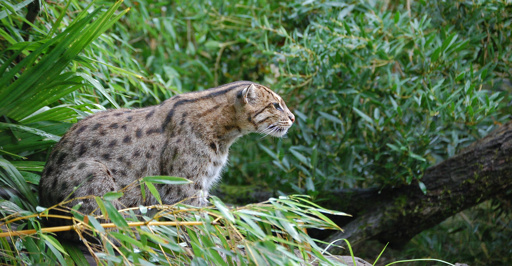
Wildlife researchers have confirmed the presence of endangered fishing cats in 158 subdistricts that cover about 32% of Bangladesh’s territory. At first glance, this may seem like charming news. But a grim situation was uncovered by researchers who analyzed more than 360 media reports published between 2005 and 2021. Their study, published in June, estimates that 31% of the analyzed media reports conveyed news of the death of 160 fishing cats (Prionailurus viverrinus), most of which were chased and trapped by fish and duck farmers and their associates. The study, characterizing negative interactions between humans and fishing cats, finds that about 47% of the cases demonstrated a kill-on-sight reaction. Calling fishing cats “true ambassadors of the wetlands of South and Southeast Asia,” the study’s corresponding author, Muntasir Akash, tells Mongabay, “In Bangladesh, the situation is dire. Our study results show that around one-third of Bangladesh has breeding fishing cat populations, and more than 95% of these regions are outside protected areas. Bangladesh’s fishing cats are experiencing the same colonial-era purge of big cats.” A camera trap image og a fishing cat in Chuadanga. Image courtesy of Muntasir Akash and Bakhtiar Hamid. The researchers counted at least 395 adult fishing cats and 170 kittens involved in recorded conflicts. Of them, 117 were released back into the wild, while 34 were sent to zoos or rescue centers more than 20 kilometers (12 miles) from the sites of conflict. However, those released individuals might face recurring experiences as human settlements rapidly expand into…This article was originally published on Mongabay
From Conservation news via this RSS feed
You must log in or # to comment.