

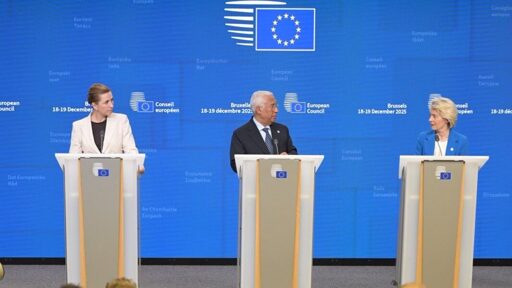
European Union leaders have agreed to continue fueling the war in Ukraine by providing €90 billion in loans to the Eastern European country over the next two years, secured through joint borrowing – a model they are usually not keen to pursue. The decision was announced at a meeting of the European Council in the early hours of Friday, December 19. The Czech Republic, Hungary, and Slovakia will not participate in the debt.
Ahead of the summit, EU officials toyed with the possibility of the bloc directly using frozen Russian assets to finance Ukraine – a move viewed as legally dubious, and one that many warned would be interpreted in Moscow as an act of open warfare.
That plan ultimately did not realize, largely due to objections raised by Belgium, considering most frozen assets are held through a Belgian-based financial institution. Still, the adopted framework includes the EU’s “right” to use Russia’s frozen funds to repay the debt if Russian authorities fail to pay future war reparations to Ukraine – whatever that may mean in the imaginations of EU bureaucrats.
Before and after the summit, Russian officials emphasized that any unilateral use of frozen assets would lead to reaction. At the same time, they argued that the EU’s policy on Ukraine and Russia is a reflection of the bloc’s own failures. “The negative impact of such short-sighted and blinkered sanctions policy on the situation within the EU is evident, including the mounting socio-economic problems and the declining standards of living of European citizens,” Russia’s mission to the EU wrote earlier this week.
Russian President Vladimir Putin echoed similar sentiments on Friday. “Russia is branded Europe’s enemy to conceal years of economic and social mismanagement by the Western ruling elites,” he said.
Read more: The fabulous hallucinations of the European leaders
And, if there was any doubt about the purpose of the loan, the Council’s official report lists the “strengthening of the European and Ukrainian defense industries” as one of its key elements. This spells more trouble for everyone involved. For Ukrainians, the EU’s promise of “unwavering support” again translates into destruction rather than a push for peace and reconstruction.
“They say, ‘We stand with Ukraine to the end,’ but this is extremely hypocritical,” Ukrainian sociologist Volodymyr Ishchenko said in a recent interview with La Stampa. “Their objective could be to buy time to rebuild European armies, because they can no longer rely on the United States. But they are buying time with Ukrainian lives, while Ukraine is being destroyed.”
Within the EU, the decision is likely to lead to more cuts in public services and social security systems. “European leaders continue to finance – at the expense of the working class in Europe – the continuation of the war in Ukraine and, above all, the militarization of the continent, without working seriously for peace and security for Europeans,” said Belgian MEP Marc Botenga. “It is time for Europe to abandon this war logic and take serious peace initiatives to stop the war as quickly as possible.”
The post EU countries to pursue joint borrowing to fund Ukraine war appeared first on Peoples Dispatch.
From Peoples Dispatch via this RSS feed
You must log in or # to comment.