

Drop Site is a reader-funded, independent news outlet. Without your support, we can’t operate. Please consider making a 501©(3) tax-deductible donation today.
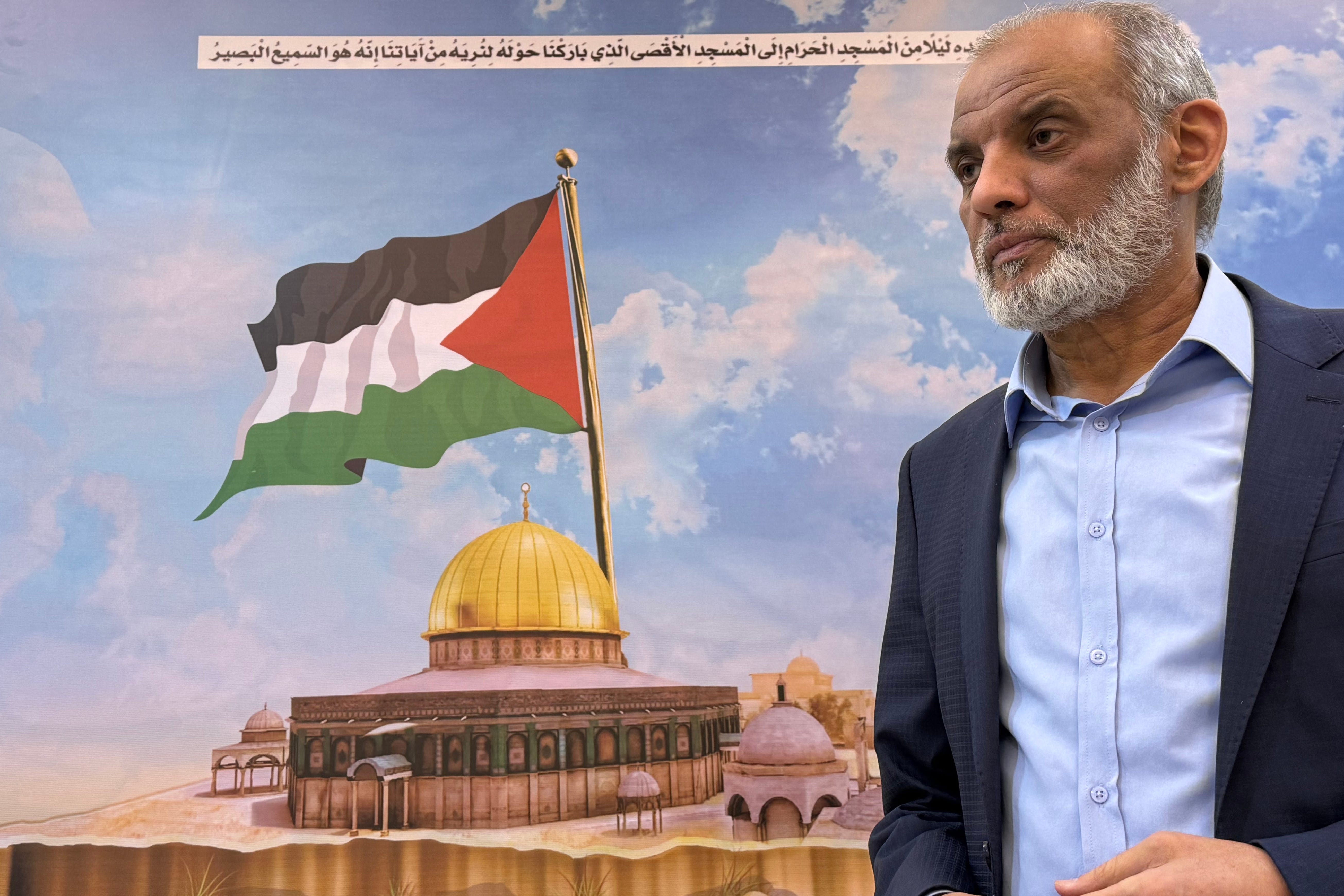
Hamas political bureau member Husam Badran in Doha, Qatar on October 11, 2025 (Photo by Rania SANJAR / AFP) (Photo by RANIA SANJAR/AFP via Getty Images).
DOHA, QATAR—Since President Donald Trump falsely proclaimed the dawn of a new era of peace and harmony in the Middle East in early October, Palestinians in Gaza have lived in an Israeli-imposed purgatory. The scorched-earth terror bombings and full-spectrum blockade on any life essentials entering Gaza have been replaced by sporadic, though daily, Israeli strikes and a trickle of food and medicine deliveries in quantities far below the terms agreed to in the October 10 “peace” deal. What is happening in Gaza is not a ceasefire, but a lower intensity, slower-paced killing operation by an Israeli regime daring Palestinians to fight back.
As the White House struggles to convince even a single nation to deploy forces in Gaza on a mission to disarm the Palestinian resistance, Hamas negotiators say there has been no formal communication from the U.S. on how it intends to proceed on any of the terms laid out in Trump’s sweeping plan. There have been no substantive discussions on how Gaza will be governed, who will be in charge of its internal security, when or how Israeli forces will withdraw, and what role Palestinians will play in determining their own destiny.
The fact remains that Hamas and other Palestinian factions did not sign an agreement beyond a ceasefire, exchange of captives, and an initial framework for the redeployment or withdrawal of Israeli forces from some parts of Gaza. Officially, there is no deal on a “second phase.” Moreover, several senior Hamas officials told Drop Site that there currently are no substantive negotiations happening with Palestinians outside of a process that appears aimed at using Palestinian Authority chief Mahmoud Abbas to give the appearance of Palestinian endorsement.
“The matter is so complex. It’s not just that we, as Palestinians, do not have a clear view of the next steps: I tell you, even the countries in charge, including America, do not have clear steps,” said Husam Badran, a senior Hamas official and a member of its political bureau, in an interview with Drop Site. Badran is a former West Bank commander of the Qassam Brigades and is currently Hamas’s head of national relations. He told Drop Site that Palestinians recognize they cannot issue demands of Trump, but can impact the reality on the ground through their refusal to surrender or to leave.
“Even though Palestinians are relatively weak compared to the occupation—sometimes we may not be able to impose what we want, but we can reject what we don’t want. As Palestinians—not just Hamas—we still have the ability to reject what we do not accept. And the world has started to realize that,” Badran said. “Certainly, we do not have the forces, military and financial capabilities, or international relations that the occupation has, but in the end, we are the people of this land; we are the people of this cause; and we are a people oppressed for more than seventy years. We live in an extremely sensitive region—not in the far West or the far East, but at the heart of the world.”
Several Palestinian negotiators who maintain contact with regional mediators from Qatar and Egypt told Drop Site that what is happening behind the scenes is largely a negotiation between the U.S. and Israel, as well as consultations with regional mediators Egypt, Qatar, and Turkey. The Palestinian side, Hamas officials said, is periodically briefed on the evolution of the U.S.-Israeli positions gleaned by the mediators, but it is not engaged in any process resembling a negotiation.
On Friday, the foreign ministers of Egypt, Qatar, and Turkey traveled to Miami, Florida, for meetings with Trump’s Special Envoy Steve Witkoff. The gathering represents the highest-level talks that have taken place since the October agreement was signed in Sharm El-Sheikh, Egypt.
“The resistance forces have fully adhered to their obligations under the agreement and remain committed to doing so, but the current situation is unsustainable,” said senior Hamas official Basem Naim on Friday. “We expect examination of how to implement what remains of the plan in a way that achieves sustainable stability, launches comprehensive reconstruction, and lays the foundation for a political path in which Palestinians govern themselves—culminating in the establishment of an independent state.” Naim called on the U.S. and regional mediators to “put an end to the ongoing Israeli rampage and to compel the occupation to abide by the requirements of the Sharm El-Sheikh agreement—foremost among them the provisions of the humanitarian track, including the entry of aid, the opening of Rafah crossing in both directions, and allowing in all needs for reconstruction and rehabilitation of infrastructure.”
Since October, Israel has adopted a posture as a victorious conqueror who now dictates the terms of surrender and occupation to a vanquished enemy—a stance fiercely rejected by Hamas. “The battle did not end with the defeat of the resistance or with the military defeat of Hamas. We paid an extremely high price, yes—martyrs and the destruction of infrastructure—but in the end, we were not defeated in this battle. You cannot compare us—excuse me for saying this—to the Japanese emperor when he was defeated in World War II,” said Badran. “We reached an agreement in Sharm El-Sheikh. It is true that [from the Palestinian perspective] the agreement is not just, but it is a political agreement attended by all the world’s leaders, foremost among them Trump.”
Despite repeated demands by Israel throughout the war against Gaza that Hamas surrender, it failed to achieve that aim through its genocidal war. Badran said that Palestinians will not suddenly capitulate their liberation struggle through a bureaucratic process masquerading as a peace agreement. “If the world—and especially the Americans, who today have the greatest influence in the world—wants to create genuine, long-term stability in this region, the only solution begins with the end of the occupation, not with anything else,” Badran said. “If you want to start by talking about disarmament and Palestinian surrender—the Palestinian will not surrender. And I tell you: even if Hamas were to disappear, others would come after it.”
On Thursday, Trump claimed he had “ended the war in Gaza, bringing for the first time in 3,000 years, peace to the Middle East.” The statement, delusional on its face, was nonetheless an encapsulation of Trump’s overarching approach to the Gaza plan—animated by a belief that his edicts alone entail equal results. Reality, though, is far more complex, and the prospects for an enduring resolution bleak.
Hamas officials have increasingly warned that Israel’s actions—and the U.S. refusal to compel Israel to abide by the terms of the ceasefire—risk destroying the deal. The head of Hamas in Gaza, Khalil Al-Hayya, said recently that Israel’s actions “threaten the agreement’s ability to hold,” and called on Trump “to compel the occupation to respect the agreement, adhere to its implementation, and refrain from exposing it to collapse.”
There are some indications that Trump realizes the Israelis want to ignite the flame that could torch his deal. The U.S. reportedly expressed its concerns that Israel conducted the strike without giving the White House prior notice and warned Israeli Prime Minister Benjamin Netanyahu against actions that would jeopardize Trump’s plan. Since the October deal went into effect, nearly 400 Palestinians have been killed in Israeli attacks, the vast majority of them civilians. Israel has also been systematically murdering the very combatants with which it signed the ceasefire deal, brazenly justifying its attacks by claiming to target Qassam fighters, including Israel’s assassination on December 13 of Raed Sa’ad, a senior commander of the Qassam Brigades. Rather than retaliate by force, the Palestinians have repeatedly appealed to mediators to intervene.
“There is no doubt that these deliberate, clear, and blatant violations pose a very serious threat to the agreement and cause it to wobble and weaken,” said Ghazi Hamad, a senior Hamas negotiator on Sunday. He warned that the pervasive Israeli violations “place the agreement in grave danger.”
The White House has already begun downsizing its plans and “pushing for an initial deployment [of an international force] that would operate only in areas controlled by Israel,” perhaps only in areas of Rafah in southern Gaza, according to the Wall Street Journal. The wild card, then, becomes whether Trump would greenlight expanded Israeli military operations in the name of disarming Hamas. That scenario would force the Palestinian resistance to decide whether to retaliate in self-defense, which Israel would seize upon to further escalate its own attacks.
Badran and other Hamas officials told Drop Site that if Trump and other world leaders do not compel Israel to cease its war of annihilation in Gaza and halt the intensifying Israeli assaults and settlement expansion in the West Bank, a third intifada could break out. Moving forward with a plan in Gaza that seeks to advance Israel’s war of conquest through non-military means under a false banner of peace will reignite the war and send a message to Palestinians that they have no choice but armed resistance.
“If the world once again says, ‘There’s been a war, we will calm things down, [slightly] improve Palestinian conditions, and then the Palestinian cause will die,’ they will be surprised by what comes next,” Badran said. “The matter is not only about what the occupation wants. If the world deals with us Palestinians as if the [Israeli] occupation decides everything, this region will never find stability. And not only in Palestine.”
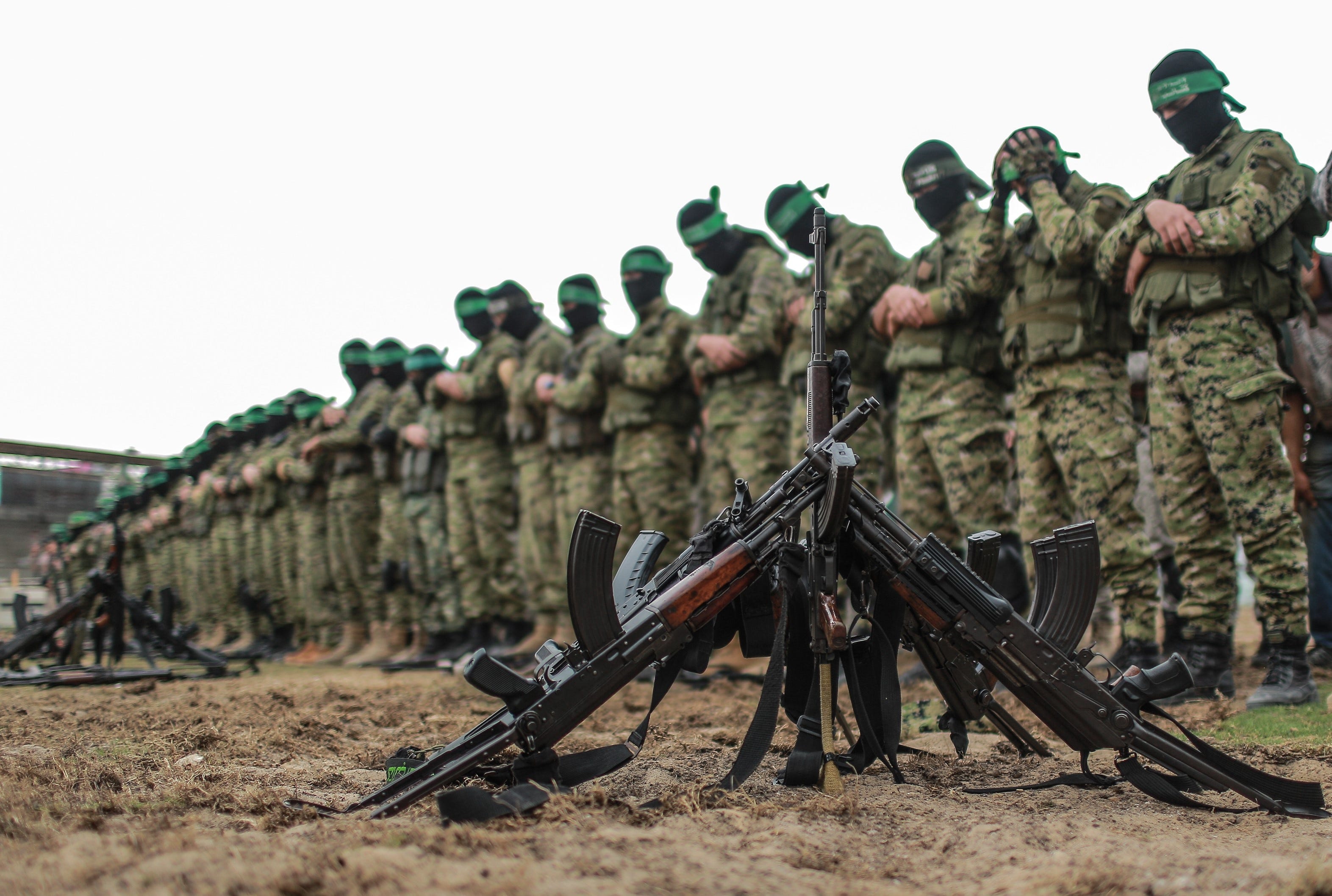
The Qassam Brigades, military wing of Hamas, pray as they attend a military parade during the 30th anniversary of the foundation of Hamas in Khan Younis, Gaza, on December 5, 2017. (Photo by Ali Jadallah/Anadolu Agency/Getty Images)
“Phase Two”: Disarmament, the ISF, and the “Yellow Line”
To listen to Trump and his allies, the priority right now is to move to the “second phase” of his grand deal. U.S. officials speak as though the terms have been laid out clearly and what remains is implementation. The plan is this: A “Board of Peace” chaired by Trump and consisting of a hand-picked assortment of world leaders will take charge of Gaza’s destiny and create a massive private and public financing scheme, estimated at $70 billion, to rebuild the enclave as part of an attractive investment opportunity. To do this, they will first deploy an International Stabilization Force (ISF) to disarm the Palestinian resistance and assume control of areas currently occupied by the Israeli army. A 15-member technocratic committee of non-partisan Palestinians will be enlisted to act as a civil administration inside Gaza, though they will be entirely beholden to the dictates of Trump’s imperial board and function more as a city council than a sovereign governing authority.
Palestinians in Gaza, the deal sheet claims, will not be forcibly displaced, but little else about their fate beyond that is spelled out. There is mention of a sufficiently reformed Palestinian Authority (PA) possibly returning to Gaza, though who would determine how the PA achieves that status is not detailed. “While Gaza re-development advances and when the PA reform programme is faithfully carried out, the conditions may finally be in place for a credible pathway to Palestinian self-determination and statehood, which we recognize as the aspiration of the Palestinian people,” Trump’s plan says without offering any specifics or addressing the massive attacks and displacement operations underway in the occupied West Bank.
The most contentious issue right now centers around the planned deployment of the international force. Trump and Netanyahu have said its first mission would be the total disarmament of the Palestinian resistance and the demilitarization of the Gaza Strip. To date, Trump has failed to get any nations to volunteer for a deployment of that nature. Arab and Islamic countries, which Trump claimed for weeks would form the backbone of the ISF, say the mission must focus on creating a barrier between the Israeli occupation forces and the Palestinians of Gaza and ensuring that the terms of the ceasefire are respected. “We do not want a stabilization force in Gaza that serves to protect one party at the expense of another,” said Qatar’s Prime Minister and Foreign Minister Mohammed bin Abdulrahman Al-Thani on Wednesday. “Delays and ceasefire violations endanger the entire process and place mediators in a difficult position,” Al-Thani said after meeting with Secretary of State Marco Rubio, adding that the force’s role should be to safeguard the October agreement.
“What we hear from these [Arab and Islamic] countries—whether we speak with them directly or through mediators—is that they want the mission to be completely clear. They cannot send their forces on an unknown mission. The most important thing is that there should be no clashes between them and the Palestinians, because that would affect even the public image of these countries,” Badran said. “The sympathy for Palestinians among Arab and Islamic peoples is nearly absolute. Therefore, any ruler in any country has to consider that they are not, in effect, confronting the Palestinians. And that’s where the complexities come in.”
Al-Hayya said “the role of international forces should be limited to maintaining the ceasefire and separating the two sides along the borders of the Gaza Strip with our 1948 lands, without having any duties inside the Strip or intervening in its internal affairs.”
From the perspective of the Palestinian resistance, the fact that it is openly welcoming the deployment of a foreign force is itself a significant concession. “Historically, Hamas did not agree with the idea of an international force. This was our fundamental political stance,” said Badran. “However, given the developments that occurred during the war—and the heavy price paid by our people in the Gaza Strip—we are ultimately a pragmatic movement that discusses what serves the general interest. Therefore, we agreed, in coordination with all the factions including the Palestinian Authority and Fatah who took the same position. We have no objection to the principle of international forces—there is no objection to that. But what their role and mission will be—that is what matters.”
In the lead up to the signing of Trump’s plan, Israel made clear it opposed the deployment of a UN force in Gaza, and senior Israeli officials railed against the international body as an antisemitic enabler of Hamas. On November 17, Trump managed to secure a UN Security Council resolution that endorsed his private force without placing it under any UN command or oversight. Nonetheless, Netanyahu’s public position on the deployment of the ISF has been one of scorn, dismissing outright that it would ever undertake the disarmament of the Palestinian resistance, while claiming that Israel would eventually need to resume its war. “Our friends in America want to set up an international force to do the work,” Netanyahu said on December 7. “I said, ‘Please, are there volunteers? Go ahead.’ We know there are certain tasks this force can do, but not everything—perhaps not even the main tasks.”
Israeli officials have also declared that the so-called “yellow line,” which currently partitions Gaza in half, is the new border with Israel by which Israel’s occupation will indefinitely remain in control of eastern Gaza. “The ‘yellow line’ is a new border line, serving as a forward defensive line for our communities and a line of operational activity,” said Eyal Zamir, chief of the general staff of the Israeli army, during a visit to troops in northern Gaza on December 8. “We have operational control over extensive parts of the Gaza Strip, and we will remain on those defense lines.” The line, which was first presented in a map accompanying Trump’s plan, was officially framed as the initial Israeli redeployment position. Since the ceasefire came into effect, Israel has been constructing military infrastructure and demolishing Palestinian homes and buildings in eastern Gaza.
The U.S. has been floating a proposal to construct so-called Alternative Safe Communities to entice Palestinians to leave areas of Gaza still controlled by Hamas by offering them temporary housing, food, and medical services in areas currently under full Israeli occupation. “This is not an earthquake that happened in an area and [you need] to move people to another area,” said Badran. “The story is connected to a people, a life, a future, political ambitions, study, education, and other such things. Even if this plan succeeds—which I expect it will not—they are talking about many years ahead. Who will have patience with them?”
Dr. Mustafa Barghouti, a prominent Palestinian political leader and former presidential candidate, sees a sinister motive driving the actions in eastern Gaza. “It’s Bantustanization with another goal, which is liquidation of the Palestinian cause. The Israelis want to end Palestine and the Palestinian people. That’s exactly what Netanyahu is dreaming about,” Barghouti said in an interview with Drop Site. “The way he’s dealing even with this idea of stabilization forces, making jokes of it. And he hints that he’s the only one who will be able to conduct the job [of disarming Palestinians]. I think he never gave up the idea of total occupation of Gaza and ethnic cleansing of its population,” Barghouti added. “The same applies to the West Bank where they are using settler groups to attack Palestinians. And they’ve already uprooted 60 communities. So the challenge is huge. But one thing I am 100% sure of, there is no power in this world that will force us to leave our country. And there is no power in this world that will break our will.”
Hamas and other Palestinian factions have emphasized that Israel is using the issue of demilitarization and disarmament of the resistance as a proxy to demand a total surrender of the cause of national liberation.
“The occupation wants not only to confiscate weapons: it could pursue us even down to the knives in people’s kitchens as ‘weapons.’ It knows perfectly well that we do not have warplanes, tanks, armored personnel carriers, or naval vessels. Everyone knows that. We are not an army: we are a resistance movement whose weapons are, in the end, simple weapons. So what does the occupation want? It wants to break the idea of resistance within the Palestinian people,” Badran said. “The issue is not about weapons; it is about wanting the Palestinian to surrender and abandon his political aspirations.”
Hamas negotiators understand that the issue of disarmament is not going to disappear and that the Israeli narrative has been fully embraced in Washington and in European capitals. “We affirm that the resistance and its weapons are a legitimate right guaranteed by international law for all peoples under occupation, and that this right is linked to the establishment of the Palestinian state,” said Al-Hayya. “We are open to studying any proposals that preserve this right, while ensuring the establishment of an independent Palestinian state and the Palestinian people’s right to self-determination.”
The foreign ministers of Turkey and Egypt—two of the most important Muslim allies supporting Trump’s plan—have said that the U.S. must be realistic about the issue of disarmament and an international force. On Friday, Rubio appeared to acknowledge that Israel’s demand for total disarmament was implausible and that the issue will require an agreement with the Palestinian resistance. “You’re not going to convince anyone to invest money in Gaza, if they believe another war is going to happen in two, three years. So, I would just ask everyone to focus on what are the kind of weaponries and capabilities that Hamas would need in order to threaten or attack Israel—as a baseline for what disarmament would look like,” Rubio said. “We’re going to leave that to the technical teams to work on. It would have to be something, obviously, that they’re willing to agree to—that our partners can push and pressure them to agree to. It also has to be something that Israel agrees to. In order for that to work, both sides have to agree on it—we need the space to do it.”
In meetings with regional mediators, Hamas has proposed a range of ideas on how to address the issue on a technical level. If the concern is ensuring no attacks are launched against Israel, then Hamas believes an internationally-enforced, long-term truce is the best path. “We are open to having a comprehensive approach in order to avoid further escalations, or in order to avoid any further clashes or explosions,” Naim said in early December. He told Drop Site Friday that, in order for Hamas to offer an official stance, it needs to see an actual proposal. “We have no idea about the true goals of the plan in clear words,” Naim said.
Hamas has expressed an openness to a deal that would see the weapons of Hamas and Islamic Jihad stored or “frozen,” a configuration that would come with the endorsement of the Palestinian resistance groups themselves. Violating such an agreement, especially one endorsed by large numbers of Arab and Islamic countries, would carry grave consequences for the broader Palestinian struggle. The most significant risk to such an arrangement, Hamas officials argue, is that Israel would continue its attacks as it has in Lebanon, while insisting Palestinians have no right to self-defense.
“In the occupation’s narrative, it wants to portray weapons as the obstacle even to implementing the second phase. Why should we fall for this narrative? In the first phase, the occupation put forward a clear goal: it convinced the Americans, and perhaps others, that the main reason for the continuation of the war was the presence of [Israeli] captives held by the resistance in the Gaza Strip. And the entire world began repeating that the only problem was the captives,” said Badran. “So where did the occupation uphold its commitments in the first phase? It did not uphold them in anything at all. This shows that the captives were merely a pretext and an excuse. Now they want to push us into the second phase—which is far more dangerous and strategic—using the same method, by claiming that the problem is weapons. The problem is not weapons.”
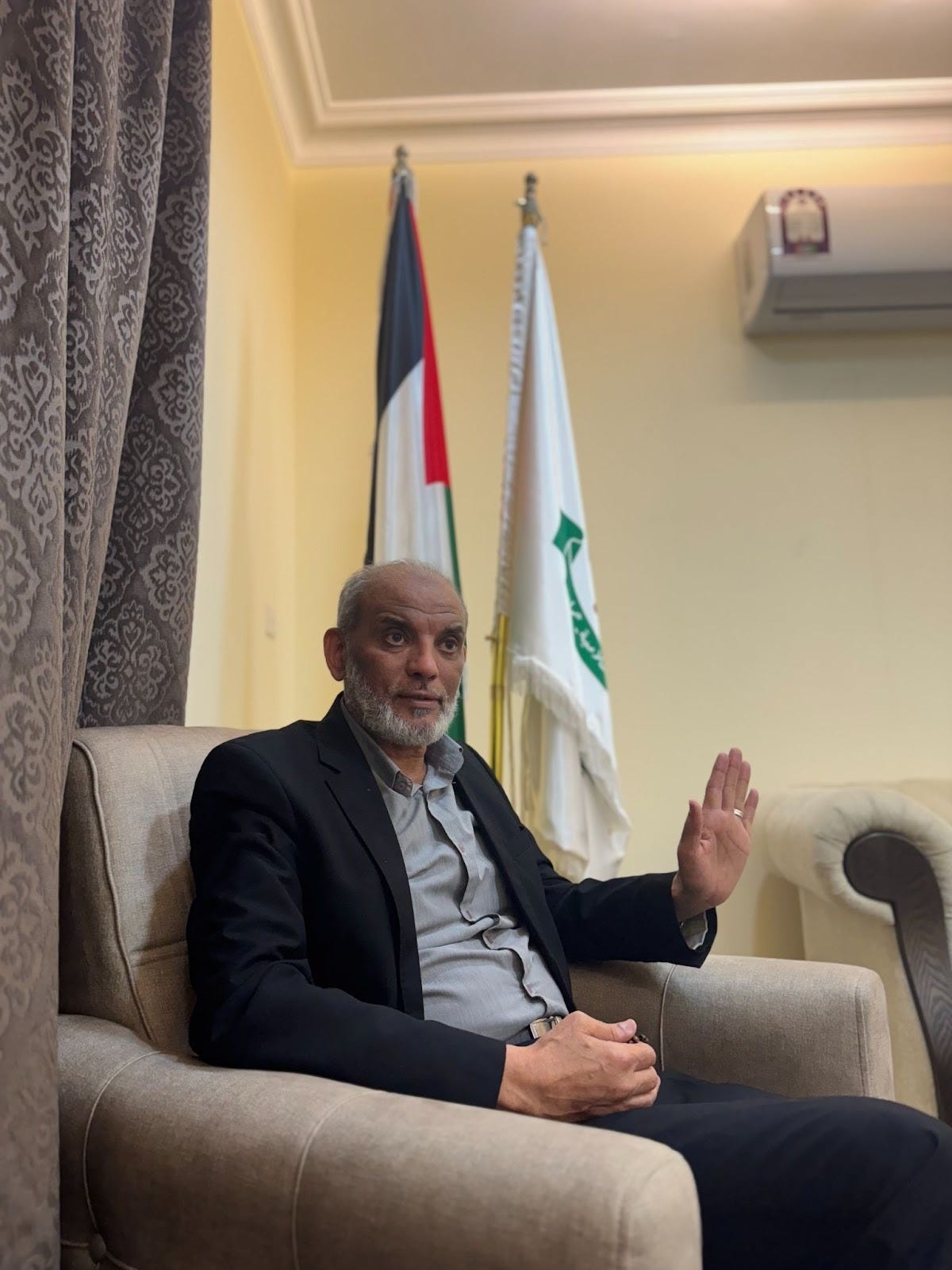
Husam Badran, Hamas’s head of national relations and a former Qassam Brigades commander, speaks to Drop Site’s Jeremy Scahill and Jawa Ahmad in Doha, Qatar, December 11, 2025 (Photo: Jeremy Scahill).
The Future of Gaza’s Security
Hamas officials have reiterated their position that Palestinians should be in charge of governance and internal security in order to stabilize Gaza, prevent a resumption of fighting, and open a space for real negotiations on the broader agenda embedded within Trump’s plan. Hamas has formally agreed to a non-partisan technocratic committee to govern Gaza in the interim, but it has insisted that it not simply serve as an enforcer of a foreign or Israeli agenda. International forces, they emphasized, should not be engaged in law enforcement or disarmament.
Badran argued that a Palestinian police force, deployed with the full support of all Palestinian factions, including Hamas and Islamic Jihad, would have the local credibility necessary to establish order and to ensure compliance with any agreement governing weapons of the resistance. He asserted that Hamas’s offer to agree to a long-term truce with Israel, wherein the Palestinian resistance agrees to store its weapons and not deploy them in any attacks against Israel, is the only tangible path to resolving the issue.
“The committee that assumes responsibility for the Gaza Strip in all its details must also take responsibility for what is called internal security or civil peace within the Gaza Strip,” he said. “The Palestinian police currently in the Gaza Strip for roughly the past twenty years are not Hamas police. It is true that Hamas has been overseeing the overall administration, but these employees—the police force—are ultimately a civilian police force—not an army. As a result, large numbers of them are not members of Hamas, even to this day,” Badran added. “Any armed individual other than the Palestinian police who appears in the street carrying a weapon should be held accountable by this police force, and his weapon confiscated. We were very clear on this point: internal security related to the Gaza Strip is the task of this committee, which is responsible for all matters, including security.”
Badran, who was born in Nablus in the West Bank, spent a total of 14 years of his life in Israeli prisons, and he was a cellmate and close friend of Yahya Sinwar, the former leader of Hamas in Gaza who was killed by Israeli forces on October 16, 2024. Badran was arrested in 2002, and in 2004 he was sentenced to 17 years in prison on charges that he orchestrated a series of deadly attacks during the second Palestinian intifada, which began in 2000. He was released in 2011 with Sinwar and more than 1,000 other Palestinians in exchange for Israeli soldier Gilad Shalit.
During his interview with Drop Site in Doha, Badran described the motivations behind the October 7 attacks; the dire humanitarian conditions in the Gaza Strip, which worsened by the month prior to the attacks; and the suffering endured by Palestinians in the seven decades preceding the launch of Operation Al Aqsa Flood in 2023.
“I think the general Palestinian feeling was that Palestinians were forced into such a step because the world wasn’t listening to them. You remember in 2018, 2019, when the Great March of Return took place—peaceful marches. Hundreds of Palestinians were killed, and still the world did not grasp the message, and the occupation didn’t either. So maybe October 7 came to tell the whole world that Palestinians are capable of doing something that you wouldn’t expect,” Badran said. “We are not seeking improved living conditions—we are not a minority living within another state. We want our political rights. And, therefore, I tell you that October 7 is fundamentally because of this idea.”
He described how Palestinians held inside Israeli prisons regularly go on prolonged hunger strikes, in some cases to achieve a simple demand that they be given glasses to drink tea. “So someone who cannot give up small things—and who paid the price of going on a hunger strike for twenty days just to obtain that one glass cup—why do you expect him to surrender?” he added. “This is the Palestinian mentality. Failing to understand it will lead major political leaders—including Trump and his team—to a wrong understanding, and therefore to wrong decisions. The feeling that Palestinians are weak, that their capabilities are limited, that Gaza has been destroyed, and that the occupation today has achieved all its glory through attacking the Palestinians—this leads to a false conclusion: that the world can live with this situation. And I tell you: it cannot.”
Badran said that Palestinians are not simply seeking better tents in which to live or a reduction in checkpoints or a slower pace of the expansion of Israeli settlements. Nor, he said, will they accept a multi-decade bureaucratic process, like Oslo, that promises a vague resolution to questions of statehood and self determination as Israel’s war of annihilation continues unabated.
“Palestinians want something clear and direct: their right to self-determination, to govern themselves, and to establish a Palestinian state in Gaza, the West Bank, and Jerusalem, with full sovereignty—without anyone controlling us or interfering in our internal affairs. This is a natural demand for any people. It is neither unrealistic nor unreasonable,” he said. “If the world wants real stability, it must act now and provide Palestinians with a genuine solution—not a solution limited to improving [living] conditions.”
From Drop Site News via this RSS feed