

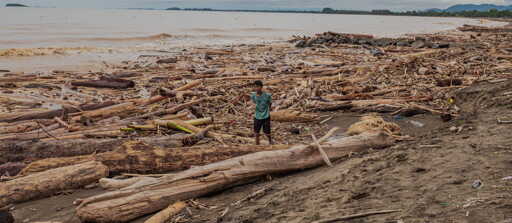
PADANG, Indonesia — At low tide along Padang’s coastline, fishing boats sit idle, not because of rough seas, but because the water is clogged with timber. In late November, flash floods from Cyclone Senyar swept through parts of Sumatra, killing residents and damaging roads and homes. Days later, their aftermath surfaced offshore. Logs carried from upstream forests poured out of river mouths and spread along the coast here in Padang, the capital of Indonesia’s West Sumatra province, blocking access to the sea and cutting off the livelihoods of hundreds of fishers. The mass of floating wood has made it impossible for fishers to pass, with some intact logs measuring up to 90 centimeters (35 inches or nearly 3 feet) in diameter. “For the past two days, the logs have been piling up. If we try to go out, the boats could be damaged,” Syafri Juni, a fisher from Patenggangan Beach in Padang, told Mongabay on Dec. 10. Residents look on at piles of logs from the flash floods at Patenggangan Beach, Padang, on Nov. 28. Image by Jaka Hendra Baittri/Mongabay-Indonesia. The formation of a hurricane in the Malacca Strait was an extremely rare occurrence, scientists say, and a devastating one — the storm killed more than 1,000 people across Indonesia, Malaysia, Thailand and Sri Lanka. On the island of Sumatra, torrential rains hit a landscape whose capacity to soak up rainfall has been compromised by decades of rainforest clearance. Syafri had not gone to sea for the past week because…This article was originally published on Mongabay
From Conservation news via this RSS feed
You must log in or # to comment.