

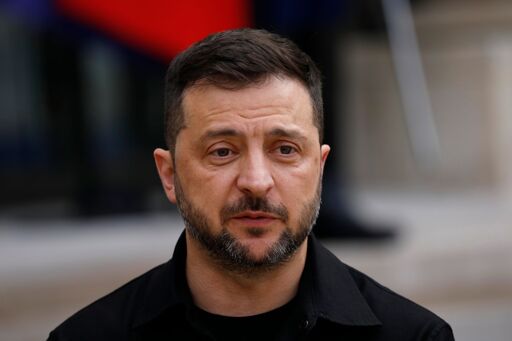
President Volodymyr Zelensky once again called on U.S. President Donald Trump to take an active role in negotiations to end Russia’s war in Ukraine, as uncertainty continues to grow around the fate of ongoing U.S.-led peace negotiations.
“I believe such strength exists in the United States and in President Trump. And I believe we should not look for an alternative to the United States, because all alternatives are uncertain as to whether they can (end the war),” Zelensky told reporters on Dec. 20.
For months, the Trump administration has led high-profile talks on ending Russia’s war in Ukraine. While Kyiv has made concessions, Russian President Vladimir Putin has largely not swayed in his maximalist demands to establish peace.
Zelensky, questioning other countries’ abilities and influence to serve as the primary negotiator, continued.
“Who else (can effectively establish peace)? Perhaps representatives of the Middle East. But I still believe the United States has greater chances. Who else? Europe—the Coalition of the Willing—which is Europe plus our friends from Canada and Japan. But they will all be at the negotiating table in one way or another. And perhaps China could as well, but we clearly see no desire from China to end this war,” the president added.
The comments from Zelensky comes as a Ukrainian delegation, led by Rustem Umerov, secretary of the National Security and Defense Council, met with American and European officials in the U.S. on Dec. 19 for a new round of talks.
Negotiations have continued as the Trump administration increases pressure on Kyiv to consider territorial concessions as part of a broader effort to end the war.
In further comments to reporters on Dec. 20, Zelensky named the top three issues where there is disagreement about the path forward in negotiations.
“The most difficult issues were and remain Ukraine’s territories. Next is the Zaporizhzhia Nuclear Power Plant, our ZNPP. The third issue is money for reconstruction,” the president said.
Moscow continues to seek major territorial concessions, including Ukraine relinquishing the entire Donbas region, encompassing both Russian-occupied territories and areas still held by Ukrainian forces.
Speaking to journalists on Dec. 15, Zelensky reaffirmed Kyiv’s position, saying that Ukrainian troops won’t withdraw from embattled Donetsk Oblast.
The U.S. has also proposed that Ukrainian-controlled Donetsk Oblast become a “free economic zone” that remains under Kyiv’s authority but sees the withdrawal of Ukraine’s military, Zelensky said.
“We are sure that the Russian army will want to enter our territory at any moment, which is basically what it has been doing all these years of aggression. That’s why it can’t be. If you want to withdraw troops anywhere, the same mirror steps are always taken. If we withdraw five kilometers, then they also withdraw five kilometers,” Zelensky said, rejecting the proposal.
“The best, honest option is to stand where we stand. Fewer compromises and less dialogue. If the issue of a ‘free economic zone’ is raised, I told my partners: I apologize, but the people of Ukraine will decide,” he added.
Questions around the proposed split in control between Ukraine and Russia of the Russian-occupied Zaporizhzhia Nuclear Power Plant have come under criticism, with several experts telling the Kyiv Independent that shared control would be practically impossible in the plant’s current condition.
The plant, legally owned by Ukraine’s state-enterprise Energoatom, would need complex modifications to split the power supply between two unsynchronized grids: the European grid, which Ukraine is connected to, and the Russian grid. The necessary changes would pose a security risk by destabilizing the electricity supply, Jan Vande Putte, a nuclear expert for Greenpeace Ukraine, told the Kyiv Independent.
Several U.S. officials have previously said that peace talks appear to be nearing completion, comparing the negotiations to the final stretch of a battlefield advance.
Meanwhile, Zelensky said Washington has proposed trilateral talks among delegations from the U.S., Ukraine, and Russia, noting he believes substantial progress toward ending Russia’s war cannot be made in that format but that it could yield results, including prisoner exchanges.
Read also: Fact-check: Debunking Russian propaganda about ‘persecution of Christians’ in Ukraine
From The Kyiv Independent - News from Ukraine, Eastern Europe via this RSS feed