


Upon being released from prison in December 2013 after serving time for “hooliganism motivated by religious hatred,” Russian political activist Maria Alyokhina observes that she and her fellow Pussy Riot punk group members “arrived in a different country.”
Outwardly, Russia sought to convey to the world during this period that it was a serious global power through events such as the Sochi Winter Olympics. The reality, as Alyokhina writes, was completely different: just a few months later, Russia would launch its war against Ukraine, annexing the Crimean Peninsula and sparking a fight in Donetsk and Luhansk oblasts.
As Russian soldiers began to commit violence abroad, Russian society itself descended into something darker: “The authorities give the green light to create violence within our own country. The number of Nazi groups increases. Gopniks with St. George’s Ribbons, calling themselves patriots, attack and beat up anyone who disagrees with the new ‘patriotism’.”
Alyokhina’s new book, “Political Girl: Life and Fate in Russia,” covers the period from her first release from prison to her escape from Russia in the spring of 2022, a span that coincides with some of the darkest moments in the country’s recent history. These years are punctuated by events such as the assassination of opposition leader Boris Nemtsov, the downing of Malaysia Airlines Flight 17 over eastern Ukraine, and the poisoning of Alexei Navalny — episodes that function less as narrative climaxes than as recurring markers of a system sliding deeper into repression.
The book lingers unevenly on these moments, but the inconsistency appears deliberate rather than careless. The effect, when the episodes are read in close succession, is cumulative rather than dramatic. What emerges is not only a record of political violence in contemporary Russia, but an account of how quickly the extraordinary becomes habitual — how catastrophe, repeated often enough, loses its capacity to shock.
Against the often fractured and polemical discourse that characterizes much writing by Russian exiles, Alyokhina’s book stands out for its clarity of judgment. She does not avoid the question of Russian society’s collective guilt for the war, unlike those who claim “if everyone is guilty then nobody is guilty.”
Instead, Alyokhina insists on holding together two uncomfortable truths: that she did what she could to change the country, repeatedly and at increasing personal cost, and that Russian society at large remains complicit in the horrors that followed. The book’s moral weight lies precisely in this refusal to convert individual resistance into collective exoneration.
“I’m afraid to say the most important thing out loud — a verdict," she writes about the Bucha Massacre. “(It’s a verdict) on all of us. I’m not sure Russia has the right to exist after this.”
The horror of Russia’s war crimes in Ukraine is intensified by how quickly much of Russian society appears to embrace the conflict, Alyokhina writes, with many insisting that Russian President Vladimir Putin is “doing the right thing.” The Kremlin’s survival is bound up with the machinery of war: it is not only a tool of foreign aggression but a domestic imperative, used to consolidate loyalty and suppress dissent as Alyokhina observes with unflinching bluntness: “Numbness. We are f–king fascists.”
A substantial portion of “Political Girl” is devoted to documenting Russia’s crimes against Ukraine, while also noting related injustices like the persecution of the Crimean Tatars or the Kremlin-backed repression in Belarus. Alyokhina details the meticulous planning behind Pussy Riot’s high-profile actions, both in Russia and abroad, aimed at securing the release of political prisoners such as Ukrainian filmmaker Oleh Sentsov.
Taken together, these episodes underscore a central argument of the book: that criticism of one’s country can constitute the deepest form of love for it. While Russian authorities brand dissenters like Alyokhina as “traitors,” her actions show that any hope of a more just society depends on confronting the enduring authoritarian structures that block such reform.
Throughout the book, Alyokhina also makes clear the heavy moral toll on those who dare to speak out, even as the dangers mount. In the shadow of the full-scale war, when dissent in Russia has become dangerous to an unprecedented degree, she captures the grim logic that makes prison feel, in her words, “the only honest thing” to do. Yet such sacrifices yield little. As one young activist tells her after serving a sentence: “Nothing has changed. I did (my time), I got out, and nothing has changed at all.”
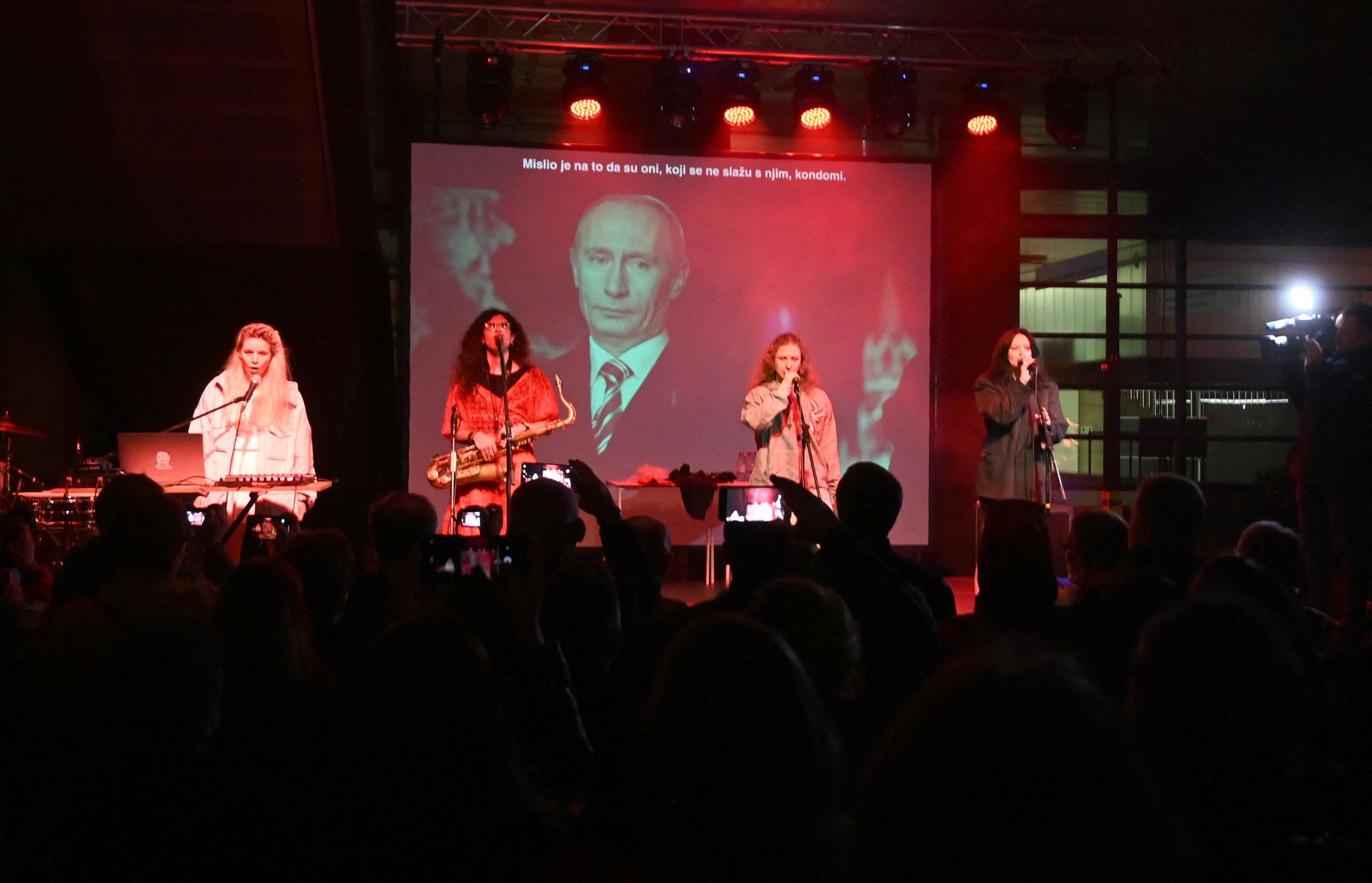
Russian political activists and members of the punk rock group Pussy Riot perform during a concert at the Zagreb Museum of Contemporary Art in Zagreb, Croatia, on May 30, 2022. (Denis Lovrovic / AFP / Getty Images)
Through her repeated encounters with Center E, the government agency tasked with combating “extremism,” Alyokhina confronts the chilling workings of an authoritarian state. In Putin’s Russia, “extremism” simply means freedom of speech, assembly, and independent thought.
When Alyokhina and her fellow activists try to exercise these basic rights, overly friendly strangers strike up conversations, probe for opinions, or try to provoke conflicts. The tactics are crude but relentless, and over time, the activists learn to recognize them. What emerges is less a cat-and-mouse game than a new social grammar, where suspicion becomes ordinary.
Alyokhina’s repeated attempts to cross the border in the spring of 2022 after fleeing house arrest are Kafkaesque in the most literal sense. With each effort, a creeping sense of anxiety builds, leaving the reader constantly on edge, unsure how she will finally manage to escape and avoid being thrust back into the relentless machinery of the Russian prison system.
While “Political Girl” is worthy of praise, one is left to ask, in the end, what can be taken from these accounts. Alyokhina writes that she and her fellow activists showed the world the “true face” of Putin. Yet he just recently taunted European leaders as “piglets” and promised to continue pursuing his war aims in Ukraine, whether through threats masked as diplomacy or by force.
The threat of another front opening elsewhere in Europe looms, with the same disbelief being voiced by those who thought a war in Ukraine was impossible. If the testimonies of persecuted Russian activists, Ukrainian soldiers, survivors of Russian atrocities, and all those who have seen Russia for what it is fail to spur meaningful action, the question looms: what can be done, and by whom, in the face of such relentless brutality? An attempt to answer this question, or at least to unpack it, is largely missing from the book.
The quality of the translation is also one of the book’s biggest setbacks. Several Russian transliterations of Ukrainian cities mar it: “Kiev” appears instead of the now-standard “Kyiv,” and “Slavyansk” instead of “Sloviansk.” (Ironically, “borshch” is correctly spelled.) The Russian transliteration lapses are unfortunate, as they diminish the moral clarity of Alyokhina’s work.
However, it is not an isolated case. A number of other recent Russian books in translation show similar inconsistencies, including former Russian opposition leader Alexei Navalny’s posthumous memoir and journalist Dmitry Bykov’s biography of President Volodymyr Zelensky, with the latter even switching between Ukrainian and Russian spellings depending on the speaker — a subtle trick that still reinforces imperial conventions.
Ultimately, “Political Girl” is more than a memoir. It is a searing indictment of the moral and political rot that permeates contemporary Russia, implicating not only those who wield power but also those who willingly look away.
Alyokhina’s account leaves no doubt about the depth of the country’s authoritarian entrenchment and the personal cost of resisting it. The book is both a record of personal courage and of collective failure: it testifies to what some dared to do, while exposing how much more could — and should — have been done to avoid the horrors of the reality we live in now.
Note from the author:
Hi, this is Kate Tsurkan, thanks for reading this article. There is an ever-increasing amount of books about or related to Ukraine, Russia, and Russia’s ongoing war of aggression against Ukraine available to English-language readers, and I hope my recommendations prove useful when it comes to your next trip to the bookstore.
If you like reading about this sort of thing, please consider supporting**** The Kyiv Independent.****
Read also: Looking for the 10 best Ukraine-related books of 2025? We’ve got you
From The Kyiv Independent - News from Ukraine, Eastern Europe via this RSS feed