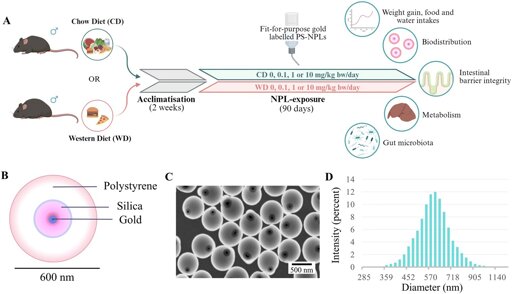
Plastics are not inert: they gradually break into fragments over time, forming micro- and then nanoplastics (i.e., particles <1 μm in size). Nanoplastics are found in drinking water and foods packaged in plastic. This reality suggests that humans may be ingesting appreciable quantities of nanoplastics to which the gut is highly exposed. Yet, there is a limited understanding of how nanoplastics affect digestive system health. Additionally, to date, studies on this topic have employed commercial particles, which often contain additives.