

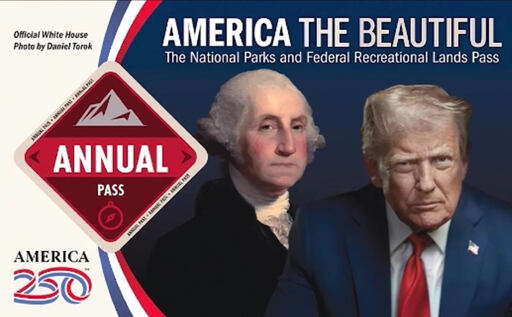
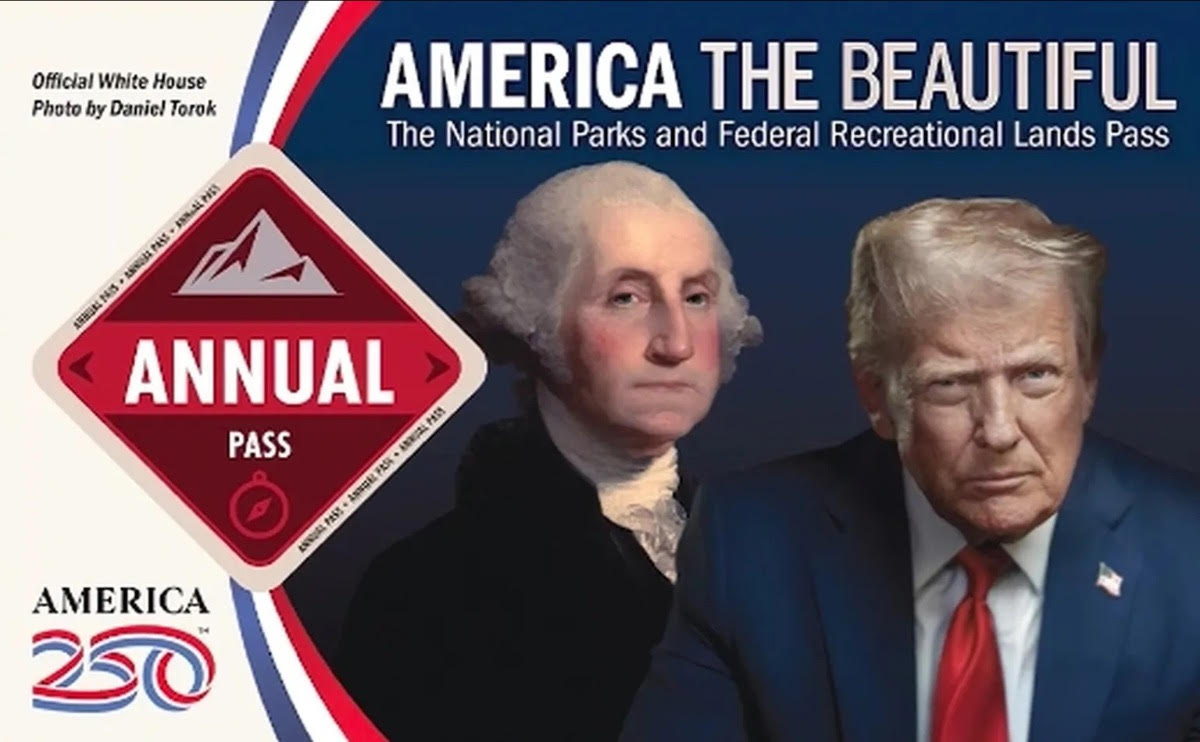
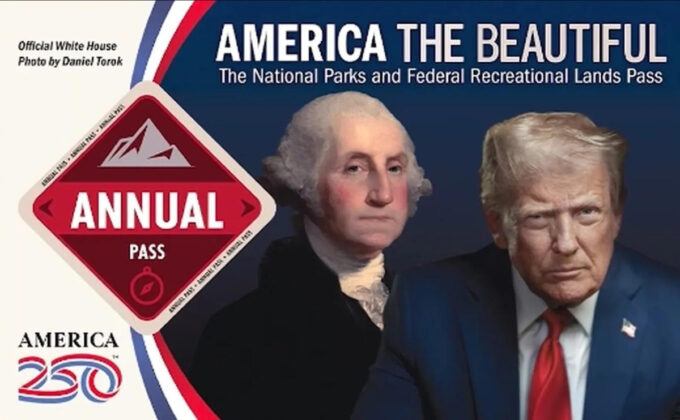
The 2026 America the Beautiful pass features George Washington and President Donald Trump. (screenshot via Department of Interior)
When critics suggest potential illnesses President Donald Trump might have, they point to evidence of a possible ailment. They notice bruises on his hands, swollen joints, dozing off during televised meetings, and his rambling, disjointed speeches. However, they never identify the one hallmark of a serious illness that he had shown even before he became president.
It is a mental condition officially defined and diagnosed by the American Psychiatric Association’s Diagnostic and Statistical Manual of Mental Disorders as Narcissistic Personality Disorder (NPD). Research suggests that between 1.3 and 13 million American adults may have it, with most being male. The Cleveland Clinic’s study found that having NPD involves an excessive need to impress others or feel important, which can lead to harmful behaviors toward others.
A first response to this possibility might be, “So what? Past presidents have been narcissistic.” However, NPD goes beyond a few stereotypical behaviors or attitudes. As explained by Sandra Silva, senior editor at Health Line Media, it’s a matter of continually distorting reality that hinders making rational decisions. But it is never a personal choice; like other illnesses, it cripples one’s ability to function normally.
The most recent example of a president accused of being a narcissist was Richard Nixon, who exhibited at least two of the nine symptoms of narcissistic personality disorder: a willingness to exploit others and fantasies about deserving success. Both symptoms are found in Trump’s behavior.
The first trait is seen when Nixon pressured Donald Alexander, the Republican he appointed as the Commissioner of Internal Revenue, to investigate those on Nixon’s notorious list of political enemies. Alexander refused, and although Nixon failed to get him fired, Nixon agreed to retain him when existing protocols did not allow it.
In comparison, Trump called Georgia Secretary of State Brad Raffensperger to overturn that state’s voter results so he could win the 2020 election. Raffensperger refused because Trump’s claims of voter fraud were not found, even by Trump’s own campaign. In retaliation for non-compliance, Trump filed four lawsuits against Raffensperger but withdrew them after failing to provide evidence and refusing to testify under oath.
Nevertheless, Trump ignored all evidence and continued to state that he had “won by hundreds of thousands of votes.” Trump then endorsed Representative Jody Hice as a primary challenger to Raffensperger’s re-election, saying he had more integrity than Raffensperger. Hice tried to get the U.S. Senate to object to Georgia’s electoral votes, but no senator joined his objection, so Congress did not debate it.
In the second expression of an NPD trait, Nixon privately believed his loss to John F. Kenndy was a stolen election and quietly encouraged Republican efforts to investigate irregularities. Nevertheless, three days after the election, he declared he would not contest it, saying that he wanted our American tradition of holding elections shouldn’t be marred by “wrangling over the results” through court challenges.
In comparison, Trump and his allies filed 60 lawsuits challenging election processes, vote counting, and vote certification in 9 swing states that could have secured him the victory. About 80% of these were dropped or dismissed, with only one case ruled in favor of Trump, which the Pennsylvania Supreme Court later overturned.
Donald Trump shows these same two symptoms, but unlike Nixon, Trump’s narcissism ignores the established norms and procedures of our republic. That’s because he has another of the nine key symptoms, which is a belief in superiority.
This is the most dangerous trait that the leader of a democratic republic could exhibit. It portrays Trump as refusing to accept that he fairly lost the 2020 election and as seeing himself as superior to the nation’s governmental institutions. This includes ignoring his own Attorney General, William Barr, and the Department of Justice, by rejecting a letter from sixteen federal prosecutors monitoring the election, stating that there was no evidence of widespread irregularities. He also continues to position himself as superior to Congress, whose laws he ignores, and to the judicial system, such as the judges who rule against those he considers corrupt or radical leftists.
There are six other symptoms that help determine whether a person has a Narcissistic Personality Disorder. Keep in mind that most people with the condition aren’t even aware of their symptoms and how they may affect their relationships, no matter how intense and pervasive they may be.
This is an illness that one can’t hide because it manifests itself publicly, even though the person may not necessarily be conscious of having it. It’s not like measles or some disease that is visible as an illness. It can only be detected by behavior.
Although a study led by University of Chicago Medicine psychiatrist Royce Lee, MD, finds that Narcissistic Personality Disorder (NPD) is marked by increased oxidative stress in the blood, there may be measurable physical changes down the road that could serve as markers for NPD. For now, we need to rely on what we observe.
Six other symptoms of NPD that characterize Trump’s repeated behavior.
Grandiose sense of self-importance – Exaggerating their achievements.
For any nation’s leader, there can be no more prestigious award than receiving the Nobel Peace Prize. Over the last 120 years, only four presidents have received that award: Theodore Roosevelt (1906), Woodrow Wilson (1919), Jimmy Carter (2002, post-presidency), and Barack Obama (2009).
Donald Trump believed he deserved one as early as the second year of his first term, saying he earned the honor for his efforts to avoid a war with North Korea. The following year, he said he “would get a Nobel Prize for a lot of things.” In June 2025, he again told reporters that he “should’ve gotten it four or five times” for his work on various peace deals, such as the Abraham Accords. He has repeatedly claimed that he deserves the prize, but they only give it to liberals, despite his unmatched achievements.
Frequent envy – Belittling or diminishing the achievements of others.
Trump has a record of diminishing the achievements of other presidents in comparison to his own accomplishments. He has repeatedly claimed that Barack Obama “got a prize for doing nothing,” most prominently just before the 2025 Nobel Peace Prize announcement. He also diminishes Abraham Lincoln and George Washington in comparison to himself.
Shortly after announcing his third run for the presidency, he released a video saying, “This is Donald Trump, hopefully your favorite president of all time, better than Lincoln, better than Washington.” Harold Holzer, chairman of the Lincoln Forum, noted that “The trouble with Trump’s use of Lincoln is that it’s kind of malice toward some, and then malice toward many and ultimately, even malice toward Lincoln.”
Entitlement – Anger when people don’t cater to or appease them
Atlantic writer David A. Graham notes that Trump “has a record of repeatedly threatening and intimidating judges, witnesses, prosecutors, and even the family of prosecutors involved in the cases against him.” And there is Trump’s response to his crowd of supporters chanting to lynch Pence while they stormed the Capitol. Cassidy Hutchinson, a former aide to Donald Trump’s White House Chief of Staff, Mark Meadows, testified before Congress that Trump was indifferent to their chanting and thought that Mike “deserved it.” Adding, “Maybe our supporters have the right idea.”
Lack of empathy – • Saying things that might hurt others
When Rob Reiner, the legendary Hollywood director, was stabbed to death in his home, along with his wife Michele, every commentator expressed unrestrained sympathy, except one – President Donald Trump. He did say that “A very sad thing happened,” and ended his comments with “May Rob and Michele rest in peace!”
Sandwiched between those two notes of modulated grief, the other 90% of the message was a tirade belittling Reiner, first as the “once very talented movie director.” He quickly launched into an accusation that Reiner was deranged and afflicted with a mind-crippling disease known as TRUMP DERANGEMENT SYNDROME (all caps by Trump). His paranoia was increasing “as the Trump Administration surpassed all goals and expectations of greatness.” This isn’t a thought-out political attack on a threatening enemy. This is an unmitigated outburst of anger that begins with unsympathetic insensitivity and roils into self-grandiosity.
Arrogance – Talking down or acting condescendingly.
Although there are many instances of Trump talking down to others, the most widely televised example of his arrogance and condescension was his meeting in the Oval Office with Ukraine’s President Volodymyr Zelenskyy.
After Trump firmly stated he would not offend Putin he attacked Zelensky as a person filled with hate, not reason. “He’s got tremendous hatred. You see, the hatred he’s [Zelensky] got for Putin, it’s very tough for me to make a deal with that kind of hate.” Zelensky had not criticized Putin in the meeting before Trump made these accusations. Trump bluntly told Zelensky, “You don’t have the cards. You’re buried there. You people are dying.” Before having Zelensky unceremoniously ushered out of the room, he warned him that Ukraine had no option but to acknowledge America’s power.
Need for admiration – Fishing for compliments.
Trump’s need for admiration is on display as he televises his cabinet meetings, where each member expresses their unrelenting, often insincere, adulation, some calling him the “peace president,” or asking all to view a a gigantic three-storey banner in front of the Department of Labor, of his “beautiful face” next to the American flag and President Teddy Roosevelt.
But that is not enough. Seattle Times columnist Danny Westneat details how Trump pushed aside roughly 7,000 amateur photographers, who competed to have their photo of nature featured on the national parks’ America the Beautiful access cards. Trump replaced the winning photo of Glacier National Park in Montana with his face, calling it more of a “bold, patriotic design.” Some would consider his glaring image as a tribute to Mother Nature ironic, given that Trump has slashed park staff and budgets, while also diminishing protections for wildlife and wilderness areas. Not to mention that Trump ignored the process Congress set up for thousands of citizens to participate in a fair contest to choose a winning photo.
Is this enough evidence that Trump is suffering from a Narcissistic Personality Disorder?
After reviewing this panoply of behaviors, you have to ask yourself: has there ever been a president who has exhibited such consistent behavior in line with these traits to this extent? It would take a dedicated scholar to find one who matches the magnitude of Trump’s achievement on the NPD scoreboard.
Nevertheless, if you don’t treat Trump’s behavior as an illness, you are inclined to ridicule, dislike, or admonish him. But you wouldn’t respond that way if someone were ill with COVID. You would be sympathetic and try to help that person heal. Here’s the problem: a narcissist refuses to be treated because they don’t believe they are ill. It is up to their friends to help them change their behavior.
Trump’s narcissism is sabotaging his own party.
The Republican Party is obliged to alter Trump’s behavior, or they will be accused of being sycophants to the narcissistic president. Since most Republican politicians have been cowed into silence, he continues to act as he pleases. Why not? As a narcissist, he interprets everything he does as a success. Anyone who is honest with him is cast aside or fired.
Republicans need to be honest with themselves and confront Trump. They may agree with his general policies, but his narcissism is beyond his control. It is a malady that is leading him to behave like an autocrat, undermining our republic’s institutions and the integrity of his party. So far, they have failed because they have no leader willing to challenge Trump.
Conservative pollster Mark Mitchell had a personal White House luncheon with Trump, arguing that his behavior may cause the Republican Party to face significant losses in the 2026 midterm elections. Trump preferred to discuss his golf game, despite Mitchell saying, “Building billionaire-funded ballrooms and jet-setting around the world and trillion-dollar investment deals looks a lot like oligarchy stuff.”
Are Republicans beginning to realize they have been following the whims of a single, narcissistic person who is more concerned with his own needs than with the public’s? If not, ordinary, non-political people are. They are abandoning the Republicans to vote for Democrats, as evidenced by Democrats winning in Congressional Districts that voted overwhelmingly for Trump in 2024.
The bottom line is that unless Republican politicians take steps to dramatically distance themselves from Trump, confront him, or remove him from office, there will be fewer Republicans in Congress after November and no Republican president winning in 2028.
The post Trump Can’t Hide His Most Serious Illness appeared first on CounterPunch.org.
From CounterPunch.org via this RSS feed
Critics have been saying this for years. This isn’t new info.