

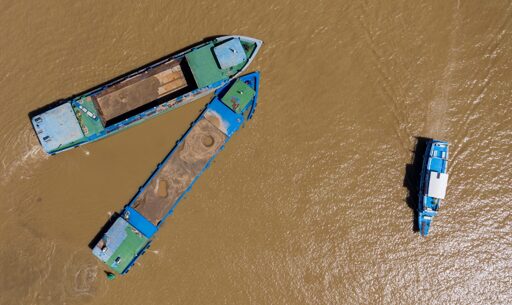
Rampant sand mining in the Mekong River is directly weakening critical seasonal river flows that sustain Southeast Asia’s largest freshwater lake, new research indicates. The Mekong’s annual wet season flood pulse that feeds water into Cambodia’s Tonle Sap Lake has been dwindling year by year. Experts have long pointed to upstream hydropower dams in China and Laos that trap sediments and alter the Mekong’s flow, combined with droughts intensified by climate change, as major drivers of the gargantuan river system’s declining vitality. A new study by researchers from the U.K. and Vietnam now shows that sand mining in the Lower Mekong Basin countries of Cambodia and Vietnam has a far greater impact on the flood pulse-lake dynamics than previously understood. “Upstream dams do have a measurable effect,” said lead author Quan Le, a flood risk researcher at Loughborough University in the U.K. “However, the primary driver of the declining Tonle Sap flood pulse is extensive downstream sand mining.” The Mekong’s heartbeat Tonle Sap Lake, a UNESCO Biosphere Reserve, lies within the lower basin of the Mekong River, the world’s second-most biodiverse aquatic ecosystem (after the Amazon). Each wet season, the lake swells up to five times in size as the Mekong’s annual flood pulse surges up the Tonle Sap River, reversing its flow. The situation then flips during the dry season, when water flows out of the lake downstream into the densely populated Mekong Delta. This rhythmic expansion and contraction is often referred to as the Mekong’s “heartbeat” due to…This article was originally published on Mongabay
From Conservation news via this RSS feed