

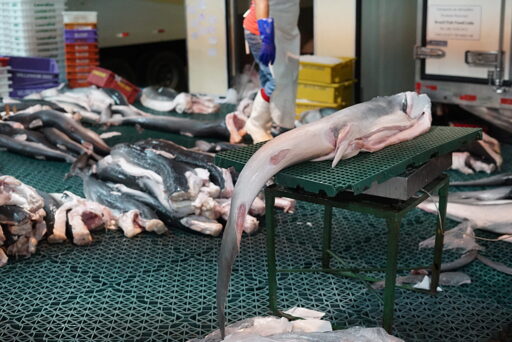
A Mongabay investigation that revealed Brazilian state-run institutions bulk-buying shark meat for public schools, hospitals and prisons has won second place in the national category of the 67th ARI/Banrisul Journalism Award, one of the country’s most prestigious journalism prizes. Mongabay, working in collaboration with the Pulitzer Center, published the investigation in late July revealing that Brazilian authorities had issued 1,012 public tenders since 2004 for the procurement of more than 5,400 metric tons of shark meat, worth at least 112 million reais ($20 million). These tenders were issued by 542 municipalities in 10 of Brazil’s 26 states, raising environmental and public health concerns. Shark meat can contain high levels of mercury and arsenic, which scientists say can be harmful to human health when consumed in large quantities; at the same time, overfishing can deplete populations of sharks, which are recognized as critical to the marine environment. A second article published as part of the investigation found that government agencies across Brazil’s southernmost state, Rio Grande do Sul, had issued tenders for at least 211 metric tons of angelshark, which are endangered. In a Dec. 12 statement announcing the ARI/Banrisul award, the Rio Grande do Sul Press Association (ARI) said the award “recognized the talents” in professional and university categories amid a record number of entries, up 40% from the 2024 edition. Senior editor Philip Jacobson and investigative reporters Karla Mendes and Fernanda Wenzel were the Mongabay authors of the two-part investigation, along with Kuang Keng Kuek Ser, the Pulitzer Center’s…This article was originally published on Mongabay
From Conservation news via this RSS feed
You must log in or # to comment.