

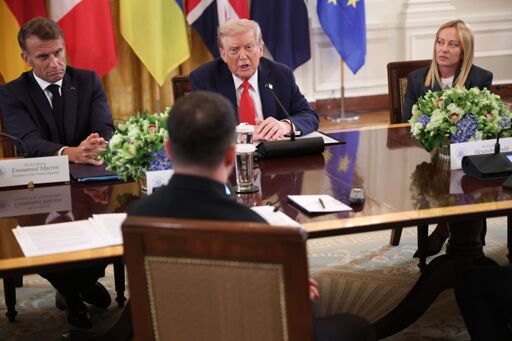
As President Volodymyr Zelensky unveiled details of a U.S.-Ukraine draft peace plan on Dec. 24, aimed at ending Russia’s full-scale war, two key provisions remain unresolved.
The disagreements center on provisions 12 and 14 of the 20-point proposal. Both deal with issues Kyiv calls existential: territories and the future of critical infrastructure.
The Kyiv Independent breaks down where negotiations are stalling and what Ukraine is offering instead.
Read also: Zelensky reveals full 20-point peace plan draft backed by Ukraine, US
Power station and power plant
One of the most contentious issues lies in the proposed management structure of the Zaporizhzhia Nuclear Power Plant, Europe’s largest nuclear facility.
Located in the occupied city of Enerhodar, the plant produced around 20% of Ukraine’s electricity before Russia launched its full-scale invasion.
Under the U.S.-backed framework, the plant would be operated jointly by Ukraine, the United States, and Russia, with all three parties sharing economic benefits.
Ukraine fears that a trilateral management model would effectively legitimize Russia’s occupation of the facility, which Moscow seized in 2022 and continues to hold.
“The Russians believe that they will, in any case, make it so that the Zaporizhzhia Nuclear Power Plant is operated by them,” Zelensky said, warning that Moscow could frame its role as a humanitarian necessity tied to restoring water supplies to occupied territories.
The Ukrainian president also pointed to pre-war experience with joint enterprises involving Russia, which often left Kyiv exposed to Moscow’s leverage.
Instead, Ukraine is proposing a bilateral alternative: a joint Ukrainian–American enterprise with equal operational control.
Half of the electricity would be directed to Ukraine, while Washington would independently decide how to use its share — potentially allowing electricity to be supplied to Russian-occupied areas without granting Moscow operational control.
The nuclear issue cannot be separated from the fate of the Kakhovka Hydroelectric Power Plant and dam, which Russian troops destroyed on June 6, 2023.
Zelensky stressed that the dam must be rebuilt to ensure the safe operation of the Zaporizhzhia plant — and that Russia has no intention of paying for it.
“The Kakhovka Dam and the Kakhovka Hydroelectric Power Plant, which are necessary for the safe and normal operation of the Zaporizhzhia Nuclear Power Plant, could be rebuilt as a joint regional prosperity project with a similar operational structure.”
Crucially, Ukraine insists that the entire area — the nuclear plant, Enerhodar, and the Kakhovka facilities — must be fully demilitarized.
Territorial disputes
Provision 14 addresses what Zelensky has described as the most difficult issue in the talks: the future of territories in Donetsk, Luhansk, Zaporizhzhia, and Kherson oblasts.
The framework proposes recognizing the current line of troop deployment as a de facto line of contact, effectively freezing positions on the ground.
“So we are in a situation where the Russians want us to withdraw from Donetsk Oblast, while the Americans are trying to find a way for us not to withdraw because we are against withdrawal,” Zelensky said.
Ukraine’s baseline position, which Zelensky calls “option A,” is to remain where its forces are currently deployed. Moscow, by contrast, is demanding that Ukraine pull troops out of parts of Donetsk Oblast that Russian forces have failed to capture.
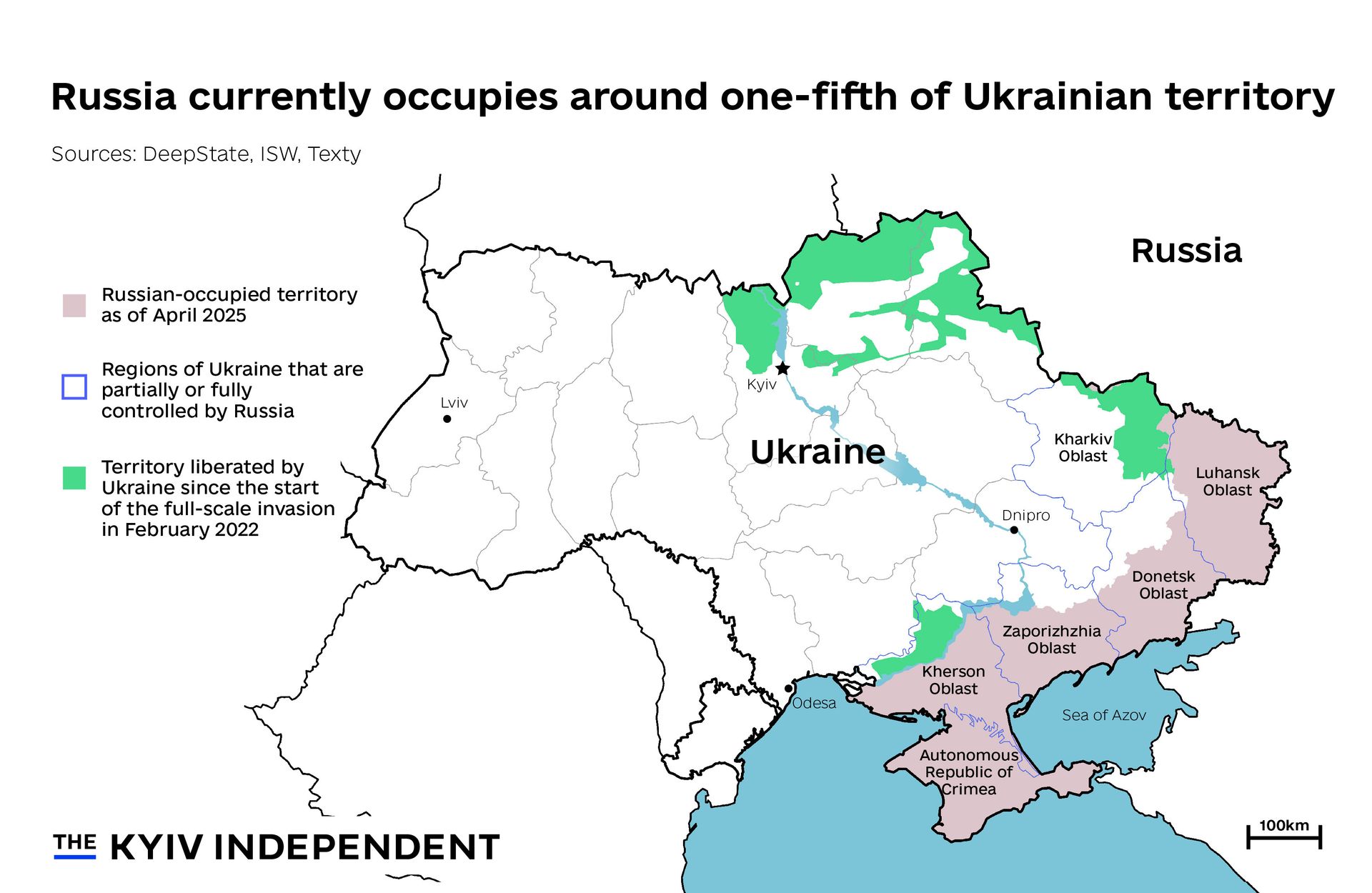
A map of Ukraine and its Russian-occupied territory. (Lisa Kukharska / The Kyiv Independent)
To bridge this gap, U.S. negotiators are exploring mechanisms such as demilitarized zones or free economic zones — formats they believe could satisfy both sides.
Zelensky said Ukraine fought to ensure that any reference to such zones remains explicitly “potential,” preventing automatic implementation.
Under Ukraine’s interpretation, any concrete decision would require domestic legal procedures, parliamentary approval, or, if necessary, a referendum.
The draft envisions a working group to determine troop redeployments and parameters for any special economic zones, but Kyiv insists that progress depends on Russian withdrawal from occupied areas.
Zelensky pointed to Enerhodar as a possible test case. A small free economic zone there could be feasible, he said, but only if the city is demilitarized, placed under Ukrainian administration, and Russian troops withdraw.
The plan also stipulates that redeployments in Dnipropetrovsk, Mykolaiv, Sumy, and Kharkiv oblasts must occur first for the agreement to take effect.
Zelensky also stressed that referendums remain a last resort.
“A referendum requires at least 60 days; otherwise, we cannot hold it… Some people live in temporarily occupied territories and cannot vote,” he said.
Zelensky argued that if Ukrainian troops are allowed to stay in their current positions without withdrawing, a referendum might not be necessary at all.
“But if we do not agree to ‘remain where we are,’ there are two options: either the war continues, or something will have to be decided regarding all potential economic zones.”
Russia’s position
Publicly, the Kremlin has remained evasive.
Kremlin spokesperson Dmitry Peskov avoided direct comment on the revised plan while responding to questions from journalists on Dec. 24.
Peskov confirmed only that Russia’s top economic negotiator, Kirill Dmitriev, briefed President Vladimir Putin on talks with the U.S. delegation in Miami.
Ukrainian and U.S. representatives held another round of talks on Dec. 21, following Ukrainian–U.S. discussions on Dec. 19 and Russian–U.S. talks on Dec. 20, all in Miami.
Based on these exchanges, Peskov said Moscow would “formulate its further position” and continue contacts with Washington through existing channels.
A source familiar with the matter told the Kyiv Independent that no U.S.–Russia talks are expected to take place on Dec. 24.
Read also: Poll shows 55% of Russians expect war to end in 2026 — and want life back to ‘normal’
Read also: Putin issued a decree. Now, thousands of Ukrainians face losing their homes
From The Kyiv Independent - News from Ukraine, Eastern Europe via this RSS feed