

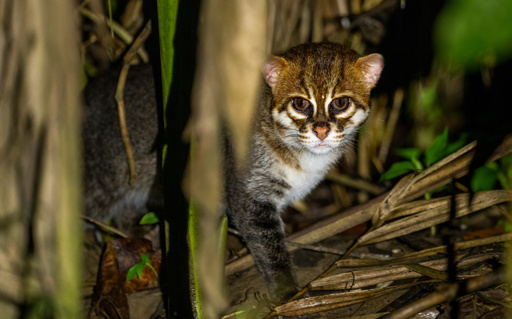
Flat-headed cats haven’t gone extinct in Thailand after all. A population is clinging on in the peat swamp forests of Princess Sirindhorn Wildlife Sanctuary, in the country’s south, after eluding detection for nearly three decades. Camera traps set up by wildcat NGO Panthera and Thailand’s Department of National Parks, Wildlife and Plant Conservation (DNP) picked up 13 records of flat-headed cats (Prionailurus planiceps) in 2024 and a further 16 earlier this year. “Rediscovering flat-headed cats in southern Thailand is an extraordinary moment for conservation,” Wai Ming Wong, Panthera’s small cat conservation science director, told Mongabay via email. In what Wong describes as a “profoundly encouraging” sign, they also spotted a female with a cub. “It shows that, where wetlands and river systems remain intact, even the most elusive and threatened carnivores can persist,” he added. A camera-trap image of a flat-headed cat and cub in Princess Sirindhorn Wildlife Sanctuary, Thailand. Evidence of reproduction is encouraging, particularly as flat-headed cats birth only one cub at a time. Image courtesy of DNP/Panthera. This elusive felid, one of the world’s most endangered and least-known wild cat species, was last spotted in the country by researchers in 1995 on the Thailand-Malaysia border. That led to the IUCN, the global wildlife conservation authority, declaring it was “possibly extinct” in Thailand, in its last assessment of the species, in 2014. Flat-headed cats are also present in wetlands and tropical rainforests in Borneo, Sumatra and Peninsular Malaysia, with the species’ total population estimated to be around 2,500 across…This article was originally published on Mongabay
From Conservation news via this RSS feed
You must log in or # to comment.