

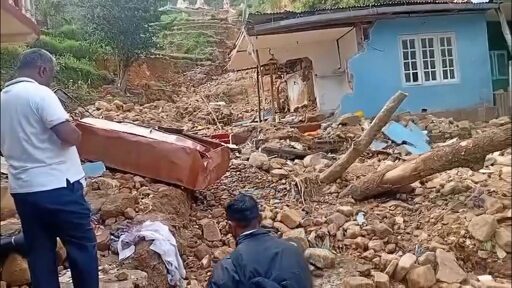
ARANAYAKA, Sri Lanka — Bandara Jayaratne from Beraliya, a village in the Aranayaka region in Sri Lanka, is among the fortunate individuals who escaped a landslide on Nov. 28 that occurred right behind his house. Landslides aren’t a new phenomenon in this part of the country. In 2016, at least a 100 people died when a massive landslide occurred in the same area. It also displaced more than 2,000 families and affected some 350,000 people. Due to the vulnerability of this location, many families were evacuated in 2016, but most returned to their homes once the weather conditions improved. Today, though, after the landslides triggered by Cyclone Ditwah at the end of November, many residents say they’re reluctant to return home, and are instead awaiting assistance from the government for relocation to safer sites. “I managed to take my parents to a relative’s house near the town as a temporary measure,” Jayaratne, who is temporarily displaced, tells Mongabay. “Right now, I’m unable to go to my house as the roads are still blocked and my house is no longer safe to be inhabited.” Features of a disaster-resilient house suitable for slopes according to Sri Lanka’s newly formulated hazard-resilient construction manual. Image courtesy of NBRO. Cyclone Ditwah affected thousands of people like Jayaratne, who saw their homes damaged or outright destroyed by landslides. The recent most report from Sri Lanka’s Disaster Management Centre (DMC) says 6,228 houses were fully damaged, and more than 100,000 partially damaged. A landslide hazard zonation mapping…This article was originally published on Mongabay
From Conservation news via this RSS feed