


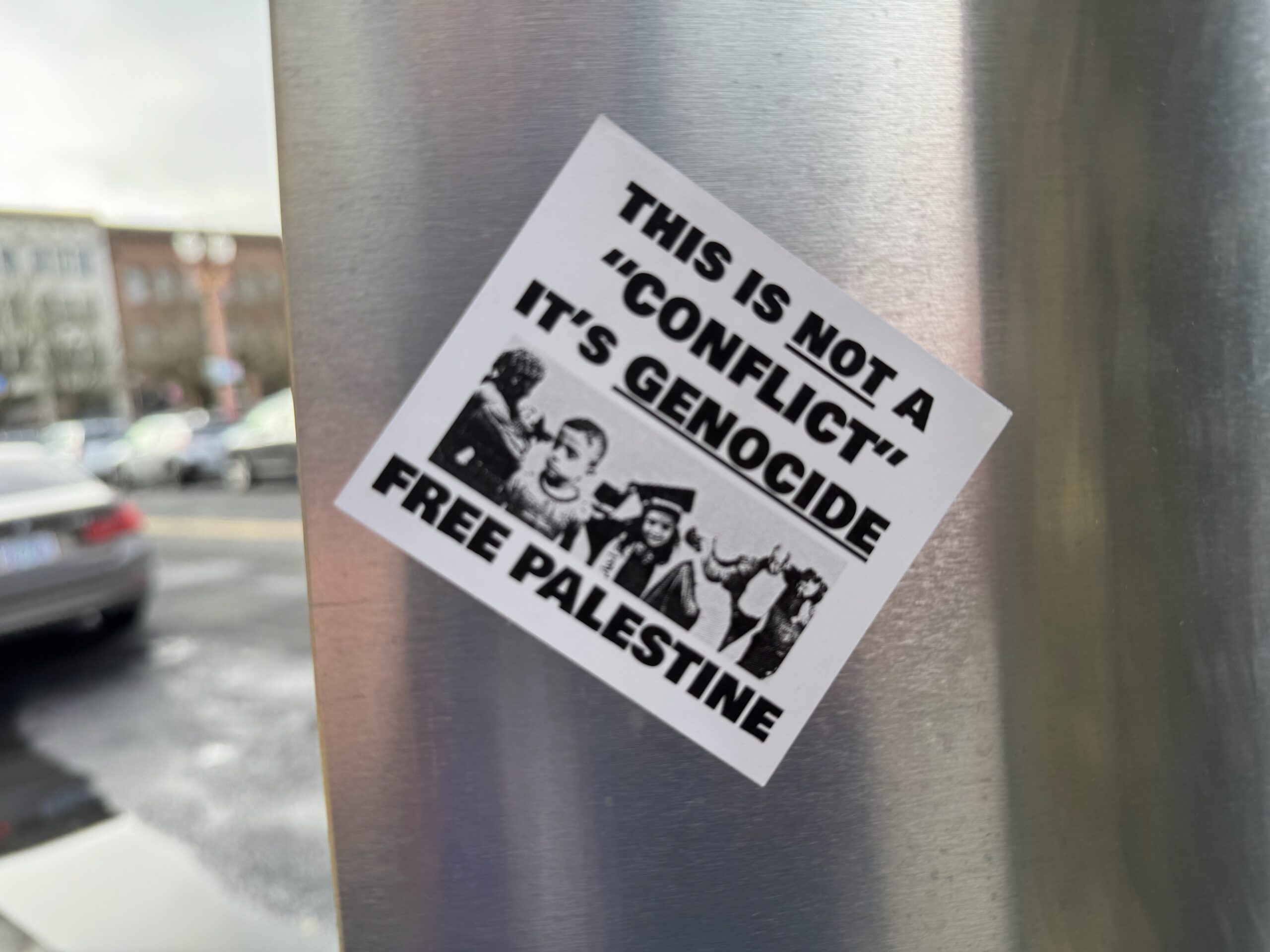
Photograph by Nathaniel St. Clair
After October 7
Throughout this period, challenging the adequacy of the UN in the face of genocide, there were reasons to redeem its reputation, including an awareness that its refusal to respect judgments of the leading international tribunals (International Court of Justice and International Criminal Court). It needs to be better understood that when the UN was established 80 years ago the Charter design gave the last word on issues of global security to the five winning states in World War II, and not to international law as believed by its most ardent champions. By clear intention, despite the priority accorded war prevention in the Preamble to the Charter, the capabilities of the UN to act coercively against aggression, apartheid, and genocide were withheld from the Organization. Instead, the winners (that is, the five permanent members of the Security Council of P5) of the recently concluded war against fascism were also given a right of veto that amounted to a limitless entitlement of any one of the five in the only UN political organ with the authority to make binding decisions, and this provision meant not only an opting out of decisions contrary to their will but of preventing Security Council from acting even when the other 14 members were united in voting for the decision. In practice, this meant that prospects for peace and security in major conflict situations were left to the geopolitical calculations and alignments of these most powerful and dangerous members of the new organization.
During the Cold War, which prevailed globally between 1945-1991, the paralysis of the UN in relation to the management of global security was mainly due to the discretion at the disposal of the opposed alliances of the US-led NATO forces on one side of the ideological divide and strategic rivalry and Soviet-led Warsaw forces on the other side. The UN contented itself with being a spectator, or site of opposing propaganda denunciations as regarding the Vietnam War, Moscow’s interventions in Eastern Europe, and other settings of violent conflict involving the strategic interests of the P5. This was partly due to the constitutional framework of the UN, but it also reflected the unwillingness of many leading countries to dilute sovereignty when it came to national security. This refusal was most dramatically illustrated by the rejection of nuclear disarmament and a preferred reliance on deterrence, exhibiting the militarist orientations of foreign policy elites in leading governments. It blends a militarized hard power version of global security with P5 strategic ambitions to reinvent Western domination in a period of collapsing European colonialism.
Against this background, the role of the UN, while disappointing, was not surprising given the strong ties between the white West and Israel in this encounter with a Muslim majority Palestine in the strategically important Middle East. This lent the struggle an inter-civilizational dimension while also posing a challenge to Western hegemony in relation to energy reserves, arms sales, and more generally, trade and investment. This line of interpretation was accentuated by the anti-Western, religiously oriented Hamas, a non-state entity that was characterized in Western media and state propaganda as nothing other than a terrorist organization. Such a posture ignored the 2006 political victory of Hamas in an internationally monitored election and its role as the center of legally grounded Palestinian resistance to an Israeli occupation that consistently violated international humanitarian legal standards as set forth in the 4th Geneva Convention of 1949 governing ‘belligerent occupation.’ UN members complicit with Israel supported the genocide in Gaza for two years, stepping back from support mainly because of the rise of public protest activity in their countries, as Israel had exceeded all constraints of law and morality in persisting with its genocidal campaign. It should be appreciated that the ICJ by a near-unanimous vote on July 19, 2024, declared continuing Israeli occupation of Gaza and the West Bank (and even East Jerusalem) to be unlawful, decreeing its withdrawal, an outcome that the General Assembly formally supported and Israel and its support group ignored.
This political agenda explains the six ceasefire initiatives that were vetoed in the Security Council, combined with the failure of complicit states, above all, the United States, to use its soft power leverage to induce Israel to stop its assault on Gaza and satisfy the legitimate grievances of the Palestinian people. Such a willingness is inhibited by adhering political realism of the pre-nuclear age and the special interests of the arms industries and a long militarized governmental bureaucracy.
The Disgraceful UN Response to the Trump Plan
In my view, the 15 members of the Security Council, disgracefully voted unanimously in favor of the US draft resolution, adopted as SC Resolution 2803 on November 17, 2025, endorsing the Trump Plan for the stabilization of Gaza. The plan emerged with the approval of Israel, significantly unveiled during a Netanyahu visit to the White House at a joint press conference. The core feature of the plan was to reward the perpetrators of prolonged genocide, preceded by apartheid and resulting in making a wasteland of Gaza. Not only were there no references in the resolution to Israel’s defiance of rulings of the International Court of Justice, resolutions of the General Assembly, or the assessments of independent scholars and genocide. Neither Israel nor the United States, nor the other complicit states were even obliged to pay reparations for the unlawful damage caused in Gaza, but this was left to be sorted out by the combined forces of vulture capitalism operating freely as if Gaza reconstruction was a real estate venture and the monetary contributions of Arab governments.
In this process, not only was the diplomatic framework imposed on the Palestinians, but the US was accepted as the legitimate ‘peacemaker’ although it was overtly collaborating with Israel in drafting the plan and pointedly excluding Palestinian participation. Indeed, the US Government went so far as to deny visas to any Palestinian Authority delegate who sought to attend the General Assembly meeting of the UN or to otherwise take part in UN proceedings shaping Palestine. What makes the resolution a step backward if the objective had been what it should have been, arrangements for a peaceful and just future crafted with the participation of proper Palestinian representation and dedicated to a just and durable peace?
Instead, SC Resolution 2803 if considered as a whole, indirectly exonerates the culprits for their past behavior, carrying impunity to an extreme. Beyond this, 2803 visibly acknowledges US total control of the present diplomatic efforts to replace unrestrained Israeli violence with a ceasefire that Israel ignores at its pleasure. The bloody result has been hundreds of lethal violations of the ceasefire killing up to now of over 400 Palestinians by estimates of the Gaza Health Ministry, without Israel even being reprimanded by Washington for so abusing a ceasefire deal. Why Hamas tolerates this Israeli practice of accepting the ceasefire while continuing with genocide at a decelerated rate, and exhibiting indifference to the persistence of widespread severe suffering among the entire Gazan population of two million?
As to the future, 2803 endorses a colonialist transitional arrangement given operational reality by a Board of Peace, of course chaired by none other than Donald Trump and given stability in Gaza by the formation of an International Stabilization Force to be formed by the contributions of troops by UN members endorsing the plan. The US has brazenly acknowledged its own transactional goals by pledging $112 billion to rebuild Gaza as a global hub for trade, investment, and tourism. Governance in Gaza is left in part to Israel which seems to be claiming a permanent security presence in northern Gaza above the so-called yellow line.
Given the highly dubious manner of recovering from the Gaza catastrophe at this late stage, how can we explain its widespread international support and the disappearance of opposition in the Security Council? The five SC members from the Global South (Algeria, Somalia, Guyana, Sierra Leone, and Panama) made some critical comments about 2803 during the formal discussion that preceded the vote, centering on its vagueness as to crucial details and even its one-sidedness, yet all ended up voting in favor. Did such a vote reflect genuine agreement, or more likely, was it a vote that recognized geopolitical primacy when it came to the management of global security? And why would Indonesia and Pakistan, Muslim majority countries, even if not members of SC, go out of their way to express approval of the 2803 path to the future? More understandable was the approval expressed by the European Union, which again served as a reminder that Israel’s treatment of Palestinians is part of Judeo-Christian civilizational long game of sustaining Middle Eastern hegemony.
As troubling was the endorsement of 2803 given by the UN Secretary General, Antonio Guterres, who not only welcomed the resolution but expressed the hope that its momentum would be converted into “concrete action.” Thankfully, UN Special Rapporteur on Human Rights in the Occupied Palestinian Territories, Francesca Albanese, expressed “serious concern with the Security Council’s adoption of resolution 2803, warning that it runs counter to the Palestinian right to self-determination, consolidates Israël’s unlawful presence in the occupied Palestinian territory, including ongoing unlawful policies and practices, and therefore risks legitimating ongoing mass violence.” Revealingly, Albanese spoke these words of truth to power after enduring punitive sanctions imposed in July for her courageous willingness to bear official witness to what was becoming all too clear to the eyes and ears of the peoples of the world. It is ironic that the UN’s response to 2803 was somewhat rescued from the taints of complicity by an unpaid appointee not subject to UN discipline. Her words are congruent with those of Craig Mokhiber who resigned from a senior position at the UN because of its failure to deal responsibly with respect to Palestinian grievances, and in the last couple of years emerged as the most informed and incisive critic of the UN approach, reinforcing Albanese’s forthrightness on behalf of law and justice with respect to Palestinian grievances and rights, but the Organization’s own transactional approach in clashed between geopolitical imperatives and compliance with the UN Charter.
It also seems strange that Russia and China, although voicing some criticisms during the discussion, did not use their right of veto to block the passage of 2803, especially given the frequent use of the veto on Israel’s behalf by the US and considering the principles at stake. It is likely that they were impressed by Hamas’ acceptance of the overall approach and did not want to be seen as spoilers held responsible for a breakdown of the Trump Plan that would have undoubtedly meant the end of the already tarnished ceasefire. Additionally, China and Russia both seem to regard global stability as dependent upon a degree of geopolitical reciprocity in relation to their trilateral relations. In this limited sense, Trump seems more in accord with how cooperative relations with these two countries would bring stability and transactional gains than did the Biden approach of fighting Russia by way of Ukraine to preserve US post-Cold War dominance, a path that increased the risk of a third world war fought with nuclear war leading to a lengthening of the Ukraine War with heave casualties on both sides. Trump’s approach, although fragile because of his mercurial style, stressed geopolitical stability if it meant accepting spheres of influence as compromising the sovereignty of smaller states and even, as here, overlooking genocide.
The rejection of 2803 by Hamas was not entirely a surprise. It does not explain why Hamas ever accepted the Trump diplomacy at its outset, except for its ceasefire and IDF withdrawal prospects. Hamas’ acceptance extended to the whole of the Trump plan, but with this stand against 2803 and its announced refusal to disarm it may now be either the basis of a better compromise or at least a stalemate as to further progress. Hamas, and Iran, the other vocal critic of the resolution, also undoubtedly are reacting to the absence on Israel’s part of any willingness to show signs of embracing a politics of reconciliation, even to the extent of conscientiously upholding the early ceasefire, partial withdrawal, and an end to the rigid constraints on humanitarian aid. For Israel to have shown no mercy to a population living without heat, secure shelter, and adequate food and medical supplies is to send the chilling message that Israel has not even considered abandoning its expansionist ambitions that include further ethnic cleansing in Gaza and a surge of settlement growth on the West Bank.
+++
The US representative insisted that “[a] vote against this resolution is a vote to return to war” was part of the ‘take it or leave it’ Trump approach. Nor is it surprising that Netanyahu hailed the endorsement of 2803 by declaring “that President Trump’s plan will lead to peace and prosperity because it insists upon full demilitarization, disarmament, and the deradicalization of Gaza.”[15] Or that France and the UK sugarcoated their endorsements of the Trump Plan by verbal statements of conditional support for eventual Palestinian statehood as affirmed in its sponsorship of the New York Declaration, envisioning future Palestinian representation under the authority of a reconstituted Palestinian Authority (PA), itself a creature of US/Israel dominated diplomacy that has evaded Palestinian self-determination, but now is being repurposed to implement the Trump Plan. The PA announced support for 2803 is a move calculated to convince Israel and the US that it can be counted upon to go along with their stabilization scenario despite its rejection of Palestinian grievances and denial of Palestine’s right of self-determination. Offering such ‘breadcrumb’ rewards to the PA, while disqualifying Hamas from any role in representing the Palestinian people is emblematic of the next phase of the Zionist end game involving the political surrender of Palestine and the elimination of Hamas and Palestinian resistance.
Concluding Remarks
The maneuvers of states, following their interests rather than the supposedly shared values associated with the UN Charter and the international rule of law, is to be expected given the history of international relations and the political realist orientation of most foreign policy elites. Nevertheless, it is regrettable, given the gross disregard of justice and rights, which pervades the Trump Plan and the diplomatic and hard power muscle at the disposal of the US. It does not augur well for meeting other world order challenges, including climate change, migratory flows, ecological stability, less inequitable distributions of wealth and income to individuals, states, and regions, as well as a more robust commitment to peaceful modes of conflict resolution.
This saga of 2803 is particularly unfortunate because it shows that the geopolitical management of global security extends beyond the veto power of the P5. For the sake of stability, the UN venue implicitly swallows the Israeli genocide to an unseemly extent by unanimously endorsing a neo-colonialist future for Gaza and impunity plus for Israel and its complicit supporters. Symbolic of this unseemly submission by the UN and its membership is the endorsement of 2803 by the UN leader, an individual declared persona non grata by Israel more than a year ago. Israel’s insulting dismissal of the UN as ‘a cesspool of antisemitism’ and the like should have at least led the Organization’s Secretary General to respond with stony silence to 2803 rather than kneel in submission. sending a shameful message to the world that, from the perspective of the UN, even genocide does not disqualify a state from receiving diplomatic and territorial rewards as long as the geopolitical actors or P5 remain on board. In effect, the dynamics of power politics are still making history, despite the disastrous consequences.
The post Shaming the UN by Ratifying Genocide appeared first on CounterPunch.org.
From CounterPunch.org via this RSS feed
You must log in or # to comment.