

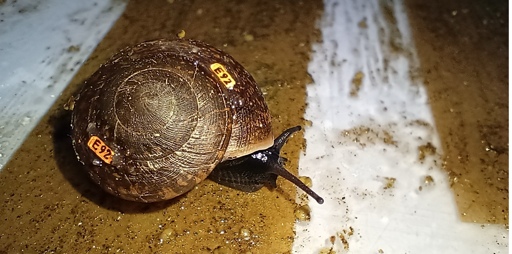
Rarely do species presumed extinct reappear with renewed hope for a better future. But researchers in Australia not only discovered a wild population of Campbell’s keeled glass-snail on Australia’s Norfolk Island in 2020 — they’ve now bred the snail in captivity and recently released more than 300 individuals back into the wild, where they’re multiplying. This translocation, according to the Australian Museum, is the first large-scale reintroduction of a snail species in Australia. Officially, Campbell’s keeled glass-snail (Advena campbelli) is still listed as extinct on the IUCN Red List, based on a 1996 assessment. In Australia, it’s considered critically endangered. In 2020, Isabel Hyman and colleagues from the Australian Museum, with the help of a Norfolk Island resident, confirmed there was still a small population of the snail living in a sheltered rainforest valley in Norfolk Island National Park. To boost its survival prospects, organizations including Sydney’s Taronga Zoo, Norfolk Island National Park, Western Sydney University and the Australian Museum started collaborated on a snail-breeding program at Taronga Zoo in 2021. The teams knew very little about the snail’s life history, diet, behavior, or what negatively impacts it, Hyman told Mongabay by email. But with “a lot of careful, painstaking work and record keeping from the husbandry team,” they began seeing progress, she said. The zoo-bred population of Campbell’s keeled glass-snail has now grown to more than 800 individuals. In June, the teams flew about 600 snails to Norfolk Island, which sits in the South Pacific, closer to New Zealand…This article was originally published on Mongabay
From Conservation news via this RSS feed