

The news cycle over the weekend was slower than usual, so I will take the opportunity to give everyone a well-deserved break. I will also take the opportunity to look forward and to look back on how this last year has changed us.
One of the most annoying features of year-end journalism is the obligatory genre of “predicting” what the coming year will bring. A brilliant person once said, “Making predictions is difficult, especially about the future.” (No, it wasn’t Yogi Berra or Niels Bohr.)
Political predictions are especially insidious. They are usually delivered by the popular political press to an anxious public desperate for certainty where none exists. Such predictions have as much likelihood of accuracy as throwing a handful of spaghetti against the wall and then applying a regression analysis to a sticky, stochastic mess. (It is not my intention to demean political analysis or analytical statistics. Both play an essential role in understanding our current situation. But in the hands of the click-baity press, they are sources of revenue, not information.)
The problem with political predictions is that they tend to overweight the past and underweight the ability of human beings to shape the future.
And the problem with the past is not just that it is past; it is not the future. No generation in human history has faced the specific set of challenges that we now face: A post-war, industrialized democracy that is still struggling to heal the wounds of a great civil war while being led by a narcissistic demagogue who seeks to reopen those wounds to maximize his profit in a post-truth world in which disinformation is currency.
Sure, every one of those conditions has existed at some point in the past in some combination, but not in the specific combination we face today. While the past is a valuable guide and helpful construct for sober reflection, it is not the future. We can affect the outcome of the future through effort and determination. (Nota bene: We cannot control the future; we can affect it.)
So, the next time you see an article that says, “Democrats will win XYZ and lose ABC races, meaning that they [Choose one: WILL [or] WILL NOT] regain control of [Choose One: the House [or] the Senate], think to yourself, “Oh yeah? We’ll just see about that!”
That is why I want to scream into my computer (or iPhone) every time I see an article that says, in effect, “These five races will determine whether democracy survives in America.”
Bullshit! (And I mean that in the nicest way possible!)
We will determine whether democracy survives! Spoiler alert: It will survive, so long as we do not quit. The struggle may be messy, difficult, and disappointing (at times), but so long as there exists a cadre of Americans willing to continue the fight, democracy will endure.
Predictions in the popular press about political outcomes should not be seen as limiting our opportunities for success—or for failure. The period between January 1, 2026, and November 3, 2026, is equal to infinity. Anything can happen—and probably will.
At this rate, everything Trump is doing is alienating his base and motivating those who opposed him in 2024, 2020, and 2016. We have plenty of room for upside, don’t let anyone dissuade you from striving every day to expand the Democratic comeback in the midterms.
We cannot rely on Trump and Republicans to defeat themselves, but we can take advantage of their hateful, divisive, destructive conduct to raise the alarm among the American people. We have 11 more months to do so. That is plenty of time—if we act with urgency!
Trump meets with President Zelensky at Mar-a-Lago.
The most significant news over the weekend was the meeting between President Zelensky and Trump at Mar-a-Lago. I confess at the outset that I am completely baffled by the disconnect between the headlines and the details of what transpired. I feel like I am in the Twilight Zone.
Much of the coverage suggested that the meeting resulted in significant progress. See The Guardian, Trump says Ukraine peace deal ‘closer than ever’ after meeting with Zelenskyy in Florida and The Hill, Zelensky: US, Ukraine negotiators agreed to ’90 percent’ of 20-point peace plan.
One problem with the disconnect is that the negotiations are being carried out through a series of unilateral US meetings with Ukraine and Russia, respectively. Worse, the lead US negotiators are real estate developer Steve Witkoff and the son-in-law of a real estate developer, Jared Kushner. The two hold separate meetings in which they apparently agree with whichever side they are speaking with, whereupon the absent party objects to the main points of agreement in the latest unilateral meeting.
While “shuttle diplomacy” was successfully used by Henry Kissinger, Witkoff and Kushner are not Henry Kissinger. As practiced by Witkoff and Kushner, shuttle diplomacy results in confusion and delay—both of which benefit Putin.
The New York Times got it right with its headline, Trump and Zelensky Meet to Iron Out Peace Plan, but Deal Remains Elusive | Subheader: The U.S. president said after a meeting at Mar-a-Lago that a deal was “maybe very close.” But a joint U.S.-Ukraine proposal appeared unfinished, as Russia rejected several ideas.
The above article is accessible to all.
The Times engaged in understatement when it wrote that “Russia rejected” several ideas.
The key component of Ukraine’s peace plan is security guarantees from Europe to enforce any ceasefire that results from the negotiations. “Security guarantees” involves the presence of European troops in Ukraine—including land seized by Russia in its war against Ukraine.
Russia’s foreign minister responded to the suggestion of European troops providing a security guarantee by warning that Russia would attack the peacekeeping troops. Per the Times:
On Sunday, Russia’s foreign minister, Sergey V. Lavrov, suggested in comments to Tass, a Russian news agency, that the Kremlin would not agree to European peacekeepers in the disputed territory of Donetsk. He added that the troops would be “a legitimate target” for Russia’s armed forces and accused Europe of being “the main obstacle” to peace in Ukraine.
When the main point of your peace proposal provokes a warning that it will expand a two-nation conflict into a regional conflict, that is not “progress.”
Moreover, Trump’s conduct was bizarre and concerning. At one point, Trump said that Russia was treating Ukraine “generously”—a statement that suggests Trump is unclear on the concept of a war of aggression.
Trump praised Russia for not bombing the Zaporizhzhia Nuclear Power Plant (the largest in Europe)—a plant that is occupied by 5,000 Russian troops. Per the Times:
Another sticking point is over the Zaporizhzhia plant, which Russia controls and would be key to mining the sort of rare minerals the U.S. wants to access. Mr. Trump suggested that Mr. Putin was open to working with Ukraine. “President Putin is actually working with Ukraine on getting it open,” he said. “It’s a big step, when he’s not bombing that plant.” (Russia has a good reason for not bombing the plant: Russian forces currently occupy it.)
Assuming (for argument’s sake) that Trump is mentally competent, the repeated reference to Russia being “generous” in its occupation of lands and operation of infrastructure taken by force from Ukraine is bizarre. (It is true that Russian and Ukrainian engineers are working to repair and reopen the damaged nuclear plant and surrounding infrastructure. If that is the definition of “generosity,” count me dubious.)
As noted by the Institute for the Study of War, Russia has rejected most of the main points of Zelensky’s 20-point peace plan. Instead, Russia insists that alleged agreements made by Trump in his meeting with Putin in Alaska in August are binding. Per the ISW,
Recent Kremlin statements are at odds with several of the positions that Trump presented as the basis for ending the war. The Kremlin has repeatedly rejected European-led security guarantees for Ukraine. Kremlin officials have also called for any future peace agreement to address Russia’s demands that NATO cease expansion and roll back its borders. Ushakov reported that Putin used his call with Trump to make “very detailed arguments” about the importance of adhering to the agreements the United States and Russia allegedly made at the August 2025 Alaska Summit.
So, while positive reports are coming from Ukraine and the US, the counterparty to the war—Russia—sees things very differently. It feels like Trump is being played for a fool.
Today’s Edition Reader Party in Los Angeles on Feb 1, 2026
During the first three years of the newsletter’s existence, Jill and I invited the entire readership to our home for a “holiday party.” That is no longer possible (given the size of the readership base), but we are attempting to replicate the experience. We have rented a large venue in the Los Angeles area that can accommodate several hundred readers. A sign-up sheet is here: Sign-up / Reader Party Feb 1.
Jill and I will be hosting a Today’s Edition Reader Party in Los Angeles on February 1, 2025, at 2:00 p.m.
It is our hope that the Reader Party will be a time for celebration and joy! We have a lot of work to do, nothing is guaranteed, and future outcomes depend on our efforts, but we have made much progress. Let’s take a moment to come together in community and hope as we prepare for the next phase of our battle to redeem democracy!
Although we are renting a large event space, we expect the available slots to be filled, so please RSVP at your earliest opportunity.
The event is free, but we will set up a voluntary1 donation link to help underwrite the cost of food, drink, table rental, and event space. Details to follow. Any surplus funds will be donated to Field Team 6. (This is a surprise to Field Team 6!)
Jill and I hope to see many of you at the party!
Concluding Thoughts
The last year has changed us as a nation and as individuals. While the changes to our nation have been damaging, the changes we have experienced on a personal level have been character-building.
A reader sent a note today to discuss how her community has rallied to support immigrants who are subject to detention by ICE. I will not share the specific location (at the reader’s request), but the experiences she describes are universal. (I have edited to anonymize some of the details.)
After describing “Chicago-style” initiatives to alert residents to the presence of ICE, the reader reports:
At the same time, we’ve set up Support Teams for the family members left behind and others impacted by the actions. Teams provide food, transportation to medical appointments, legal documents, and notaries—things to help everyone survive what’s happening. It brings tears to my eyes to watch these towns come together—over the holiday—to do everything they can to help their neighbors.
In small towns and large cities across America, citizens are stepping up to assist immigrants in extraordinary ways. Once people take those exceptional measures, they are changed for good! They understand, as never before, that the liberties we have taken for granted are precious beyond measure. Moreover, we have come to realize as never before that our liberties depend on the vigilance of a dedicated and mobilized citizenry.
The lessons of 2025 have been hard. But they have motivated us to step beyond our comfort zones, to claim personal responsibility for the continued existence of democracy. That is no small burden, but it is one that every generation before us has assumed and discharged with success.
The successes of prior generations haven’t been perfect—far from it. Nor are we called upon to achieve perfection. We must only remain on the field of battle long enough for the next generation to rise in defense of democracy. We can do that. We did it for 2025—and we will do it in 2026 and beyond!
Stay strong! Talk to you tomorrow!
Pro-democracy protest photos
Oakland, CA
One of our weekly Dump Trump demonstrators has revamped his rotating street sign. He finds something to rig it to, then goes and gets lunch! The sign says it all.

Whitefield, NH
It’s been a tough year, and we know the next one is likely to be tougher. We’re ready to keep going - whatever it takes. Thank you for always cheering us on.
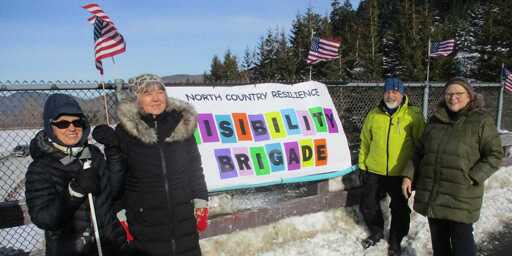
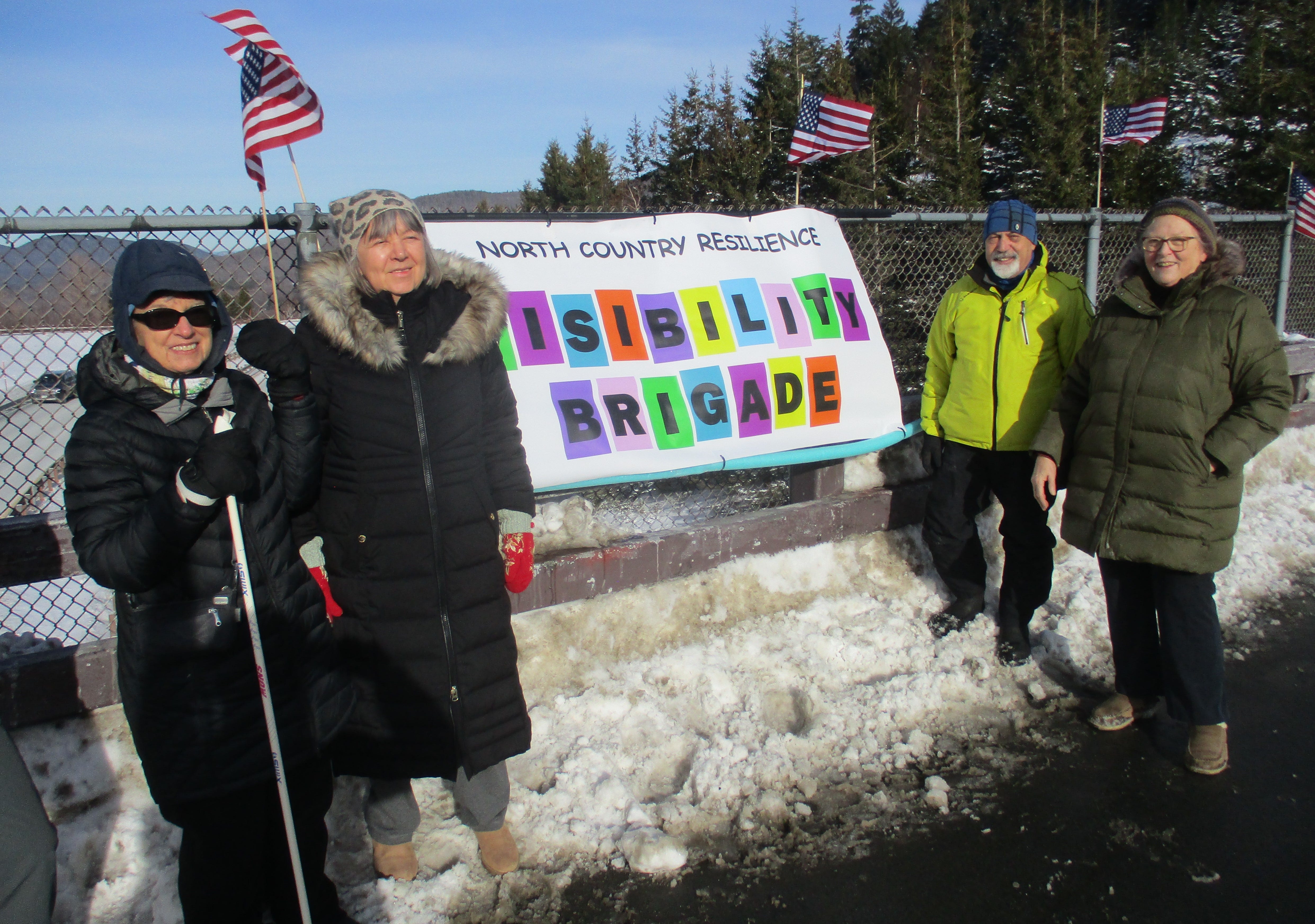
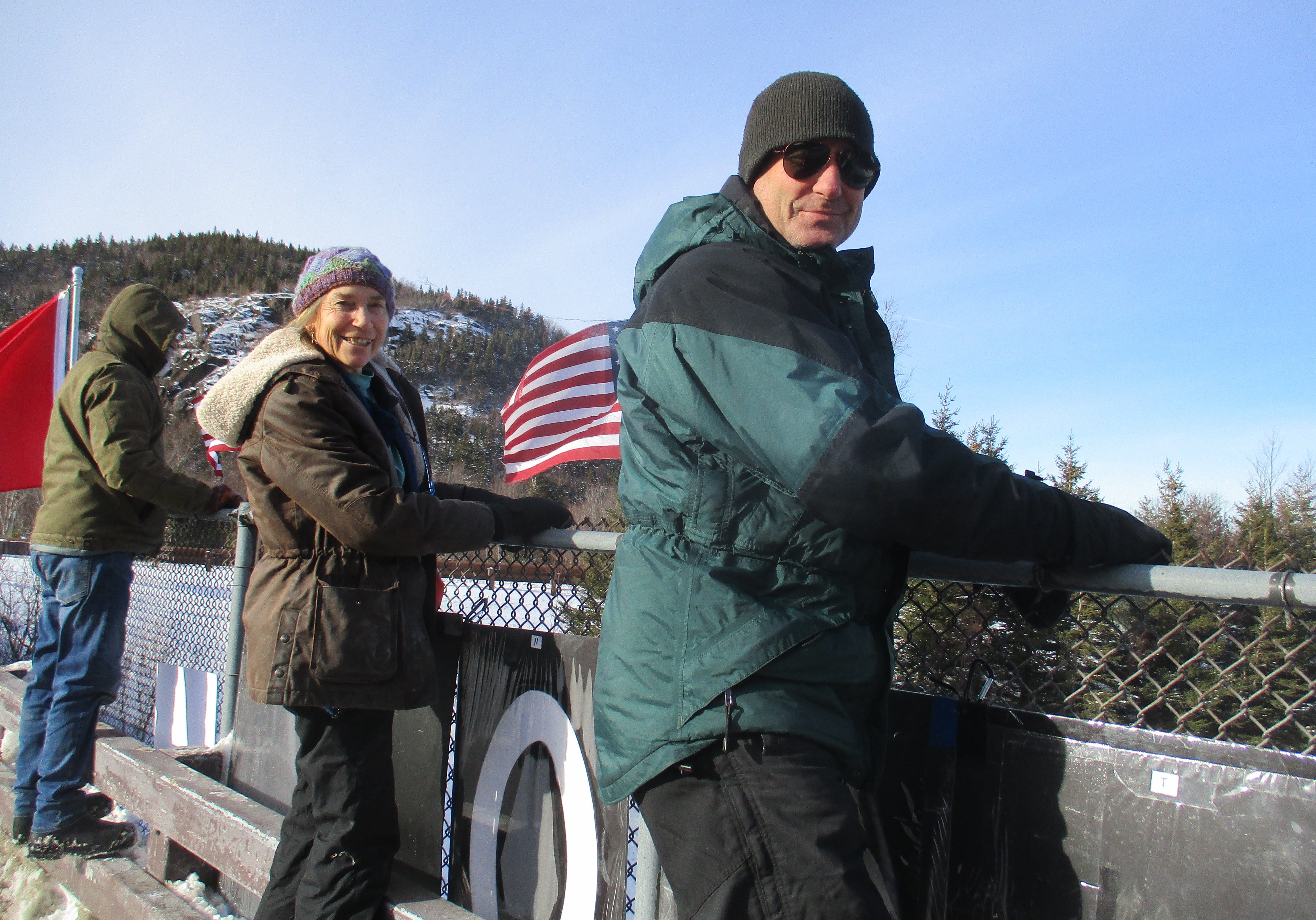
Today, despite temps in the low 20s, it was sunny and calm on the northernmost I-93 overpass in Franconia Notch as our North Country Resilience volunteers displayed these messages: “RING IN RESISTANCE” and “EVEN FROSTY HATES ICE.”


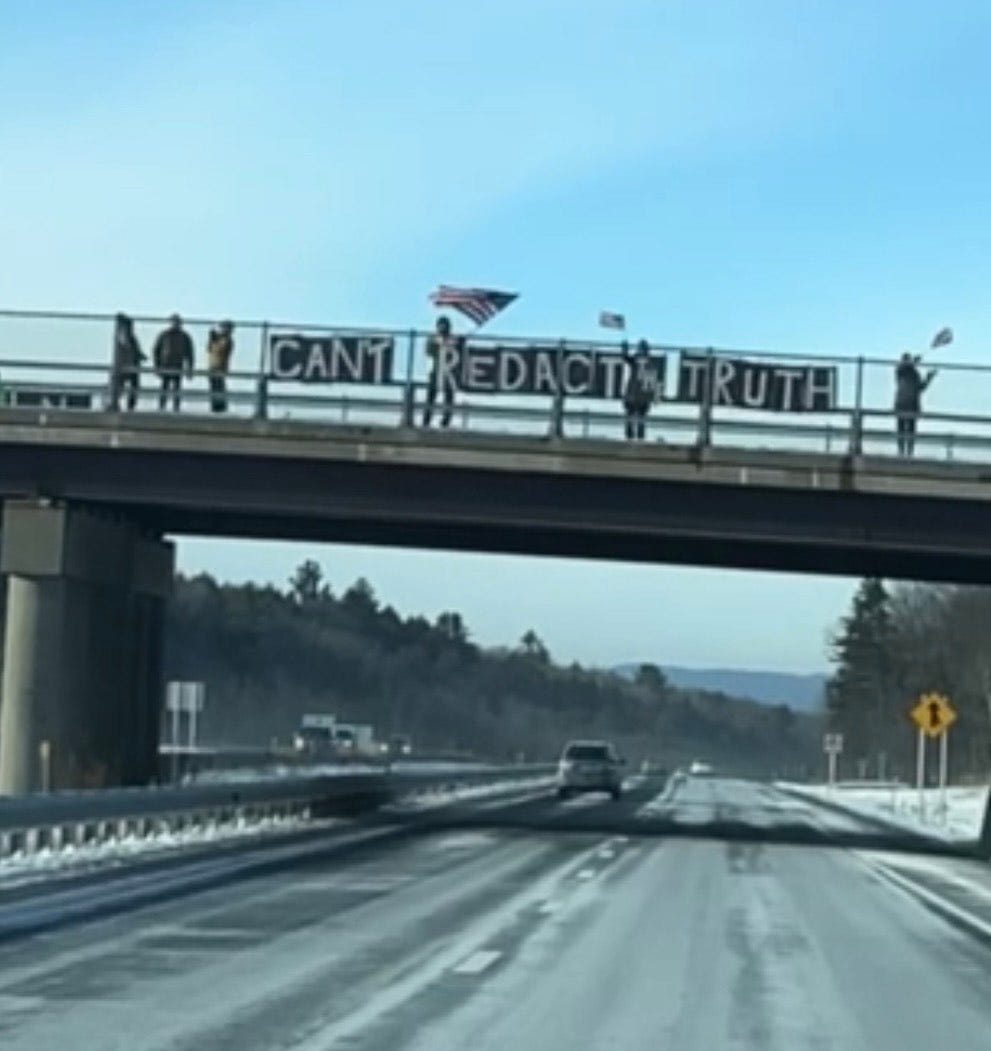
Enfield, NH.
Our sign was one of many that hung today over I-89, in an effort coordinated by NH Bridge Brigade. Local groups created their own individual messages.
The donation is truly voluntary and will in no way affect anyone’s ability to attend. If we cannot accommodate everyone who wishes to attend (due to limitations on the event space), we will use a lottery system to ensure fair access to the party without regard to time zone (i.e., those in Europe and Eastern US are able to RSVP earlier, so “first in time” is not a workable methodology for accepting RSVPs).
From Today’s Edition Newsletter via this RSS feed
You must log in or # to comment.