

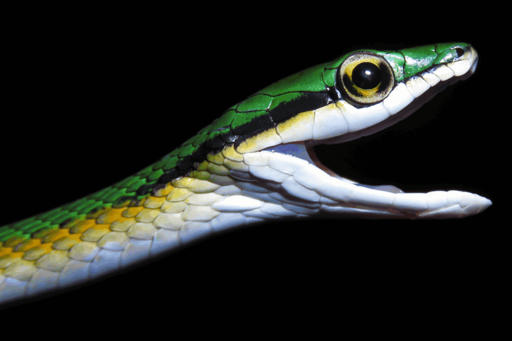
The world still holds its secrets. Hidden under wet rocks, in the ocean’s twilight crevices, and in the minutiae of the genetic code are creatures unknown and unnamed by the human species. Every year, scientists find hundreds of new animals, insects, plants and fungi. This year, researchers described a tiny new marsupial, a new Himalayan bat, an ancient tree, a bright blue butterfly, a parrot snake, and a fairy lantern plant, among others. “I think most people believe that we know most species on Earth,” Mario Moura, a professor at the Federal University of Paraíba in Brazil, told Mongabay, “but in the best-case scenario, we know 20% of Earth’s species.” Some estimate that only 10% of all the species on the planet have been described. Unfortunately, many species may be threatened with extinction before they’re even formally named — victims of human activities like development and climate change. Some of these species could be food or medicine for humans, but each plays a unique role in Earth’s interconnected web of life. “We’re understanding more and more that every species on the planet has a role, and in one way or another, is linked to our well-being through the part they play in ecosystems,” said Boris Worm, a marine conservation biologist who co-authored a study that quantifies the number of undescribed species on land and in the ocean. “We can’t protect them … if we don’t know them.” Atlantic manta ray (Mobula yarae) with a diver off the coast of Mexico. Originally…This article was originally published on Mongabay
From Conservation news via this RSS feed