

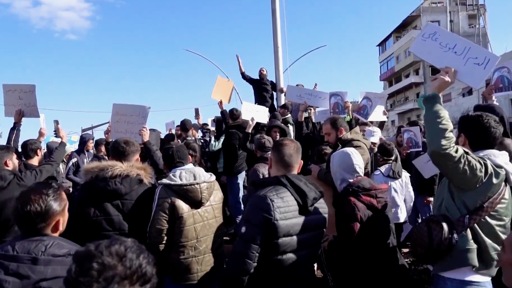
At least three people were killed and dozens injured during protests on Sunday, December 28, over the rising sectarian violence in Syria.
Protests by the Alawite community (a religious minority in the country) erupted in the western governorate of Homs, the coastal cities of Latakia and Tartous, and other areas after at least eight people were killed and 18 others wounded in a deadly explosion in a mosque in an Alawite-majority neighborhood in Homs on Friday, December 26.
The Syrian Observatory for Human Rights reported that law enforcement officers, who were forcefully dispersing the demonstrations, as well as counter-protestors, were responsible for many of the injuries and deaths that occurred on Sunday. The government of former al-Qaeda leader, Ahmed al-Sharaa, blamed the violence on the Alawite protestors, calling them loyalists of ousted president Bashar al-Assad and claiming they attacked security forces.
Saraya Ansar Al Sunna, a splinter group of the Islamic State in Iraq and the Levant (ISIS), claimed responsibility for Friday’s mosque bombing, a seemingly sectarian-motivated attack, in a statement released on its Telegram channel.
The bombing came one week after the United States had launched Operation Hawkeye with a series of airstrikes, on dozens of targets presumably belonging to ISIS in Syria. The operation is expected to continue in cooperation with US allies in the West Asia region.
The explosion and the deadly violence during the protests mark the latest episode of the broadening sectarian strife, which has been rising since al-Assad was overthrown.
For many, the bloody events that unfolded over the last year, which have mainly targeted religious minorities, are reminiscent of the sectarian violence that erupted in the aftermath of the 2003 invasion of Iraq, following the ousting of late Iraqi president Saddam Hussein.
Read More: Syria’s president: from Al-Qaeda to White House guest
Stoking religious and ethnic-based division among the peoples of the region is a historic strategy of the US, enabling it to more easily subjugate populations and thus maintain its geopolitical interests.
In a 1992 article in Foreign Affairs Magazine, British-American historian and political commentator, Bernard Lewis, who was a staunch supporter of Zionism, promoted the elimination of nation-states in order to weaken the central power of countries across West Asia by inciting infighting between sects, religions, tribes, and parties. By doing so, the United States and Israel could tighten their grip on the war-stricken region.
The post Three killed, dozens injured in protests over sectarian violence in Syria appeared first on Peoples Dispatch.
From Peoples Dispatch via this RSS feed
You must log in or # to comment.