A recent communiqué and continent-wide survey released by the Pan-African Progressive Front (PPF) signals a crucial shift in Africa’s reparations movement, moving it from symbolic demands to a coordinated political and institutional agenda.
The survey, conducted across all regions of Africa and involving 1,861 respondents from 57 African countries and the diaspora, found that 70.3% of Africans support demanding reparations from former colonial powers, while more than 78% favor an interstate reparations fund under public oversight.
According to PPF, the findings informed a communiqué that seeks to close what it describes as a long-standing historical and political gap: Africa’s fragmented engagement with global reparations debates.
“Everyone agrees the wound is real,” said Princess Yanney, head of the PPF Public Affairs Directorate, in an interview with Peoples Dispatch. “But Africa has too often entered global conversations about slavery, colonial extraction, debt, and stolen heritage as scattered voices, country by country, ministry by ministry, sometimes NGO by NGO. That fragmentation makes it easy for former colonial powers to reduce reparations to symbolic regret rather than enforceable justice.”
From moral argument to political instrument
Yanney explained that the communiqué responds directly to this fragmentation by converting reparations from a moral appeal into a continental political instrument.
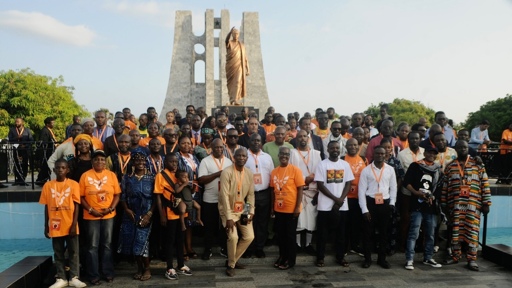
“The communiqué does this in two moves,” she said. “First, it anchors the agenda in a new legitimacy point, the Accra Declarations adopted in November 2025 by over 280 delegates from political parties, trade unions, and public organizations across Africa and the diaspora. Second, it reframes reparations as concrete demands: cash compensation, return of stolen cultural heritage, debt cancellation, institutional reform, and strategic development investment, all framed as sovereignty and self-determination, not charity.”
The Accra Declarations, adopted during the International Conference of Pan-African Progressive Forces in November 2025, now serve as the political foundation for the Front’s reparations agenda.
Why now?
The timing of the communiqué, according to PPF, is strategic.
“This moment mattered because the political window was open in a way it hasn’t been for a long time,” Yanney says. “The African Union had already designated 2025 as the Theme of the Year on reparations, signaling that this was no longer just a civil society conversation. And across the Atlantic, CARICOM’s sustained reparatory justice work showed that regional blocs can pursue reparations as policy, not poetry.”
She described the communiqué as a political timing document aimed at consolidating momentum.
“It’s saying: we have a continental wind at our back; now we must build the vessel institutions, formulas, enforcement tools, and mass consent before the moment passes.”
Reparations as a sovereignty project
Beyond figures, PPF says the survey reveals a deeper transformation in African political consciousness.
“What stands out is not just support for reparations, but how people imagine pursuing them,” Princess explained. “This is reparations as a sovereignty project, not a pity project.”
A majority of respondents supported mechanisms such as a unified reparations fund and tariffs or transaction levies on companies from colonizing countries, aimed at making payments systematic and gradual rather than ad hoc.
“That’s the language of statecraft,” Yanney said. “It shows a Pan-African public beginning to think in instruments, bargaining power, and policy.”
The survey also revealed strong public preference for continental coordination rather than isolated national approaches. The results showed that 78.5% supported an interstate reparations fund under public control, while 81.2% favored centrally-calculated reparations that explicitly include the Caribbean diaspora.
“This is unity as a governance model, not a slogan,” Yanney said. “It’s unity as accounting, as institutional architecture, and as a transatlantic political identity.”
Another notable finding was widespread skepticism toward state-led processes without public oversight. When asked who should conduct reparations research, 60.1% chose independent experts from Pan-African organizations, far surpassing support for governments acting alone.
“That tells us people are not only demanding justice from the outside world,” Yanney observed. “They are also demanding credibility and integrity from their own representatives. There’s a clear desire to protect this agenda from elite capture, party cycles, and backroom deals.”
Read More: “Inalienable right of Africans and people of African descent to full reparations”, asserts Accra Declaration
While over 70% support reparations, 20.6% of respondents said they were unfamiliar with the concept, a figure PPF sees not as a weakness but as a strategic challenge.
“That number is a map of the next battlefield,” Yanney said. “The agenda has escaped seminar rooms, but it hasn’t yet fully landed in markets, campuses, unions, churches, and online communities. The communiqué is implicitly trying to bridge that gap.”
The Pan-African Progressive Front will continue to intensify its organizing and advocacy, the communiqué has positioned reparations as a live political struggle over sovereignty, justice, and Africa’s place in the global order.
The post “70% of Africans back reparations,” says Pan-African Progressive Front appeared first on Peoples Dispatch.
From Peoples Dispatch via this RSS feed
You must log in or # to comment.
It seems clearly obvious that colonial powers profited by fucking Africa but why would any agree to pay money now again?
But they released a communiqué! That’s like two steps from a harshly worded letter.