

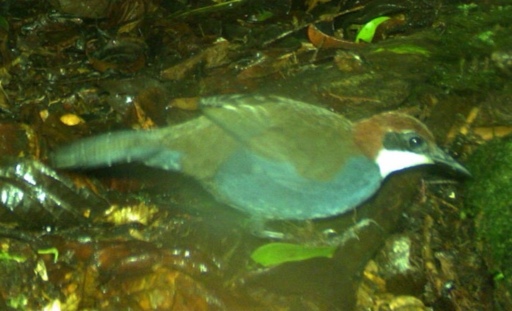
Within a forested limestone landscape of Papua New Guinea lives a shy, striking bird that’s new to science. This bird is also incredibly rare and may already be endangered, according to a recent study. Researchers have photographed fewer than 10 individuals of the newly described hooded jewel-babbler (Ptilorrhoa urrissia) in about 10 years of monitoring — all within a 100-hectare (250-acre) area of Iagifu Ridge, located in the Agogo mountain range of Papua New Guinea. Extrapolating from these figures, “we estimate that Iagifu Ridge may support some 50-100 individuals,” Iain Woxvold, study co-author from the Australian Museum Research Institute, told Mongabay by email. “However, an accurate estimate will require further research, and the actual number may well be fewer.” Jewel-babblers are ground-dwelling birds with distinctive black masks and white throats or cheeks. Four species were known until now, all from the island of New Guinea. Woxvold and colleagues first chanced upon the hooded jewel-babbler in 2017. They had set up camera traps to survey biodiversity on Iagifu Ridge, and among the images were those of two birds on the forest floor with distinctive coloration. “We were fairly certain it was a new taxon in 2017 … However, at that stage we were still not 100% sure that it was a new species,” Woxvold said. More of these birds turned up during subsequent camera-trapping surveys in 2019 and later. “It was strange and wonderful to see them in those early photographs!” Woxvold said. “In 2022, we also set a video camera…This article was originally published on Mongabay
From Conservation news via this RSS feed
You must log in or # to comment.