

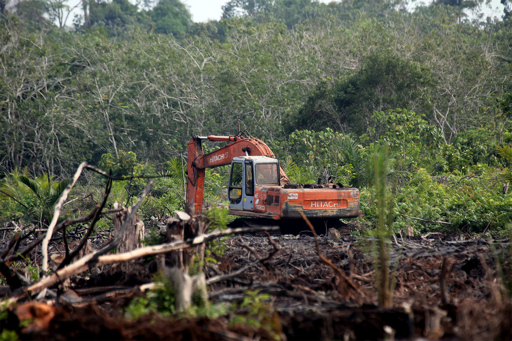
The water-filled ditches that laced through the oil palm plantation in Sarawak, a Malaysian state on the island of Borneo, nagged at Kuno Kasak when he saw them in 2022. He knew that these canals, used to draw water out of spongy peatlands to make them suitable for agriculture, had been shown to be sources of methane. But just how much remains an open question, with too few data points to make estimates with certainty. Though methane dissipates more quickly in the atmosphere than CO2, it’s more than 20 times more effective at trapping heat. It’s also responsible for nearly a third of the global temperature rise since the industrial revolution, making accurate methane accounting imperative for addressing climate change. Kasak, a professor of environmental technology at Estonia’s University of Tartu, is the lead author of a recent study in which he and his colleagues report that methane from these drainage canals accounted for as much as 10% of the total greenhouse gases from a given hectare of the oil palm plantations they studied. At the same time, the ditches covered no more than 4% of the plantations’ total area. “This is significant because it means that previous estimates of emissions from drained peatlands likely underestimate the contribution from ditches, which are often ignored in global carbon accounting,” Kasak told Mongabay in an email. They also found that the ditches were sources of CO2. One of the oil palm plantations where Kasak and his colleagues sampled emissions from drainage ditches.…This article was originally published on Mongabay
From Conservation news via this RSS feed
You must log in or # to comment.