

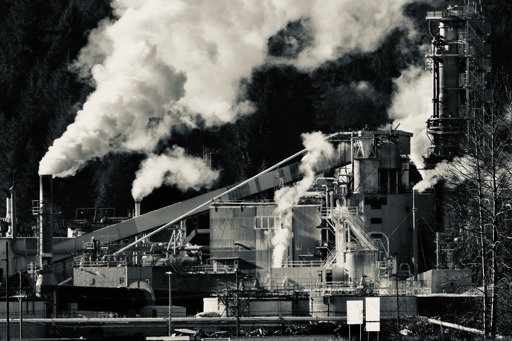
Mill, Westport, Oregon. Photo: Jeffrey St. Clair.
2025 will go down as the second or third hottest year on record. The last decade has been the hottest decade in human history. Driven by drought and extreme winds, a massive fire burned its way across the LA Basin, incinerating more than 10,000 homes. The estimated damage ranges from $76 billion to $133 billion. Total losses to businesses and workers in income and wages totaled at least $297. The year saw two of the largest, most rapidly intensifying hurricanes in the history of the Atlantic Ocean. Floods in central Texas killed at least 137 people, while massive flooding driven by twin cyclones that tore across Sumatra and the southern Philippines killed at least 1,800 people and left more than a million people homeless. We are in the midst of the largest mass coral bleaching event in history, affecting 83% of the world’s extant coral reefs. The melting of the West Antarctic Ice Sheet is accelerating. Its surface is fracturing, causing massive ice falls and rockslides that are warping the southern continent’s geology. A total collapse of the ice sheet, which now seems certain, would raise global sea levels by 12 feet. The Arctic Ocean is now expected to be “ice-free” in the summer by 2030, twenty years earlier than predicted just a few years ago. The Atlantic Current is slowing down and may be on the verge of collapse, which would likely destabilize rainfall patterns for much of the planet. Wildfires in Canada now burn year-round. There were 24,000 heat-related deaths in Europe this summer from June to August alone. Deaths from extreme heat in the US have increased by more than 50% since 2000.
None of these catastrophic events has left the slightest impact on Trump, who has ordered his administration to slash nearly every restraint on the release of CO2 into the atmosphere. Oil drilling has been expanded on federal lands (including the high Arctic) and waters. The dying industry of coal mining has been put on life support with new subsidies and exemptions from environmental regulations, while coal-generating power plants slated for closure have been forced to keep operating. Large-scale renewable energy projects, in the planned for years, have been cancelled and tax credits and incentives for small-scale solar have been gutted. Energy-hogging data centers have been fast-tracked and freed from regulatory constraints. Prior to Trump’s re-inauguration, Bethany Kozma — who now heads RFK’s Department of Health and Human Services Office of Global Affairs— vowed that the administration “will have to eradicate climate change references from absolutely everywhere” in government. And they’ve largely followed through gutting NOAA’s Office of Atmospheric Research; the EPA’s Office of Research and Development, National Center for Atmospheric Research, U.S. Global Change Research program and NASA’s Earth Science program. Climate research stations have been shuttered. References to climate change have been removed from federal websites, documents, databases and signage on federal lands, offices and parks.
And it’s not just Trump. The supposed global protectors of the climate had their annual meeting in Bélem, Brazil this year and likely generated more CO2 coming and going from the confab than they saved during the sessions. That’s in part because they came and went without even mentioning fossil fuels in their final document. These actions go beyond denial and amount to incitement of the wrath of the climate gods. Their vengeance will be a terrible thing to behold. We’ve gone from trying to survive in a global greenhouse into a madhouse.–JSC
January
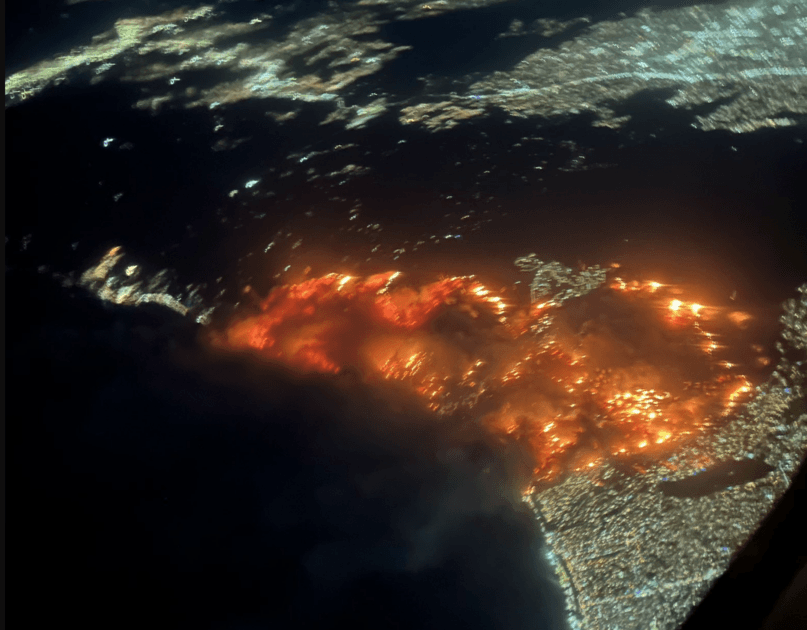
Pacific Palisades fire from a flight leaving LAX. (Screengrab from video posted to X.)
“The climate crisis reveals that our civilization has never really been organized around science, contrary to the usual Enlightenment narrative. It is organized around capital. Science is embraced when it serves the interests of capital and is often ignored when it does not.”
– Jason Hickle
There’s nothing so terrifying as a nightmare come to life. The Santa Ana winds have haunted the dreams of southern Angelinos for decades. Like the Chinooks of the Rockies and the Mistrals of the Rhone Valley, these winds play on the mind. They tell you they’re coming for you. They whisper the dangers they bring with them. Van Gogh believed the mistral inflamed his madness. Another kind of madness seems to be inflicting LA, the madness of boundless consumption.
Some listen to the warnings of the wind. Some don’t. Those who listen are driven mad by those who don’t. In the chaparrals of southern California, the warning of the Santa Anas has always been: fire. Fires that race down hillsides and canyons faster than any Tesla can drive. Fires that leap roads, highways, malls. Fires that ride on the wind.
This is not new. The Santa Ana winds come with the territory–that territory being the desert basins behind the coastal mountains and canyons. They are katabatic winds that rush downhill, dry and fierce, as they pour through the Cajon, San Gorgonio, and Soledad passes. Geography makes them. Climate change and a rapacious real estate industry that has remained deaf to their message have turned them into killers.
Historically, the Santa Anas (ponder the resonance of that name in our time of mass xenophobia) are autumn winds, warm winds that carry the dust of the Mojave. Now, Santa Anas can erupt any time of year. That’s climate change, for you. Yet a threat that is omnipresent often seems somehow less ominous, making it more likely to catch you off guard.
Even so, LA wasn’t entirely taken by surprise this week. They had two days to get ready. The Santa Anas create the conditions for catastrophic fires on their own. They are fire-making weather events that dry out already parched landscapes, lowering the humidity and raising the temperature as they blow through.
On November 13, 2008, 50-mile-per-hour Santa Ana winds whipped up a bonfire started by college students into an inferno that spread across neighborhoods in Montecito and Santa Barbara. The Tea Fire burned for three days, destroying 210 homes. Then-Governor Arnold Schwarzenegger described the charred landscape as “looking like Hell.”
The next day, the still-roaring winds, gusting to 80—mph, supercharged a fire in the Santa Clarita Valley that ravaged the town of Sylmar. The Sayre fire burned for a week and destroyed more than 600 buildings, including 480 mobile homes.
We don’t know how this week’s fires originated—cigarette, campfire, truck spark, downed power line, or arson. But the Hollywood Hills, Santa Monica, and San Gabriel Mountains were already primed to burn. Chapparal is born in fire and thrives in it. In their natural state, the chappal landscapes of southern California experience low-intensity fires once every 20 to 50 years.
After a couple of relatively wet years, the southern California coast has now flipped back into drought conditions. It hasn’t experienced any measurable rainfall in eight months. Climate change has made southern California drier, increasing the frequency and intensity of the region’s natural fire regime. Even fully functioning fire hydrants will never replace the amount of moisture climate change has stolen from the ecosystem.
They talk about the “urban-wildland” interface. In So Cal, that interface is under relentless siege as new luxury homes, condos, and “mixed-use” buildings creep inexorably up the hillsides and canyons, undeterred by the rugged geography, faultlines, or flammability. The boundaries between the natural and the manufactured have been shredded, both on the ground and in the atmosphere. The buffer zones are gone and now nothing is standing between you and the wind.
Yes, you were warned. But no number of red flags could really fortify you for what was coming; no amount of preparation at this late stage could save you from hundred-mile-per-hour winds from a hurricane of fire.
Even palaces burn.
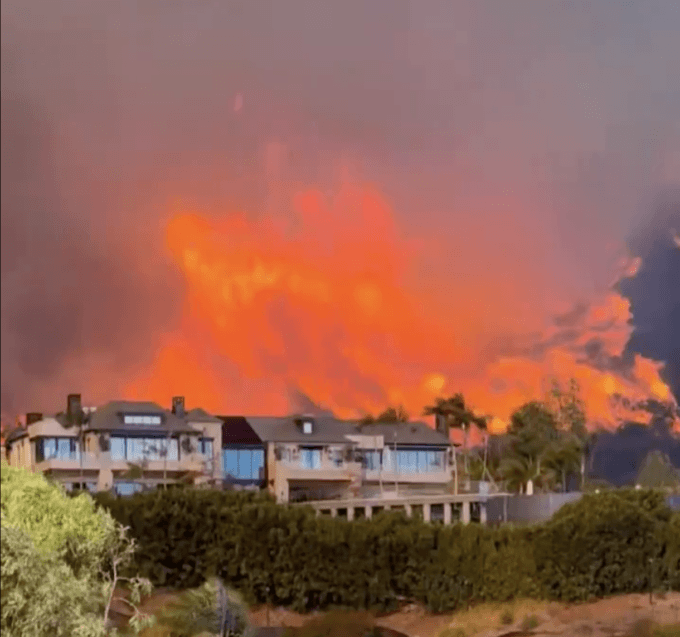
Pacific Palisades fire. (Screengrab from video posted to X.)
+++
-
You don’t have to be versed in Mike Davis’s The Ecology of Fear to understand that the people who always pay the heaviest price for these kinds of cataclysms in So. Cal–even in elite zip codes like Pac Palisades–aren’t Hollywood moguls or hedge funders, but LA’s mostly brown and black working poor…
-
In 2019, Eric Garcetti, then the mayor of Los Angeles, told David Wallace-Wells: “There’s no number of helicopters or trucks that we can buy, no number of firefighters that we can have, no amount of brush that we can clear that will stop this. The only thing that will stop this is when the Earth, probably long after we’re gone, relaxes into a more predictable weather state.”
-
An initial estimate from AccuWeather Inc. puts the total cost of the LA fires at between $52 billion and $57 billion, making it the most expensive fire event in history.
-
In July, State Farm, one of the biggest insurers in California, canceled 1600 homeowner policies in Pacific Palisades. A year earlier, the same insurance company had dropped more than 2,000 policies in the nearby neighborhoods of Brentwood, Calabasas, Hidden Hills, and Monte Nido, all of which have now been ravaged by devastating wildfires. But the big insurers who have canceled policies for homeowners and businesses in climate-vulnerable states continue to insure the fossil fuel industries that make people’s homes uninsurable.
-
19 of the 20 largest fires in California history have ignited since 2000…
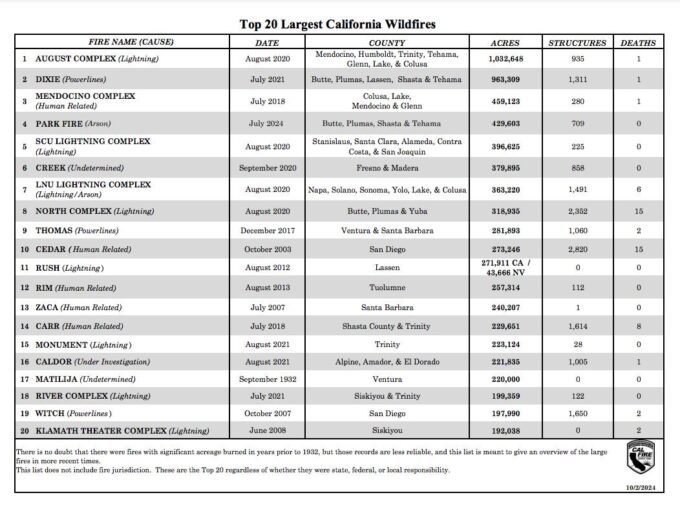 + Environmental historian Stephen J. Pyne, author of Fire in America: “If we keep fighting a war with fire, three things are going to happen. We’re going to spend a lot of money, we’re going to take a lot of casualties, and we’re going to lose.”
-
Mike Davis: ‘The loss of more than 90 percent of Southern California’s agricultural buffer zone is the principal if seldom mentioned reason wildfires increasingly incinerate such spectacular swathes of luxury real estate.”
-
It’s worth noting that one of the reasons California likes to keep its prisons as full as possible is that inmates make up around 30% of the state’s firefighting force. For risking their lives on the firelines, prisoners are paid between 16¢ to 74¢ an hour (maxxing out at $5.80 to $10.24 a day) and rewarded with a bologna sandwich and an apple for lunch on the job.
-
When there’s a mass shooting, the response from MAGA is “thoughts and prayers.” When there’s a climate-driven cataclysm, the response is: “Drill, baby, drill, rake, baby, rake, and log, baby, log.”
The LA fires will be used as Trump’s Reichstag fire against environmental regulations.
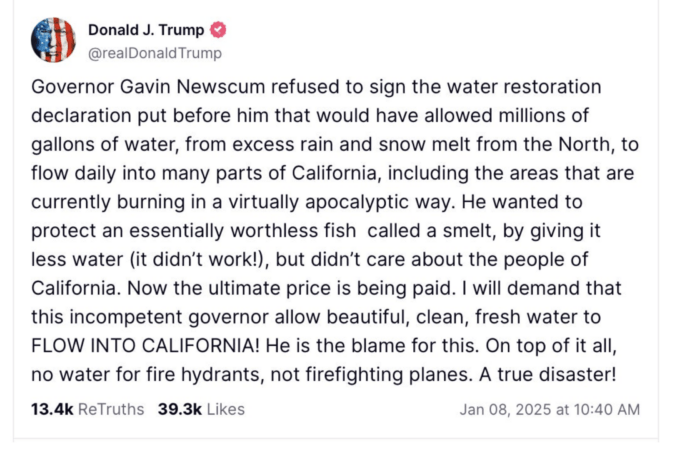 + He’s deliriously wrong about everything in this post, except for the incompetence of Gavin Newsom, a preening servant of the real estate and energy industries.
- President Empathy struts his stuff one more time…
 + If Biden keeps this up, he may be destined to end his presidency less popular than Trump was after Jan. 6, 2021.
-
Norman Maclean, Young Men and Fire: “In this story of the outside world and the inside world with a fire between, the outside world of little screwups recedes now for a few hours to be taken over by the inside world of blowups, this time by a colossal blowup but shaped by little screwups that fitted together tighter and tighter until all became one and the same thing–the fateful blowup.”
-
In 2000, the global warming trend predicted the world would hit 1.5C warming in 2041. It happened in 2024.
-
According to a new study by Aurora Energy Research, rescinding the Inflation Reduction Act’s technology-neutral clean energy tax credits could increase Americans’ electricity bills by 10%. Some states, like Texas, could see increases of more than 20%.
-
Last year, the European Union imported more Russian LNG than ever.
-
The Federal Trade Commission announced that crude oil producers XCL Resources Holdings, LLC (XCL), Verdun Oil Company II LLC (Verdun), and EP Energy LLC (EP) will pay a record $5.6 million civil penalty for illegal coordination that led to a crude oil supply shortage. Before merging, the crude oil companies started working together, limiting the oil supply when the US faced shortages and inflated prices.
-
As more green power plants have gone online, German gas imports dropped by 11% in 2024.
-
After the first week of congestion pricing in NYC, the commute times into Manhattan were cut in half….
+++

Drone image of Pacific Palisades.
Number of destroyed or severely damaged buildings in LA (so far): 20,000 Population of LA County: 10 million
Number of destroyed or severely damaged buildings in Gaza (so far): 80,000 Population of Gaza: 2.1 million
-
In only five days, the Pacific Palisades fire destroyed more structures (> 12,500) than any fire in California history, except the Camp Fire of 2018, which burned for 18 days.
-
In the 1980s, the US experienced around three weather-related disasters that caused more than $1 billion in damages. Now, the average is around 18 a year. (NOAA)
-
More than 1000 incarcerated people are out fighting LA’s fires, but their families aren’t allowed to contact them to see if they’re safe.
-
Jason Oppenheim, owner of the celebrity real estate firm featured on Selling Sunset, told the BBC that his clients are being price gouged in post-fire LA. One landlord was asking $13,000/month, but when his client went to rent the home, the landlord demanded $23,000. Welcome to the club…Meanwhile, California State Attorney General Rob Bonta said that his office has received numerous reports of hotels and rental properties in southern California increasing their prices by more than 10%, which violates the state’s anti-price gouging law. According to the LA Times, the asking price for single-family homes in the Los Angeles area are being listed for nearly 20% higher since the wildfires started.
-
Florida’s state residual insurance plan is on the hook for $525 billion in losses, twice the amount in 2022, while California’s state insurer faces $290 billion in liabilities, a sixfold increase from 2018. Thirty-six states now have residual insurance plans, but 21 of the states don’t explain how they will pay when the liabilities overwhelm their assets.
-
A report by researchers at the University of Colorado and the University of Wisconsin-Madison estimates that three-fourths of homeowners may not have enough insurance to fully cover losses after a disaster.
-
Shed a few tears for the investment bankers of So Cal, one of whom shelled out $27 million to buy a now incinerated mansion on ‘Billionaire’s Beach.’ He told Fortune that he only expects $3 million from insurance. He’ll probably write the loss off on his taxes for the next decade, assuming he’s paying any.
-
The New York Post reported on Wednesday that Los Angeles landlords have increased rents by as much as 124% after the wildfires.
-
Here’s a spreadsheet tracking rental price-gouging by landlords in LA County…
-
Potential insurance exposure to the Los Angeles fires is $458 billion. The state’s FAIR insurance program only has $700 million cash on hand to pay claims.
-
From Yves Smith at Naked Capitalism:
Out of approximately 700 homes destroyed in the 2020 Santa Cruz Mountains Lightning Complex Fire, only 95 have been rebuilt and occupied 4 years later, with only 158 more in construction. Nearly two-thirds are not being rebuilt.
-
The top five least affordable metro areas in the US are all in California. According to Redfin, someone living in LA Country who makes the median income in 2024 would need to spend 77.6% of their earnings on monthly housing costs if they bought a median-priced home. How long can this go on?
-
Octavia Butler wrote about a climate-change-ignited wildfire in her path-breaking novel, the Parable of the Sower. The cemetery in the historic black community in Altadena where Butler is buried was burned in the LA fires.
-
A new paper by Zeke Hausfather published in Dialogues on Climate Change exploring climate outcomes under current policies finds that the planet is likely headed toward 2.7C warming by 2100 (with uncertainties ranging from 1.9C to 3.7C), which, if it pans out, is a little better than the 4C warming many of us feared.
-
More than 11 million Californians now live in high-risk wildfire zones, including large areas of Los Angeles County, San Diego, and the wine country of Napa and Sonoma.
-
$2,000: cost per hour of private firefighting teams employed by wealthy homeowners in southern California.
-
If you’re looking for a book to help explain the political ecology behind the LA fires and other climate-driven cataclysms, try this one by a couple of writers you might be familiar with: The Big Heat: Earth on the Brink…
-
As he prepared to go out the door, Biden took time this week to sign an Executive Order cutting regulations for “energy sources” (nuclear, among them) for AI data centers, which are expected to consume around 12% of U.S. electricity by 2028.
-
From an FT story on the coming collapse of the Atlantic Circulation Current: “Data uncertainty is substantial. But uncertainty is not our friend. Uncertainty could mean the tipping point is passed early.”

+++
- In Ventura County, farmworkers are harvesting strawberries in the dense, toxic smoke from the still-spreading Hughes Fire. Employers are required to provide them with respirator masks when the Air Quality Index hits 150. Many don’t.
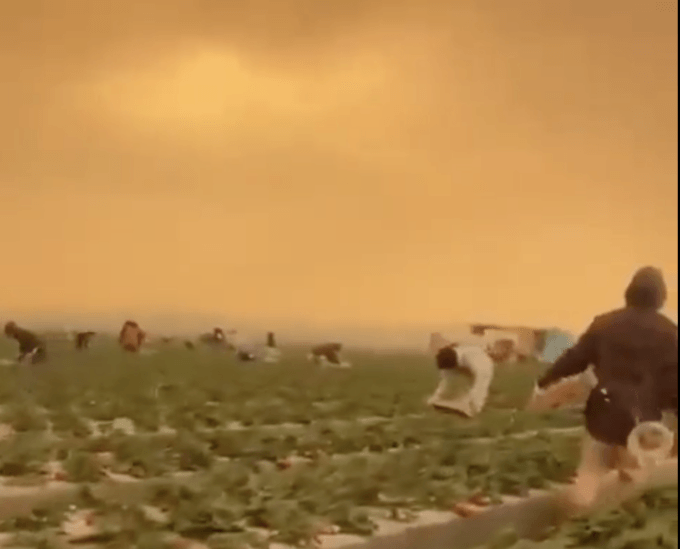
Image: United Farm Workers.
-
In one 24-hour Arctic blast, Pensacola, Florida, was buried under 8.7 inches of snow, more snow in one day than 8.0 inches the Gulf Coast City had experienced in the previous 124 years combined.
-
Climate scientist Daniel Swain on the LA fires: “I don’t see this as a failure of firefighting. I see it as an indication of what you can achieve when conditions are this extreme.”
-
A third of Alaska’s vast tundra, once one of the Earth’s greatest carbon sinks, is now a carbon emitteras the permafrost melts, releasing tons of carbon dioxide and methane gas.
February
- Number of fire alerts in LA County during the first three weeks of 2024: 183
The average number of fire alerts in LA County in the first three weeks of the year from 2012 through 2024: 1.5

-
So, maybe the problem isn’t the Delta Smelt?
-
Maybe part of the problem was private equity’s increasing stranglehold on the fire truck industry, which left more than half the fire trucks in Los Angeles out of service as the fires raged through the Palisades and Altadena.
-
The once giant Ogallala Aquifer, the largest groundwater source in the nation, dropped by more than a foot last year in western Kansas.
-
A new study published in Environmental Research under the ungainly title, Quantifying the Acceleration of Multidecadal Global Sea Surface Warming Driven by Earth’s Energy Imbalance, warns that: “Policy makers and wider society should be aware that the rate of global warming over recent decades is a poor guide to the faster change that is likely over the decades to come, underscoring the urgency of deep reductions in fossil-fuel burning.”
-
The rate of ocean warming has more than quadrupled since 1985, which is pretty clear evidence that global warming is rapidly accelerating.
-
Outside of China, the oil sheikhdoms of the Middle East are the world’s fastest-growing markets for solar power. What do they know the USA doesn’t?
+++
-
California is considering a new law that would permit victims of climate-driven disasters to sue fossil fuel companies for damages. Under existing law, utilities, such as PG&E, can (and have) been held liable if their equipment, such as transformers or power lines, starts wildfires. This move comes as So Cal Edison admitted its power lines (and not the Delta Smelt) may have been responsible for igniting the Eaton Fire that raging through Altadena.
-
Citing climate and environmental concerns, Gustavo Petro ordered the state-run oil company Ecopetrol to cancel a joint venture with Occidental Petroleum (Oxy) that was expected to produce around 90,000 barrels of oil per day, citing environmental concerns.”
-
NYC’s congestion pricing plan now enjoys the support of 66% of the drivers who pay the toll the most frequently.
-
The planet just experienced its warmest January on record…

-
At least 55 million Americans are expected to migrate within the country in the next decade, most of them fleeing the environmental and health consequences of climate change, including more than 5 million this year alone.
-
Energy Secretary Chris Wright: “The US should stop the closure of coal-fired power plants,” Energy Secretary Chris Wright said, adding that the fuel source would be “essential to the nation’s power system for decades to come.” Why? Power-hungry AI data centers that need the electricity to steal all of the future, except those involved in the mining of coal.
-
In 2004, it took the world a year to install a gigawatt of solar power. In 2023, it took only a day. Americans, however, can’t get too excited about this remarkable achievement given that Trump has “paused” the permitting of solar projects, even on private lands, effectively paralyzing the development of new renewable energy plans across the country for at least the next two months.
-
EPA director Lee Zeldin said he will try to “claw back” some $20 billion in funding for climate projects awarded under the Biden administration.
-
Trump on gut regulations for powering AI data centers: “We’re going to let the people that are buying the electricity make their own electric plants, electric generation plants… We’re calling it a national emergency. And that’s exactly what it is.” As long as those plants don’t generate electricity through solar, geothermal, wind or hydro power.”
-
Natural ecosystems have seen a 47% decrease against their estimated baselines as of 2019.
Global forest area: –32 % Natural Ecosystems (extent and condition: -47% Coral reefs: -50% Wetlands: -85%
- Werner Herzog should remake Fitzcarraldo as a climate change thriller, but instead of lugging a steamship over the mountains, try the even more surreal-but-real task of pulling it up the dried-out riverbeds of the Amazon…

Photo:Divulgação observatório do clima.
+New research shows that carbon capture technology is more costly (and less effective at reducing CO2 levels) than switching to renewables: “If you spend $1 on carbon capture instead of on wind, water, & solar, you are increasing CO2, air pollution, energy requirements, energy costs, pipelines, and total social costs.”
-
For the first time in 2024, China’s clean energy technologies contributed more than 10 percent of its GDP, with sales of $1.9 trillion. On the other hand, China constructed 94.5 gigawatts (GW) of new coal plants in 2024, the most in the last 10 years.
-
Peatlands store more carbon than all the world’s forest biomass combined. But they are rapidly being drained and developed around the world and, according to new research published in Conservation Letters, only 17% enjoy any legal protection.
-
A Carbon Brief analysis reveals that 182 of the 193 countries that signed the Paris Accords (nearly 95%) missed the UN deadline to submit new climate pledges for 2035. Countries missing the deadline represent 83% of global emissions and nearly 80% of the world’s economy.
March
- What comes first this time around, a Dust Bowl or a Depression?

-
Laurie Laybourn, director of the Strategic Climate Risks Initiative, on the failure to take decisive action to reduce carbon emissions: “It’s only really now that the penny is dropping that we didn’t prevent a global-scale climate crisis. We’re now in a global-scale climate crisis.”
-
From a new study in Nature Food: At 1.5C warming scenario, more than half of the 30 crops examined would experience a decrease in the extent of their global potential cropland. Wheat, barley, soya beans, lentils and potatoes would suffer the most significant declines. A 2C warming scenario shows more precipitous declines in suitable areas for the 30 crops with some crops surpassing 50%. At 3C warming, all of the 30 crops studied would have their suitable cropland area reduced.
-
Over 1,000 people came out this week to protest the firings of NOAA scientists in Colorado: “We used to attract people even with our lower pay because we had a good mission and it was a mission valued by the public,” said Nancy McLean, a retired NOAA manager.
-
Increasing tree mortality, attributable primarily to climate change, has resulted in Colorado’s forests now emit more carbon than they absorb.
+++
-
Secretary of Defense Pete Hegseth: “The Defense Department doesn’t do climate change crap. We do training and warfighting.” The US military emits more than 59 million tons of carbon a year, a carbon footprint that’s larger than many industrialized nations.
-
Last year, atmospheric C02 levels reached an 800,000-year high, leading to at least 151 “unprecedented” extreme weather events in 2024.

Two domed solar sensors at the Mauna Loa Observatory, University Corporation for Atmospheric Research, Public Doman.
-
The Trump administration plans to pull the plug on the Mauna Loa Observatory, one of the world’s most crucial monitoring stations for atmospheric CO2.
-
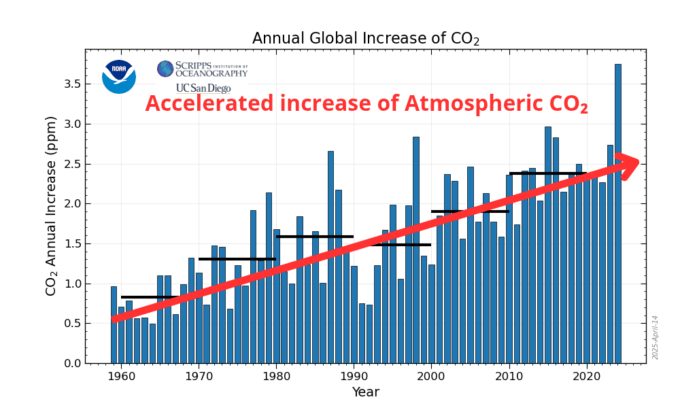
The global average increase of atmospheric CO2 concentration in 2024 not only set a record at 3.7%, but represented a 25% increase over the previous record.
-
According to an IPSOS poll, climate activism continues to decline even as concerns about climate change increase.
-
A new report by the Boston Consulting Group and Cambridge University (Too Hot to Think Straight, Too Cold to Panic) predicts that by 2100, 13 major climate tipping points will be reached:
Greenland ice sheet collapse (1.5C) West Antarctic ice sheet collapse (1.5C) Extinction of tropical coral reefs (1.5C) Abrupt thawing of permafrost (1.5C) Barents Sea ice loss (1.6C) North Atlantic subpolar gyre collapse (1.8C) Tibetan Plateau snowmelt (2.0C) West African monsoon shift (2.8C) East Antarctic subglacial basins collapse (3.0C) Boreal forest southern dieback (4.0C) Gulf Stream disruption (4.0C) Boreal forest northern retreat (4.0C).
- At the onset of tornado season in the center lanes of tornado alley, the National Weather Service will be without weather balloons. Maybe the Chinese could loan them a couple (as long as the Air Force promises not to shoot them down this time)…

-
A recent study on congestion pricing in NYC (The Short-Run Effect of Congestion Pricing in New York City) documents increased commuter speeds and decreased emissions. The study found “no significant difference between neighborhoods with different incomes.
-
The Department of Energy estimates AI data centers could consume up to 12% of total U.S. electricity by 2028, up from just 4.4% in 2023.
-
While South Africa continues to generate 82% of its electricity from fossil fuels (mainly coal), Kenya has made a radical transition. It now generates 88% of its electricity from geothermal, wind, hydro, biofuels, and solar.
-
Javier Blas, energy columnist at Bloomberg News: “A senior executive of an American oil company told me, ‘We thought that Chris Wright, the energy secretary, was “our guy,” someone from the industry. And here in Houston we just realized that Mr. Wright is Trump’s guy. He’s not our guy. He’s going to do what the White House is telling us to do. And if that means $50 oil and bankruptcies in the oil patch, so be it.’”
-
The deglaciation of Glacier National Park is nearly complete: “In 1850, the area that is now Glacier National Park had approximately 80 glaciers; as of 2015, there were 26—all shrinking. In the last decade, 13 of those have broken apart and can no longer technically be considered glaciers.”
-
Paul Hawkins: “When people say we’re going to “fix” the climate … to me, it’s just so emblematic of this profound disconnection between self and other. We don’t have a climate crisis; the climate cannot have a crisis. We are the crisis”.
-
The Chinese EV maker BYD announced this week that its new line of cars can be fully charged in about the same time it takes to refill a gas-engine vehicle at the pump. It takes about 8 hours to fully charge a Tesla at home and up to 30 minutes to fully charge a Tesla at a “super-charging” station on the road…if you can find one.
-
Sandeep Vaheesan, author of Democracy in Power: “China pursues an abundance of tech while the United States opts for an abundance of tech billionaires.”
-
Climate change is causing increased emissions, which are quickening climate change, which is….well, you get it. The record increase in global emissions last year was attributable to record heatwaves in India and China, which increased the use of coal to power air conditioning.
-
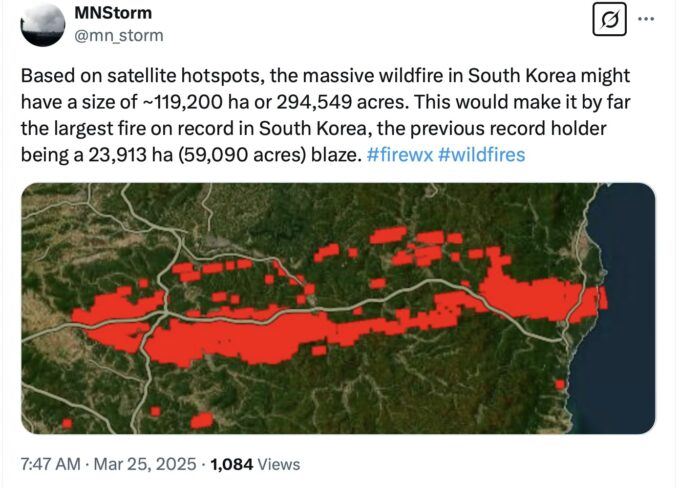
It’s March and wildfires are burning out of control across the Carolinas and New Jersey.
-
I repeat: It’s March and …
April
-
At least 50,000 clean energy jobs have been killed off or delayed by the Trump administration in the last two months. More than $56 billion in clean energy investments have been defunded or halted since February.
-
“Two-thirds of all irrigated agriculture in the world is likely to be affected in some way by receding glaciers and dwindling snowfall in mountain regions, driven by the climate crisis, according to a Unesco report.”
-
Planetary Death Wish 2025: Trump has signed an executive order calling for the use of coal to power AI data centers.
-
More than 470 tornadoes have been reported across the U.S. so far this year, nearly double the historical average for the year to date. According to AccuWeather, extreme weather and natural disasters in America have caused a staggering $344 billion to $382 billion in total damage and economic loss so far this year. But let’s restart the coal plants to power AI data centers!
-
Hank Green: “A tricky thing about modern society is that no one has any idea when they don’t die. Like, the number of lives saved by controlling air pollution in America is probably over 200k/year, but the number of people who think their life was saved by controlling air pollution is zero.”
-
As predicted, the Keystone XL pipeline ruptured in North Dakota. Rescind that judgment against Greenpeace!
-
The global growth rate in CO2 emissions was 3.5 PPM, causing NOAA to extend its y-axis by 1 ppm for the first time. The significance of the graph is still understated, since it’s charting the rate of increase not the amount of CO2 in the atmosphere, which would continue to grow even if the rate of increase fell flat or even decreased.
-
According to Berkeley Earth’s dataset, March 2025 tied with March 2016 and March 2024 as the warmest on record. It was 1.55°C above preindustrial (1850-1900) levels.
-
Imagine living in a place that cared even a little bit about your health and well-being…
-
A new study in Science estimates that as many as 1.4 billion people live in areas with soil dangerously polluted by heavy metals such as arsenic, cadmium, cobalt, chromium, copper, nickel, and lead.
-
“History shows again and again, how Nature proves the folly of men…”

-
The first quarter of 2025 was the second warmest on record, just a fraction behind last year’s mark. An ominous portent, given that 2024 was super-charged by a strong El Nino event, while 2025 started off with weak La Nina conditions.
-
According to a new study by researchers at Dartmouth College published last week in “Nature”, emissions from 111 fossil fuel companies have caused $28 trillion in climate damage, the study finds. These five generated the most harm. The top culprits….
Saudi Aramco: $2.05 trillion Gazprom: $2 trillion Chevron: $1.98 trillion ExxonMobil: $1.91 trillion BP: $1.45 trillion
May
- Bloomberg News reports that Chinese purchases of American oil are down 90% year-over-year, while Chinese purchases of Canadian oil are up +700% year-over-year.
+ As hurricane and wildfire season opens, the National Weather Service has been blinded by staff cuts ordered by DOGE and now faces 155 “critical” vacancies. At least 30 National Weather Service offices are currently without a chief meteorologist, including those who issue forecasts for New York City, Cleveland, and Houston. Dr. Robert Rodhe, Berkeley Earth: “Severe staffing shortages at the National Weather Service will lead to missing data, worse forecasts, and late or missing warnings of extreme weather. Sooner or later, people are going to die as a direct result of this.”
-
Meanwhile, David Richardson, the newly appointed head of FEMA, admitted in private meetings that with two weeks to go until hurricane season, the agency doesn’t yet have a fully formed disaster-response plan, according to a report in the Wall Street Journal.
-
After record temperatures in 2024, many climate scientists predicted that this year would be cooler. In fact, the planet seems to be heading for a second consecutive year with temperatures breaching the 1.5°C climate goal.
-
New research indicates that “the warming trend has been accelerating from a rate of 0.15 – 0.2 C° per decade during 1980-2000, to more than twice that rate most recently.”
-
China’s CO2 emissions are declining for the first time in decades and are now a full one percent below their 2024 peak.
-
Maybe just “Drill, baby” and not “Drill, baby, drill”? According to Kaes Van’t Hof, CEO of Diamondback Energy, U.S. oil production has peaked and will start to decline due to the drop in oil prices.

-
On Monday, the city of Shabankareh in Iran hit 52.1°C, the earliest any town has ever topped 125°F…We’re making large swaths of the planet unlivable for humans and other forms of life, in our own lifetimes. What a thing to witness.
-
Over his first 100 days in office, Trump has approved more than 145 measures to roll back or eliminate pollution rules and promote fossil fuels, more than the entire number of rollbacks during his first term.
-
In the first quarter of 2025, China added 60GW of solar power, more than half of it as rooftop installations. This is more than the total installed solar capacity in Spain and France combined–all in only three months. In 2010, the US and Europe were the largest solar and wind power manufacturers. By 2024, China had installed six times more wind and solar power than all of Europe and eight times more than the US.
-
By gutting the incentives for renewable energy, the Trump tax bill passed by the House will likely:
+Cost more than 830,000 jobs
- hike energy bills
- increase carbon emissions by an additional 230 million tons by 2035, roughly the annual emissions of Spain
-
A new report on sea level rise published in Nature: Communications warns that millions globally will be forced from their homes by advancing waters and extreme tides even if warming remains below 1.5 °C. “We’re starting to see some of the worst-case scenarios play out almost in front of us. At current warming of 1.2 °C, sea level rise is accelerating at rates that, if they continue, would become almost unmanageable before the end of this century.” But the world is on track for 2.5C-2.9C of global heating, which results in the collapse of the Greenland and west Antarctic ice sheets–a scenario that would lead to a catastrophic 12 metres of sea level rise.
-
Rep. Yassamin Ansari: “I sit on the Natural Resources Committee, where we witnessed the most anti-environment legislation go through. It includes massive giveaways to the oil and gas industry. I also discovered that the chairman, for the first time in his career, had purchased hundreds of thousands of dollars’ worth of oil and gas stocks. So we’re seeing incredible amounts of corruption.”
-
Fox Business’s Maria Bartiromo: “Should we really have wind and solar subsidies in this bill? What if it’s not windy? What if it’s not sunny?”
June
[Content truncated due to length…]
From CounterPunch.org via this RSS feed