

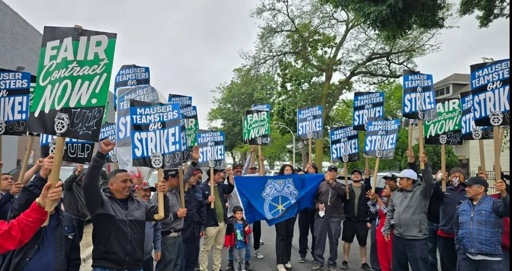

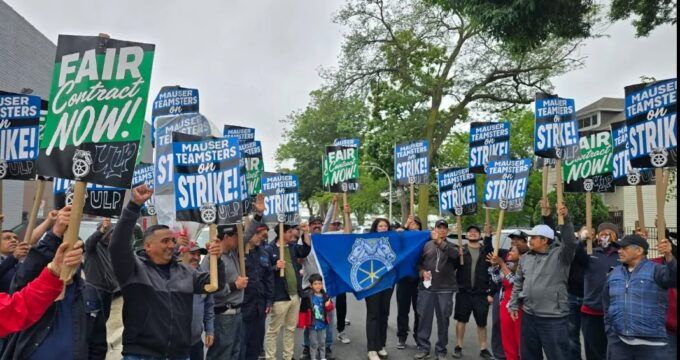
Photo: Mauser Teamsters’ Facebook page.
What has happened to the Mauser strikers — and what could have been different? Teamsters Mobilize believes that these are essential questions that have to be asked by everyone within the Teamsters union and the broader labor movement. There is a concerning trend within the Teamsters union; a local or regional strike will pop off, Teamsters social media will shout it out, and then either they will claim victory without going into too many specifics of the settlement, or it will be buried and never mentioned again. Mauser is getting the same treatment — the Teamsters website and social media has not said a peep for months about the heroic endurance of the strikers. This is particularly concerning because the strikers have made contractual protections against immigration persecution the key issue in their ongoing struggle. The lack of discussion is simply unacceptable; every strike is a lesson for the working class, which demands both the widest possible mobilization during the strike, and the clearest analysis of events afterwards.
Before examining the narrative, it is important to note that as recently as Tuesday, December 16, the Mauser strikers were confronted on the picket line by Border Patrol commander Greg Bovino and a group of armed agents1, in a blatant and thuggish attempt at intimidation which calls to mind the long and infamous history of police repression against working class activity in this country. While the circumstances of this unwelcome visit are not immediately clear, the Teamsters’ own representative hinted2that this might be a result of direct collaboration between the company and federal agents. Without a doubt, the unpleasant events of December 16 confirm, if more proof was needed, that the ruling class’s current anti-immigrant offensive has the overt, conscious goal of breaking the ability of the working class to resist its own exploitation. The response of important sections of the organized working class, like the Teamsters and their leaders, must be judged through this lens. In that spirit, let’s examine the current situation and how it developed.
The last major development in the strike itself was the company’s announcement in mid-October that they would be closing the plant by the end of November, which they have now done. While companies will often spread rumors about closing struck facilities in an attempt to weaken the resolve of the workers, Mauser has proven that, in their case, this is no idle threat. In Seattle just this year, a small Mauser shop organized with the Teamsters was already locked out and then shuttered entirely. This should have been the canary in the coal mine for the entire union, signaling that the company was intent on establishing an entirely open shop and driving the Teamsters out of their operations. Sean O’Brien said so himself when he spoke at a rally for the locked-out Seattle workers in April, bellowing “when a multinational bully like Mauser tries to break our union and crush working people, the Teamsters don’t stand by — we fight back with everything we’ve got”. Yet, in the run-up to the negotiations at the Little Village location in Chicago, local union officials claimed that they had no intention of striking the facility3 and that they were relying on the company to bargain “in good faith”4. International leadership, for their part, said absolutely nothing — perhaps praying that the company would buy into the same fantasy that they did, about the organized workers and their bosses sharing the same interests.
Nevertheless, the workers did take the initiative to strike when the company put forward an insulting contract offer (possibly calculated to provoke a strike) and refused to budge on the key demand of immigrant worker protections. Since then, the workers have showed exemplary solidarity, refusing to scab and unanimously rejecting the company’s latest mediocre offer in mid-August.
It is worth pausing here to emphasize the importance of the immigrant protection demand that has been raised by the Mauser workers. The demand is simply this; that the new contract include language whereby the company promises to refuse access to Immigration and Customs Enforcement (ICE) agents who attempt to enter their property without a warrant. As simple as that may sound, the implications of this demand are explosive. To our knowledge, this represents the first attempt to use strike action, and the organized strength of the working class, to counter President Trump’s renewed and ruthless anti-immigrant offensive. If the Mauser workers can win this language on paper and give it teeth through militant action, they will have taught the entire class a lesson — it is possible to win (limited, but real) relief from ICE terror by using the strike weapon. With 2.2 million unionized immigrant workers in this country5, many of whom are vulnerable to this new offensive and many of whom are situated in important industries like food production, such a victory might prove to be the spark which ignites an inferno of resistance.
Just as important as the raising of the demand itself is the outstanding attitude of the native-born and documented Mauser workers, who have so far stood in lockstep with their coworkers and refused to allow the immigration question to split the strike down the middle. This is a recognition of the simple fact that, as long as one section of the workers is held down by the threat of brutal police repression, it is impossible for any other worker to make significant gains. This is as true for the entire working class, as it is for one small shop in Chicago. So if the Mauser strike is victorious, here too will be another lesson; native-born workers must take up and address the specific problems of immigrant workers as if they were their own, as the only possible method of creating the ironclad unity necessary to confront and reverse the savage attacks of the ruling class.
With that said, let’s return to the conduct of the strike itself. Despite the questionable pre-strike view of the company’s intentions, when it comes to the actual direction of the strike it is difficult to fault Local 705. From the outside it would appear that they have backed their members more or less to the hilt; popularizing the struggle, extending picket lines at several Mauser facilities organized under the Teamsters, and most importantly refusing to fold on the immigrant protections question.
Yet, the workers and their Local are placed in an increasingly untenable position. Only a small minority of the total Mauser workforce in the US is organized under the Teamsters, and they are scattered all over the country and over Mauser’s supply chain. These are clearly difficult conditions in which to win a strike. On the other hand, there are very recent examples of important Teamsters strikes being won in not-dissimilar circumstances. For instance, the Teamsters recently declared victory over Republic Services, a waste company that is less than 25% unionized, after a months-long struggle originating in O’Brien’s Local 25 which ended up seeing over 2,000 workers nationwide hit the picket lines. So, perhaps more important than the tough objective conditions is the type of leadership that is being provided to the strike — which brings us around to the conduct of the International.
In the Republic Services strike, the initial walkout in Boston was followed almost immediately by concurrent local strikes in Illinois, Washington, California and Georgia. This was further supplemented by picket line extensions in Indiana, Arkansas, Ohio and multiple locations throughout the initial strikers’ states. This mobilization was achieved through close coordination between locals and careful planning, all facilitated by the International.
By contrast, the Teamsters have thus far failed to call out a single Mauser worker on strike other than those that are already striking the Little Village facility. Although the International was quick to crow about picket line extensions in Minnesota and Los Angeles6, it is unclear how long these workers remained off the job or what kind of damage it did to the company, if any. In any case, the peculiar nature of a “picket line extension” is that workers at the facility where the picket line extension is happening are legally barred from joining the picket that closes their facility — they are essentially paid to stay in their house. This can be impactful of course, but it is fundamentally different from a true solidarity strike where the causes of workers at different sites are united into one struggle for improved conditions.
Even more damning is that, as Luiz Leon reported in August7, there is another organized Mauser facility in Chicago, under Teamsters Local 743. This facility has remained at work the entire time that their brothers just down the road have been fighting for the life of their union. Local 743’s president, Deborah Simmons, has been happy to make speeches on the Little Village picket lines8, but has not taken the one practical step which could help those workers win their strike. It is bad enough that these workers are isolated from each other in different locals, working under different contracts — this is typical self-defeating Teamsters localism, worthy of contempt at any time. But to not unify their struggles in an hour of desperate need is the highest betrayal of the principle of working class solidarity.
And yet, this could only happen because the International is allowing it to happen. The Mauser strikers are receiving second-class treatment from their International, and far from “bringing the full strength of this union to the fight”9 their strike is being allowed to wither. To explain this, we have to look at the main sticking point in contract negotiations — protective language for immigrant workers.
The ruling class has a strong and enduring interest in terrorizing migrant workers, to prevent them from organizing and to use them as a tool against the native-born workers. Sean O’Brien has made clear his support of this goal by repeatedly expressing chauvinistic contempt for immigrant workers10 and actively giving aid and political cover to vicious anti-immigrant, ruling class politicians11. The truth is that O’Brien has secured his comfortable position as Teamsters general president through accommodation and alliance with members of the ruling class, both at the corporate and political levels. Therefore he thinks, in many ways correctly, that their interests are the same as his — never mind the interests of the members or the broader working class. Does it seem likely that his International would back up a strike over immigrant rights language? Or are they neglecting the strike on purpose, perhaps even pressuring the Local and their members to cave on this key demand?
Local 705 is a staunch O’Brien local, and their leader Juan Campos is part of the OZ slate and an International Vice-President at Large. So, it is unlikely that the truth of the matter will ever be conclusively revealed. But, if true, the fact that this betrayal would occur in one of the most important O’Brien-allied locals in the entire union reveals a great deal about the character of the so-called “alliance at the top” between “reformers” and O’Brien, as well as the “model local” strategy which is pursued doggedly by TDU12.
The great hope of this strategy is that through alliances with whatever reactionary union leader opportunistically needs their support, “reformists” will be able to carve out a space in the union where they can showcase the correctness of their ideas, and build support for “reform” throughout the whole organization. This is how TDU conceives of their relationship to O’Brien, and why they were willing to enter into an alliance with him at the cost of their (flawed, but real) critical role towards leadership. O’Brien’s general presidency was supposed to take the boot off the neck of ‘progressive’ locals like 705, 804, 90, 251 and others, to allow them to practice clean TDU-style unionism in peace. What we are seeing in the Mauser strike is how delusional this strategy is.
As inconvenient as it is to proponents of the “model local” strategy, the actual practical struggle of the Teamsters members will not and cannot remain purely local affairs, which can be concluded neatly and used as shining examples in Teamster Voice. Even the smallest struggle represents one section of the working class, which is systematically exploited and oppressed by the ruling class, both through the corporations and through its bought-and-paid-for government apparatus. We can see this clearly in the Mauser strike. The bargaining unit itself is tiny, a drop in the bucket compared to enormous Teamster shops like UPS CACH or Worldport. But almost as soon as the strikers walked out, it was obvious that it would be necessary to mobilize workers far beyond the Little Village plant, and indeed far beyond Chicago, in order to win the strike. Not only that, the struggle immediately became an example to the whole U.S. working class. Depending on the outcome of the strike, it could either inspire similar efforts and raise the struggle to new heights, or it could scare many potential militants away and lead to the fire of revolt being stamped out.
In order to win these struggles, the entire membership must be systematically prepared, both practically for wide and intense struggle and ideologically in terms of their understanding of class society — in this case, particularly the need for unity and mutual protection between immigrant and native-born workers. There can be no question of carrying out such an enormous task in one small section of one Local. The Little Village strikers already hold an advanced position on immigrant rights protections — it is the other workers in the Teamsters which need to be educated and mobilized on this basis. This is necessarily something that must be carried out throughout the entire union (and beyond!). It falls on the highest body within the Teamsters, the International, to carry this out. As we can see, they have failed to do so. And within the “model local” strategy which promotes a ‘live and let live’ attitude towards the reactionary bureaucrats in the Teamsters, they will be let off the hook for it! The exact details of the shameful betrayal of the Mauser strikers will remain a secret, something talked about at the bar by in-the-know staffers and stewards. Worse, without knowledge of the way that the struggle was kneecapped, the rest of the working class will be left with the false impression that strikes for immigrant worker protections cannot succeed in the current climate. Without fighting the reactionaries all the way up to the top, the “model locals” in this union will find their struggles sabotaged, isolated and ultimately defeated — no matter how cozy they think their relationship with “friendly” reactionaries is.
As armed federal agents roll up on Teamster picket lines and attempt to deliver a knockout blow to a long and hard-fought strike, the fighting workers in this union need more than puff pieces describing their resilience (and right now, they are not even receiving that from the International!). They need leadership which views their fight as one battle in a war between international classes that will always be opposed to each other. They need real analysis of the structural problems in the union which keep workers isolated from other Teamsters and other members of the working class. And when they don’t get this, the criticism and fight has to go to the very heart of this union. Only in this way, in front of and with the increasing participation of the entire membership and the broader working class, can the union be truly transformed.
While the final outcome of the Mauser strike is still uncertain, we know that any result other than victory will not fall on the shoulders of the brave workers who hit the pavement this summer. It will fall on the reactionary Teamsters leadership and those who give them cover. So long as our mis-leaders escape criticism and so long as members are not made aware of the depth and breadth of their sell-outs, the Teamsters union will continue to lose strikes and stagnate. Let every worker with knowledge of these misdeeds join us in spreading that knowledge far and wide. Let us join these small streams of rebellion together until they make a torrent, which will wash our union of class-collaborators and turn it into the powerful, independent working class weapon that it needs to be.
The post What Happened at Mauser? appeared first on CounterPunch.org.
From CounterPunch.org via this RSS feed