

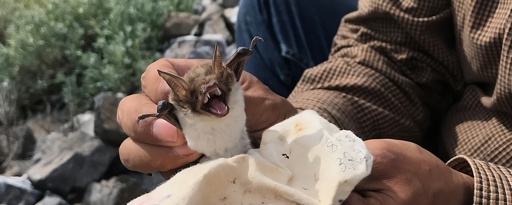
In the early 2000s, José Juan Flores Martínez was studying for a bachelor’s degree in biology and working as a volunteer in a program designed to control invasive rodents on islands in the Gulf of California in northwestern Mexico, which are home to several seabird colonies. On one of those expeditions, his group traveled to Isla Partida Norte near the city of La Paz, where something surprised them: they heard bats. Accustomed to seeing them in caves, Flores Martínez was intrigued when he saw them coming out from between the rocks and making clicking sounds under his feet. “It surprised me to find out that they were on an island, in the middle of the desert, under extreme conditions: They can resist sub[-freezing] temperatures and heat above 50 degrees [Celsius, or about 122° Fahrenheit],” said Flores Martínez, now an academic technician at the National Autonomous University of Mexico’s (UNAM) Institute of Biology. “But it was much more surprising to me that, when I began to ask questions, I was told that they feed on fish.” They were fish-eating bats (Myotis vivesi), and they fascinated Flores Martínez. This fascination led him, along with researcher Gerardo Herrera Montalvo, to embark on a scientific journey that has lasted a quarter of a century and counting. The fish-eating bat is the largest bat in its genus, reaching up to 16 centimeters (about 6 inches) in length. Its long, shiny fur is waterproof, which comes in handy as it maneuvers above the surface of the…This article was originally published on Mongabay
From Conservation news via this RSS feed