

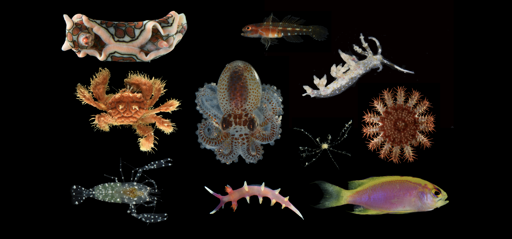
A transparent goby fish drifted through the darkness, its skeleton visible through paper-thin skin. Nearby, a sea slug wore yellow polka dots like a party dress, while an orange fish with bulging eyes hid among the coral. No human had ever seen these creatures — until now. They live in the ocean’s “twilight zone,” a dim underwater world between 55 and 100 meters (180 and 330 feet) deep, where light fades and strange life thrives. Hidden in the depths off the coast of the Pacific island of Guam, these animals make their homes on unusual structures that scientists had quietly placed on the seafloor years earlier. In November, Luiz Rocha and his team at the California Academy of Sciences finally returned to collect what those structures had been gathering for eight years: a treasure trove of life never before seen by humans. A few of the species (not to scale) found living in the “twilight zone” near Guam. Some are likely new to science, others have not been seen before at this depth. Photos courtesy of California Academy of Science. “I’ve wanted to be an explorer ever since I was a kid,” Rocha told National Geographic, “and there’s nothing better for an explorer than going to a place that nobody has ever been, finding a species that nobody has ever seen before.” The monitoring devices, called ARMS (Autonomous Reef Monitoring Structures), are stacks of square PVC plates that act as artificial reefs, like mini-condos for critters. Sea creatures settle on them…This article was originally published on Mongabay
From Conservation news via this RSS feed