

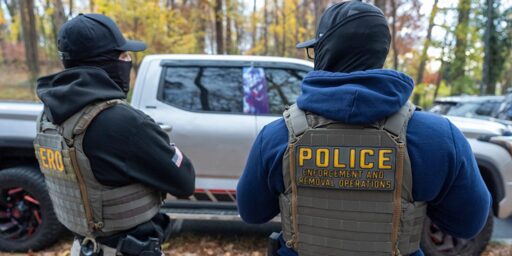
Activists in the Pacific Northwest are building a database of license plates used by immigration authorities with the hope of keeping tabs on agents’ movements.
The database, put together by an autonomous group of volunteers, currently lists more than 600 plates matched to the make and model of the vehicle they were spotted on. Most of the sightings coming from vehicles involved in enforcement actions in and around Portland, Oregon.
In helping community members to identify unmarked vehicles used by U.S. Immigration and Customs Enforcement officers, organizers hope to give people information about the government’s activities in their area, according to one activist involved in the effort.
“It helps reduce the unknown and reduce fear,” the activist said, speaking on condition of anonymity to avoid retaliation from authorities. “ICE is doing whatever they can to be undetected, and so anything we can do to chip away at that obfuscation.”
Rather than hosting the database on a centralized website, which they fear would be vulnerable to subpoenas and takedown orders, the group put their findings out through the InterPlanetary File System, or IPFS, a decentralized, peer-to-peer method of file distribution.
The database is built around community submissions of photos of ICE vehicles in action. Once the images come in, volunteers vet each picture to confirm that the plate and vehicle in question are being used by agents. The activist who spoke with The Intercept declined to go into detail about how the volunteers vet the information but said that every plate listed publicly in the database has appeared in at least two sightings.
“The reason we’re confident in what we released is that we have probably twice as many plates as what was published, but we made a decision to only publish those plates that had at least two observations,” the activist said. “And while we’re confident in the rest of the database, this was an extra measure to reduce confusion and inaccuracies. We want people to feel like they can trust what we’re publishing, and we don’t want to accidentally cause harm by releasing inaccurate information.”
[
Related
Kat Abughazaleh on the Right to Protest](https://theintercept.com/2025/11/01/briefing-podcast-kat-abughazaleh-indictment-protest/)
The effort comes amid a dramatic uptick in ICE activity in Oregon. For most of the year, ICE officers had largely contented themselves making targeted arrests, such as picking people up at immigration check-ins or detaining people with existing deportation orders. In October, however, federal agents began taking more sweeping actions, according to Natalie Lerner, a board member with the Portland Immigration Rights Council.
“We’re seeing a number of collateral arrests, where they’re arresting anyone who can’t prove that they have status,” she said, referring to detentions that arise from contact with immigrants who are not the targets of raids. “And I think that’s particularly scary and just super lawless.”
“It’s unimaginable how scary it is for folks,” Lerner told The Intercept. “So many people are calling our hotline saying they’re afraid to leave their homes, or they’re afraid to go to work. They’re not able to do the things they need to do to live their lives.”
Lerner’s organization — which has no connection to the volunteer database project — tallied nearly 800 detentions in the area since the start of October, which she said is likely an undercount. According to the activist involved in the database, ICE’s ramping up of enforcement makes the project even more important.
“It’s getting more and more blatant, and that’s why it’s so important that community safety efforts become more focused,” the database volunteer told The Intercept. “We’re working against this entity that has the most up-to-date technology and money and tools, and so we have to create our own tools.”
The database in Portland is perhaps the most well-organized collection of license plates from vehicles used by immigration authorities, but similar efforts have popped up across the country.
Activist networks have sprung up in various cities organizing know-your-rights workshops, building rapid-response teams and neighborhood watch groups to track the movement of agents, and distributing whistles to people in immigrant neighborhoods to swiftly notify the community of the presence of ICE agents.
[
Related
The Feds Want to Unmask Instagram Accounts That Identified Immigration Agents](https://theintercept.com/2025/09/18/dhs-subpoena-ice-instagram-dox/)
Recent efforts to monitor and unmask ICE agents have caught the attention of top federal officials. In July, Department of Homeland Security chief Kristi Noem issued a warning to “criminals and Antifa groups” seeking to unmask ICE agents and other members of federal law enforcement.
“We will prosecute those who dox ICE agents to the fullest extent of the law. These criminals are taking the side of vicious cartels and human traffickers,” Noem said in a July 11 statement.“We won’t allow it in America.”
The post ICE Drives Unmarked Cars. This Public Database Tracks Their License Plates. appeared first on The Intercept.
From The Intercept via this RSS feed
You must log in or # to comment.
Don’t they use rental cars so that they can swap out vehicles on a whim?
Someone ought to alert the insurers of those car hire companies as to the potential risks involved when vehicles are used in detention operations.
Although it would be a shame if those insurers raised premiums and car hire companies decided to stop renting out to ICE as a result…
