


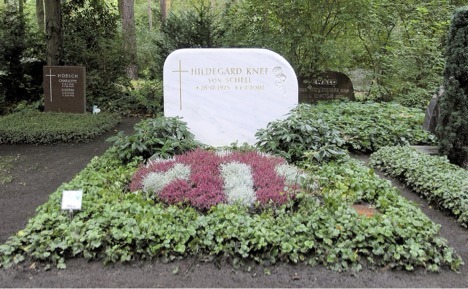
Hildegard Knef’s grave. Waldfriedhof (Forest Cemetery), Zehlendorf, Berlin. Public domain.
Hildegard Knef would have celebrated her 100th birthday on December 28 just passed. Given the number of cigarettes she smoked (Marlboros, three packs a day), the years she spent addicted to morphine (nearly twenty) as a result of the many operations she underwent and after the disastrous birth of her only child, and her long battle with breast cancer, she was lucky to make it to 77 when she died in 2002.
She was lucky even to make it out of her teens in Berlin. She survived harrowing air raids, was once nearly incinerated trying to get into a crowded bunker. In the last days of the war she fought against the Russian advance into her neighborhood dressed as a male in German army uniform. She helped operate a machine gun, fired on the enemy though she hated the Nazis. In this disguise, she avoided rape, but also, miraculously, execution for impersonating a soldier. In the conflict’s closing chaos she married an older German officer who, after the defeat, was disappeared to Russia and never returned. In the weeks after the surrender, Knef’s beloved grandfather killed himself.
Her gripping memoir, Der geschenkte Gaul (The Gift Horse), published in 1970, four years before she turned fifty, was a huge hit. The English translation remained atop The New York Times bestseller list for eighteen weeks. Her surreal account of the Battle for Berlin is literally hair-raising: severed limbs aflame, oxygen sucked from the air, people losing their minds and lives or both. Soon after the war she was summoned to America by David Selznick, keen on making her the next Ingrid Bergman. On her arrival, the notorious producer insisted that she take six hours of English lessons every day. Selznick also wanted her to change her name to Gilda Christians. She refused.
Out in L.A., she studied German literature with Herbert Marcuse, but he didn’t teach her her extraordinary gifts for language. Her autobiography is a gripping, often non-linear, sharply written book filled with acid commentary and self-criticism. Mixing dialogue in her native Berlin dialect with grammatically intricate and brilliantly telling details in eccentric, challenging prose, Knef’s work is hateful of hypocrisy and full of the unblinking flair that also brightens and darkens her songs after she increasingly turned away from film acting in the 1960s.
Marcuse and Selznick are just two of the dozens and dozens of names that are dropped in Der geschenkte Gaul. They don’t fall as densely and lethally as the bombs of Berlin but do detonate with their own kind of explosive power on the page. After getting a job as an animator at a Berlin movie studio, she caught the eye of producers and was soon receiving acting training and bit parts. Goebbels noticed her on screen, but with the help of canny mentors in the Berlin film business she evaded him as she did ordnance.
Married first to a Jewish-American officer who also spoke German, since he’d been born in Bohemia, Knef got American citizenship and shuttled back and forth across the Atlantic working in films in English and German. To rave reviews, she starred in the original Broadway cast of Silk Stockings in 1955, was befriended by its author Cole Porter as well as Noël Coward. William Faulkner got drunk at one of her parties at her apartment on Fifth Avenue and fell asleep in the corner. She acted across from Erich von Stroheim, was a protégée of Marlene Dietrich, but fell out with her as she did with so many friends, lovers, and husbands. Knef was in Billy Wilder’s penultimate film, Fedora (1978), only to find out at the premiere that her voice had been dubbed. In this one case, she claimed not to have the words to express her disgust.
Too much attention is often paid to the fact that Knef did the first nude scene in German cinema, posing for a portrait being done by the onscreen artist (Gustav Fröhlich), in Die Sünderin of 1951. Censorship, indignation, and protests ensued, especially in Catholic Bavaria. In her memoir, Knef quotes the response to all this moral outrage offered by another of her mentors, the most important interwar German film producer, Erich Pommer (The Cabinet of Dr. Caligari; Metropolis; The Blue Angel): “They start a revolution over a film, but not over the gas chambers.” The nude scene was cut from the version released in America.
Over these decades Knef raked in heaps of money with her books and songs and movies but spent more than she made. More than a little was stolen by unscrupulous managers. She lived large because she couldn’t be small.
Declare your admiration for Knef now to Germans of my generation—children of the 1960s—and prepare to be scoffed at. Younger folks will look blankly at the mention of her name.
Ella Fitzgerald called her “the greatest singer in the world without a voice.” That contradiction captured an essential quality of Knef. Her devotees were as ardent as her detractors. There was no middle ground in anything she made or did or in the reactions to the spectacle that was her life. Ella’s was a sincere compliment, not a backhanded one. It was easier to dismiss and defame Knef from afar than to confront the force of her persona on screen or in song. She communicated a truth, often bitter even if—or because—it was hazed or honeyed, whether live in a concert hall or club, or in the soundproofed confessional booth of the recording studio.
She is known mostly now outside of Germany, a quarter century after her death, as a chanteuse in spite of being a huge film star in her day. Her song lyrics oscillated between cynicism and maudlin sincerity that, on reflection, couldn’t necessarily be trusted, at least not completely. She brought the sweet and sour together in sometimes painful embrace. One of her biggest hits, Für mich soll’s rote Rosen regnen (For me it should rain red roses) of 1968, was an oozy paean to youthful dreams and potential that could be heard both to accept and to mock its own limitless desire and heartwarming resilience. In 1999 she simultaneously updated and demolished the song with the backing of the German punk rock band Extrabreit.
My favorite from her considerable catalog is the first song I heard: “Ich bin den weiten Weg gegangen” (I’ve walked the long path), written with her longtime collaborator, the Austrian composer and keyboardist Hans Hammerschmidt, who died just over a year ago at the age of 94. He’s heard on the groovy electric keyboard that animates this Lied as anti-biography. It’s a simple song made out of a relentlessly repeating bass line that descends by step before changing direction to arrive at the cadence and the start of another pass through the cycle. A radiant bridge occasionally rises from amidst these repetitions.
I was immediately drawn to the song not only because of its soaring 1970s strings and studio effects, the paradoxically laid-back urgency of the drumming, the slightly frail cockiness of the electric bass, the frankness of the singing (back me up here, Ella), but also because it reminded me of one of my favorite ground basses, Dieterich Buxtehude’s setting of the 42nd Psalm: Quemadmodum desiderat cervus (Like as the hart desireth the water-brooks, so longeth my soul after thee, O God). This baroque masterpiece of some six minutes demands virtuosic singing that Ella could have mustered, but not Hilde. The ecstatic lines unfurling at tempo and the sustained notes holding out against the kaleidoscopic counterpoint of the ensemble ardently express an unquenchable, ever-forward striving love of the Lord.
Knef’s take on this vamp begins with an admission that the road she has taken has often gone in circles. She was clever but never wise. In the second pass through the bass pattern, she sings that her life initially pursued had clear goals. She knew what these were and where she was going, in spite of the opening acknowledgment of circularity that, like the bass line, brings the narrator and listeners incessantly back to where they started. Nonetheless, she believed that her goal was a good one. It must have been fame but is never mentioned.
After the third pass through the pattern there is a preemptory key change up a half step. This classic pop maneuver is usually saved as a triumphant, even redemptive gesture that comes late in a three-minute song, not dangerously near the opening as it does in “Ich bin den weiten Weg.” This chromatic boost announces not transcendence but defeat: her goal was “run over” (unters Rad gekommen)—destroyed, presumably by the wheels of the express train of her own ambition. Still, the bass line rolls on, unstoppable, indifferent as she confesses to seeking a new goal but to no avail, even as the violins strive for contradictory heights. In the end the music carries her on after she renounces direction, instead embracing individual moments (the scent of the early morning and the cool of green trees) and “the hope in others.” It is as if she wants to stop time even as the music refuses to.
The inexorable groove of progress and achievement gives up on those very goals. The path leads not ahead but in circles, Knef repeats at the end before Hammerschmidt riffs into the smoggy sunset of the fade-out: words and music to live and listen by, whether the year is new or old.
The post Hildegard Knef’s Century appeared first on CounterPunch.org.
From CounterPunch.org via this RSS feed