

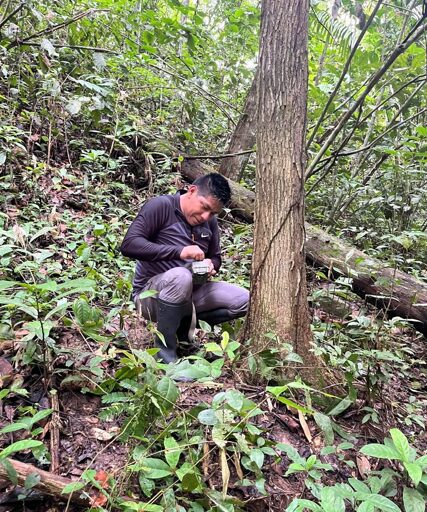
In Indigenous Asháninka belief, bees were once spirits in human form. Stories tell of a woman who enjoyed making masato, a traditional Amazonian fermented beverage. Every day, she would boil and mash the yuca, patiently fermenting it and offering the drink to whoever stopped by. Whole families would go and sit to drink it. The woman made more and the masato never ran out. Word spread throughout the forest until it reached Avireri, the god of creation, who went to the community to see the woman with his own eyes. He tried the masato and waited for it to run out, but it never did. Intrigued, the god looked at her and asked, “Why does your masato never run out? I’d better turn you into a bee.” Thus, the legend goes, stingless bees were born, destined from that moment on to make the sweetest honey in the Peruvian Amazon. Richar Antonio Demetrio had to leave his community in search of better formal educational opportunities, but he returned to study their knowledge using scientific methods. Image courtesy of Richar Antonio Demetrio. This story, which has been passed down from generation to generation among the more than 50,000 Asháninka who currently live in Peru, is now enshrined in a scientific paper. Published in the journal Ethnobiology and Conservation in March 2025, the study documents, for the first time, traditional ecological knowledge (TEK) about stingless bees in two communities of the central Peruvian rainforest, Marontoari and Pichiquia. The study reveals that Asháninka communities…This article was originally published on Mongabay
From Conservation news via this RSS feed